The political turmoil in the country regarding delimitation has reached its peak. The government argues that the scope of representation will increase with the increase in Lok Sabha and Assembly seats. This is also being said as an important step towards implementing women's reservation. In the proposed system, there is talk of increasing the number of seats in every state by 50 percent. Despite this, opposition parties including Congress are raising questions on this entire process. The opposition fears that under the guise of increasing seats, the boundaries of the constituencies are being fixed in such a way that the ruling party gets political advantage.
At present, the delimitation models of Assam and Jammu and Kashmir are at the center of this debate. After all, what happened at these two places, which is being said to be an alarm bell for national delimitation?
Why does the opposition object to the Delimitation Bill?
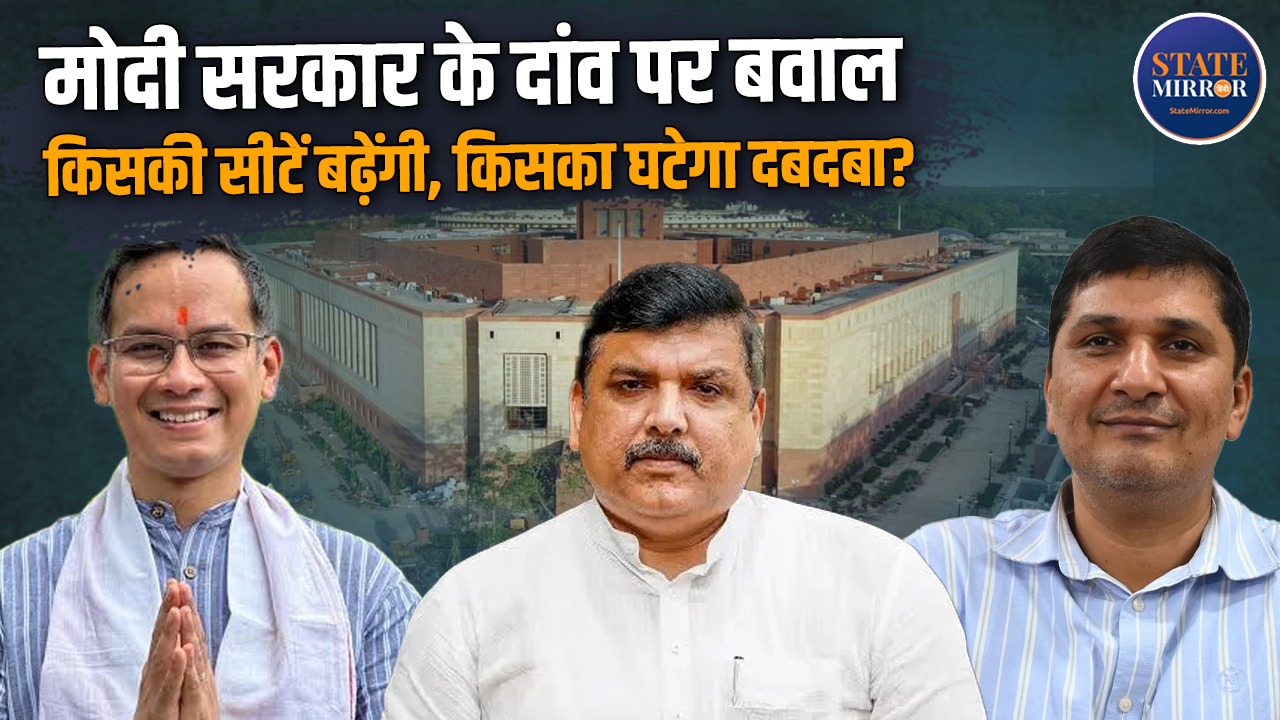
Aam Aadmi Party MP Sanjay Singh has given a sharp reaction to the Delimitation Bill and the government's announcement of a special session of Parliament. He says, “First of all, there should be no injustice to anyone in this country. This is not a delimitation bill, but a 'BJP wins bill'. The opposition parties which are going to support it are shooting themselves in the foot. History will never forgive them, because the way BJP will redraw the constituencies, it will ensure that it never loses. Assam and Jammu and Kashmir are examples of this.”
At the same time, Delhi Aam Aadmi Party in-charge Saurabh Bhardwaj alleges that under the guise of delimitation, BJP is preparing a strategy to remain in power for the next 25 years. According to him, the reorganization of constituency boundaries and seats can be used in such a way that the election results are influenced in favor of the BJP. In such a situation, even if the majority of voters in the country do not want a BJP government, still the party can be successful in gaining power and maintaining the government. He raised questions on the fairness and democratic process of delimitation.
How will there be fair delimitation?
Congress MP Gaurav Gogoi raised questions on the government's intentions in Parliament, citing the example of delimitation of Assam. He argued that the basic objective of delimitation is to ensure approximately equal representation in proportion to the population in every constituency. But in Assam, there are 14 lakh voters in one Lok Sabha constituency, while in another this number has reached 26 lakh.
Gogoi's question was that when there is such a huge difference in the population of constituencies, can it be called fair delimitation? He also objected to geographical boundaries. According to him, at many places the structure of the constituencies has been made such that one part is on this side of the river and the other is on the other side. It may be difficult for an MP from a constituency spread over such a large area to reach every voter and understand his problems.
Why were questions raised on Assam model?
The opposition had made serious allegations regarding the delimitation in Assam in 2023. A total of 126 assembly seats were retained in the state, but the boundaries of constituencies changed in many areas.
According to the data, seats in Central and Lower Assam reduced from 49 to 44. Whereas in Barak Valley their number decreased from 15 to 13. Congress and AIUDF have political influence in these areas. On the other hand, the position of seats changed in some areas under the influence of BJP and its allies.
The example of Hailakandi is also important to understand this controversy. According to election analysis, before delimitation the Muslim population in this seat was about 59 percent, which came down to about 37 percent after the new boundaries. The geographical structure of the constituency also changed.
The opposition alleges that by creating such boundaries the political influence of some communities was reduced. However, it would not be appropriate to consider the entire election result as the result of delimitation on the basis of these changes alone.
A game to benefit BJP?
Following the example of Assam, it is important to understand how changing the boundaries of constituencies can benefit a political party. Fixing the boundaries of constituencies in such a way that a particular political party gets electoral advantage is called Gerrymandering.
In this, voters influenced by the opposition are concentrated in a few selected seats. Due to this, they can become decisive on some seats, but their influence reduces on other seats.
The second method is cracking. In this, the strong voter groups of the opposition are divided into different constituencies. The result is that their vote does not become a decisive force on any one seat.
Political analyst Yogendra Yadav has also expressed similar apprehensions regarding delimitation. He alleges that BJP wants to achieve four big political goals through this. These include changing the electoral equation in those states where BJP has not been successful in forming its government. Apart from this, there is a fear that the boundaries of the constituencies will be fixed in their favor and the distribution of seats under SC-ST and women's reservation will be done in such a way that it will affect the strong political base of the opposition.
What changed in Jammu and Kashmir model?
After Assam, the delimitation of Jammu and Kashmir is also at the center of questions of the opposition. During the delimitation held in 2022, the assembly seats of Jammu region were increased from 37 to 43. At the same time, seats in Kashmir Valley increased from 46 to 47.
That means Jammu region got six additional seats, while Kashmir Valley got only one seat. After this change, questions arose regarding population ratio and regional representation. Opposition parties alleged that in this process an attempt was made to politically strengthen the Jammu region. However, the Delimitation Commission had also cited geographical conditions and administrative needs as the basis behind its decision.
How does BJP benefit from national delimitation?
Yogendra Yadav fears that even if there is delimitation at the national level, the boundaries of the constituencies may be decided keeping in mind the political equations. Apart from this, selection of seats for SC-ST and women reservation can also influence electoral politics.
That means the dispute is not just about increasing the seats of Lok Sabha and Assembly. The real question is how will the increased seats be distributed and what will be the basis for deciding the boundaries of new constituencies? The opposition fears that like in Assam and Jammu and Kashmir, the process of delimitation at the national level may also be influenced by political interests. On the other hand, the challenge for the government will be to prove that the reorganization of seats will be transparent, fair and based on the same criteria for all states.