
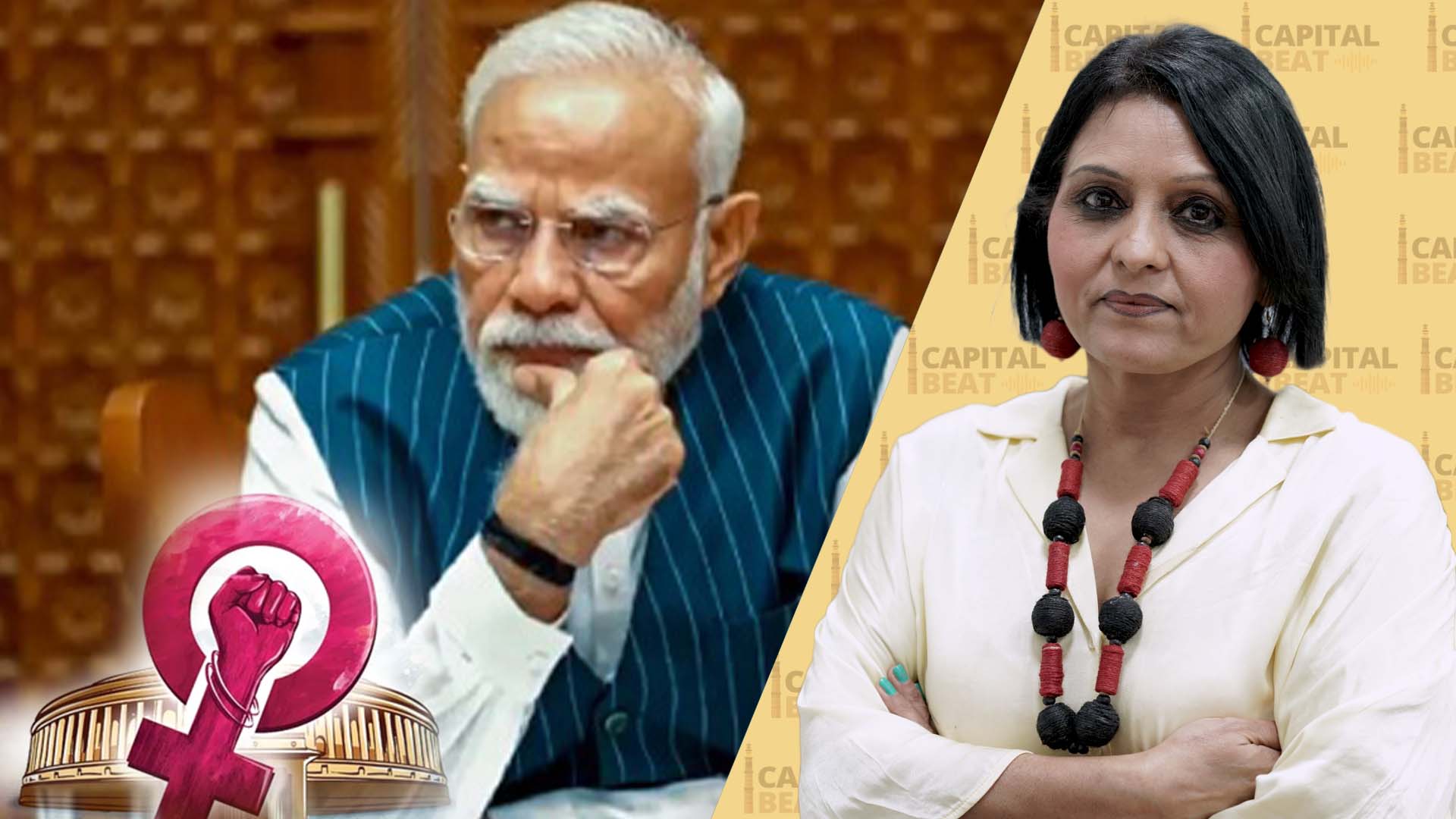

As Prime Minister Narendra Modi was seen adopting a more localised campaign style in poll-bound Tamil Nadu and West Bengal, political observers debated whether such a strategy signals adaptability or a deeper credibility challenge. Questions that were doing the rounds included whether the PM’s attempt to recalibrate his image, through cultural outreach and softer optics, is backfiring.
Also read: In Bengal’s Muslim heartland, quiet discontent tests TMC’s grip
Is “Brand Modi” under threat?
The Federal spoke with senior journalists Shikha Mukherjee and Anand Sahay in this episode of the Capital Beat to find out an answer.
Mukherjee minced no words when reflecting on Modi buying “jhalmuri” (spicy puffed rice), which is a popular street food in Bengal, after a public meeting in Jhargram in the south-western part of the state on Sunday (April 19).
“Repositioning by buying jhalmuri will not help—you fix policy failures, not optics,” she said, sharply criticising the prime minister’s campaign strategy.
Comparing Modi with Mamata
Both journalists, however, agreed that Modi’s campaign style appears to have evolved in recent elections. From high-decibel, centralised messaging, he is now seen attempting more direct, personal outreach.
Also read: Modi’s craving for ‘jhalmuri’, Bengal’s iconic street food, stirs up hot political row
However, Mukherjee said Modi’s ‘jhalmuri moment’ may not align with his established political persona, even though many felt it was an attempt to humanise his image and connect directly with the voters in a state which his Bharatiya Janata Party is desperately trying to snatch from the Trinamool Congress.
The senior journalist noted that direct street-level engagement has traditionally been associated with Bengal’s Chief Minister Mamata Banerjee.
She said Banerjee’sMamata’s politics is deeply rooted in on-ground interaction—walking among people, visiting tea stalls, and engaging spontaneously. In contrast, Modi’s leadership style has been more centralised and security-driven, making such attempts appear inconsistent.
Bengal strategy
Mukherjee further pointed out that isolated symbolic acts like the interaction’ over “jhalmuri” may not significantly influence voters’ perception.
Also read: PM Modi urges people to take 9 pledges for a developed India
She questioned the relevance of such gestures, stating that a national leader focusing on governance and policy may not benefit from “trivial optics”. Instead, she suggested that consistency in messaging and credibility matter more in a state like Bengal.
She also highlighted contradictions in the BJP’s broader campaign narrative. While Modi’s outreach attempts to soften his image, other elements of the party’s campaign continue to project aggressive symbolism, creating mixed messaging.
This, she suggested, could dilute the intended impact of such repositioning efforts.
Tone shift
The discussion also touched upon Modi’s changing tone in Bengal. During a campaign in 2021, when Bengal last held its Assembly polls, his rhetoric, such as the controversial “Didi, O Didi” remark, had drawn criticism.
Mukherjee described that episode as a major political misstep, arguing that it came across as heckling and a personal attack, which did not resonate well beyond core supporters.
This time, she observed a more restrained approach, with fewer personal attacks and less overt communal rhetoric. However, Mukherjee emphasised that this shift is likely strategic, aimed at attracting non-core voters whose support is crucial in a competitive electoral landscape.
Also read: Lights on, spirits low: Modi’s Chennai election rally has a ‘muted start’
She also traced the BJP’s rise in Bengal, noting how its vote share surged significantly between 2016 and 2021, partly due to support shifting from the Left and Congress. But she cautioned that replicating that momentum may be difficult in the current political climate.
Tamil Nadu optics
In Tamil Nadu, the other state set to go to polls, Modi’s campaign has taken on a different dimension, focusing on cultural identification.
Social media discussions have centred on his attempts to align visually and culturally with the local population. Viral images comparing his appearance during a national address and a campaign event in Coimbatore sparked debate, with some alleging a deliberate “bronze” or “tanned” look.
Also read: Fighting 19 states, the Centre for common people: Mamata Banerjee
While the authenticity of such claims remains unverified, the conversation itself reflects heightened scrutiny of Modi’s image-building efforts.
The host noted that even if such differences were due to lighting conditions, the perception battle on social media is intense and often unforgiving.
PR challenge
Sahay took a broader view, arguing that the issue goes beyond individual campaign tactics to a larger credibility question.
He suggested that attempts at cultural adaptation, whether through food, attire, or visual presentation, may be perceived as “election-season optics” rather than genuine engagement.
Also read: BJP may flag ‘infiltrators’ but Bengal border villages tell a different story | Ground report
Sahay also raised ideological concerns, arguing that the BJP’s broader political framework does not traditionally emphasise regional cultural diversity, which may make such outreach appear inconsistent.
According to him, this creates a disconnect between messaging and perception, especially in states like Tamil Nadu and Bengal, where regional identity plays a significant role in politics.
Trust deficit
A key question that emerged during the discussion was about trust.
Sahay argued that over time, there has been a noticeable erosion in the credibility associated with “Brand Modi”. He contrasted this with earlier political eras, where leaders faced criticism but retained a degree of personal trust among the public.
He suggested that current challenges—ranging from economic concerns to political controversies—have contributed to a growing trust deficit.
Also read: Modi’s six promises as he calls out TMC rule as ‘Nirman Sarkar’
Mukherjee echoed this sentiment indirectly, emphasising that voters are more influenced by substantive issues than symbolic gestures.
Social media shift
Both speakers acknowledged a changing dynamic on social media, once considered a stronghold for Modi and the BJP.
As this writer pointed out that online reactions to recent campaign visuals—from the “jhalmuri” video to Tamil Nadu imagery—have been sharply divided, the experts argued that this fragmentation indicates that the narrative is no longer as tightly controlled as before.
Also read: Holy Mackerel! BJP, TMC in serious debate over fish ahead of Bengal polls
Sahay noted that while media and institutional support may still play a role in shaping perception, public opinion, especially in the digital space, is becoming increasingly unpredictable.
As campaigning intensifies in key states, Modi’s evolving strategy reflects an attempt to adapt to changing political realities. However, as the panel discussion highlighted, repositioning a well-established political brand is complex and fraught with risks.
The content above has been transcribed from video using a fine-tuned AI model. To ensure accuracy, quality, and editorial integrity, we employ a Human-In-The-Loop (HITL) process. While AI assists in creating the initial draft, our experienced editorial team carefully reviews, edits, and refines the content before publication. At The Federal, we combine the efficiency of AI with the expertise of human editors to deliver reliable and insightful journalism.

Comments are closed.