It raised the Vietnamese government’s long-term local- and foreign-currency issuer ratings from Ba2 to Ba1. This means the next upgrade would put Vietnam at Baa3, the lowest investment-grade rating on the agency’s scale which implies moderate credit risk.
Moody’s also raised Vietnam’s local-currency ceiling from Baa2 to Baa1 and its foreign-currency ceiling from Ba1 to Baa3.
The agency noted that Vietnam has accelerated reforms since late 2024. It highlighted efforts to streamline public administration at the central and local levels, strengthen judicial institutions, step up the fight against corruption and digitize public services. Vietnam’s governance indicators are approaching those of some higher-rated countries.
Moody’s said tax incentives, simpler licensing, new international financial centers, a wider network of trade agreements and investment in digital infrastructure, research and strategic technologies are helping Vietnam build a more productive economy.
|
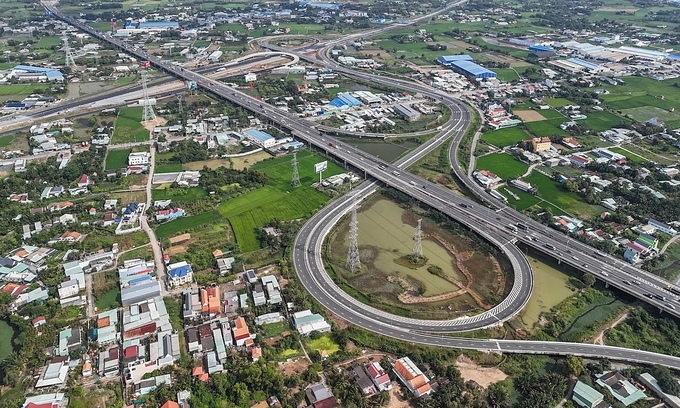
Ben Luc – Long Thanh Expressway, connecting HCMC with Long Thanh International Airport, Dong Nai City, as seen in August 2026. Photo by VnExpress/Quynh Tran |
Foreign direct investment (FDI) is increasingly concentrated in semiconductors, advanced electronics and high technology. Registered FDI rose 74% year over year in the first 10 months of this year. GDP grew more than 9% in the first nine months, compared with 8% for all of 2025.
Moody’s said Vietnam’s low debt and its ability to afford debt payments give the government room to spend more on infrastructure and development. Moody’s expects government debt to rise from about 30% of GDP this year to 35% by 2030.
Moody’s expects the debt burden to remain “moderate,” citing strong nominal growth and Vietnam’s record of prudent debt management. Vietnam’s fiscal indicators are stronger than those of many similarly rated countries, and its public investment disbursement rate has begun to improve.
The Ministry of Finance said the upgrade helps bolster investor confidence and makes it easier for Vietnam to raise long-term capital.
Moody’s identified weaknesses in data quality and transparency, regulatory quality and the effectiveness of monetary policy. It said rapid credit growth and high leverage across the financial system are factors that need monitoring.
Before Moody’s upgrade, credit rating agency R&I raised Vietnam to investment grade on its own scale on Oct. 8.