

“Never before have prices been this low,” said Dao, the owner of a durian orchard in Gia Lai Province in the Central Highlands.
Her profit has fallen by half from last year to around VND40 million after selling two tons of Musang King, a variety originally from Malaysia and often dubbed “the king of durians.”
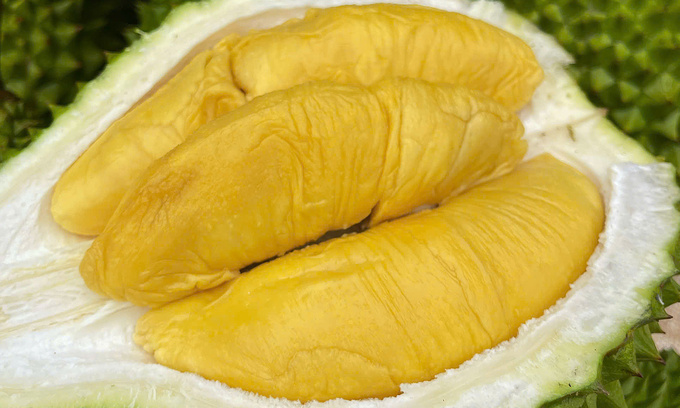
A Musang King durian grown in Dak Luck, Vietnam. Photo by Read/Phan Hang |
Prices were in the range of VND80,000-150,000 per kg last year, but now an average-quality fruit is sold for only VND50,000. This has prompted Dao to consider cutting down 50 Musang King trees after this season to switch to another variety.
The decline is not limited to Musang King, as the durian market overall has cooled this year.
Monthong durians, originally from Thailand, are now sold at VND63,000-69,000 per kg. Ri6 durians, a Vietnam variety, range from VND33,000-39,000 per kg. Compared with the same period last year, prices for both varieties have fallen by around 30-50%.
Phan Thi Hang, a trader in Dak Lak, said standard-quality Musang King fruits are being purchased from farmers at most VND70,000 per kg, while an average-quality fruit is selling for less than VND50,000 per kg.
The VND70,000 price tag is the lowest price ever recorded for standard-quality fruit. In previous years, high-quality fruits were usually purchased at VND90,000-100,000 per kg, Hang said.
Only about 3-5 tons of standard-quality Musang King can be procured each day because the number of orchards following proper cultivation techniques remains limited, she added.
Vo Tan Loi, chairman of the Dong Thap Durian Association, said the decline in Musang King prices was the result of multiple factors, including rising supply as more growing areas entered the fruiting stage and unfavorable weather that reduced fruit quality.
He said prolonged rainfall has caused many growing areas to experience problems with durians developing unripe or poor-quality flesh, with affected rates reaching 30-40% in some areas, reducing the volume of fruit meeting export standards.
Musang King is already considered a difficult variety to cultivate in Vietnam, and quality varies significantly between orchards, making it more vulnerable when weather conditions are unfavorable.
In addition, Loi said traders are no longer buying durians at any price but are selecting only the best fruits that meet export standards.
Meanwhile, China has increasingly tightened requirements on growing area codes, packing facilities, pesticide residue levels, yellow O substance, cadmium content, and traceability. Standard-compliant shipments continue to sell smoothly, while average-quality fruit is mainly sold domestically at lower prices.
The downward price trend is also occurring in major producing countries. According to the South China Morning Post, Musang King prices in Malaysia have fallen by more than half to below 30 ringgit ($7.35) per kg. Amid oversupply, Malaysian Prime Minister Anwar Ibrahim said he would work with China to promote durian consumption.
Industry insiders said amid rising supply and increasingly strict quality requirements from import markets, Musang King remains a premium durian variety but no longer maintains its previous price levels. Even standard-quality batches are now trading at the lowest prices since the variety was commercially cultivated in Vietnam.
Comments are closed.