
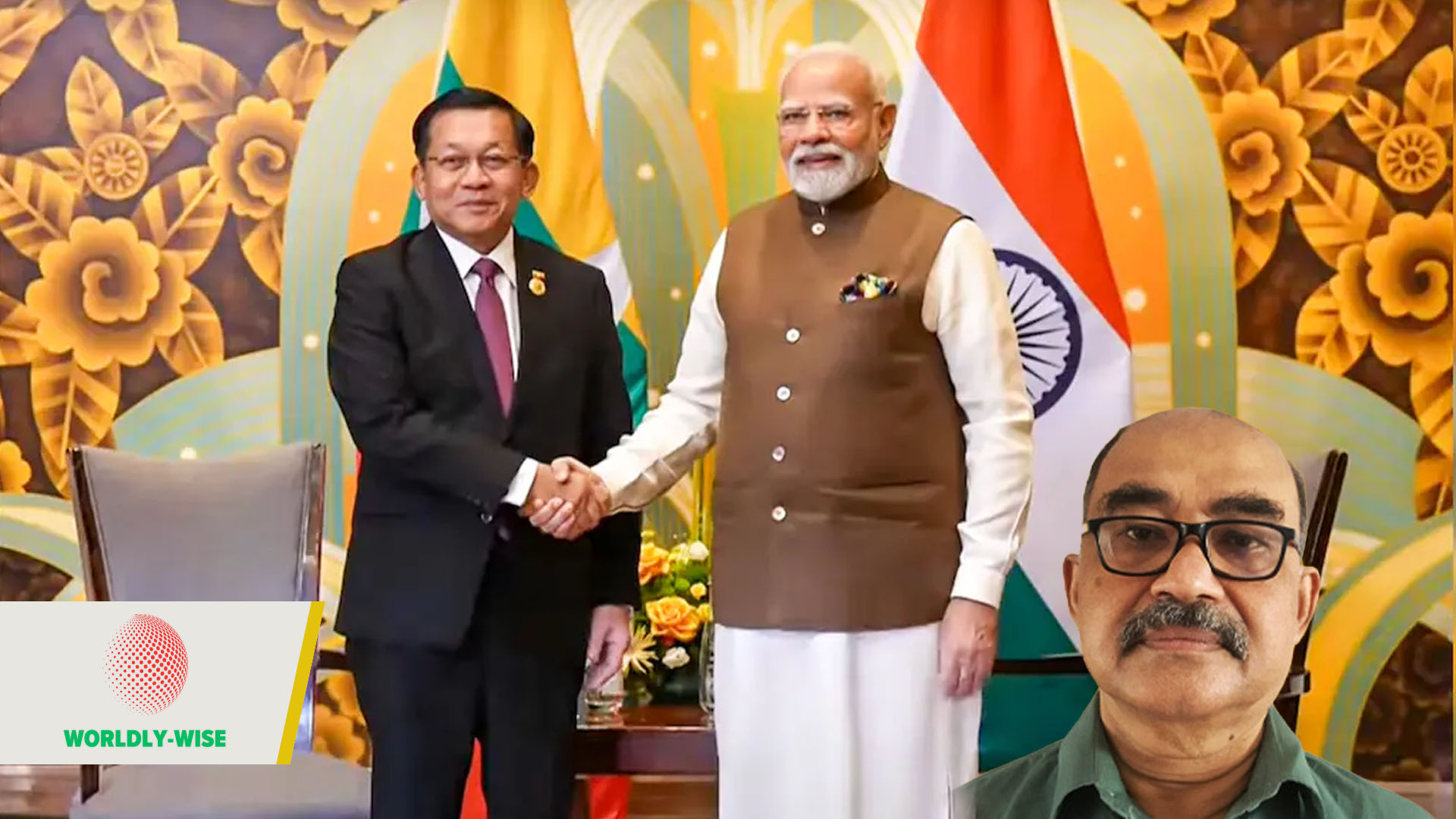

India’s approach to Myanmar reflects “strategic inaction” at a time when the country is engulfed in a prolonged civil war, according to senior journalist Subir Bhaumik. He argues that New Delhi must engage not only Myanmar’s military-led government but also the powerful rebel groups that control large stretches of territory along the India-Myanmar border.
Myanmar President Min Aung Hlaing’s recent visit to India has sparked debate over New Delhi’s Myanmar policy, border security, connectivity projects, and regional geopolitics. In this episode of Worldly-Wise, The Federal spoke to Bhaumik about the implications of the visit, the realities on the ground in Myanmar, and what India’s strategy should be going forward.
Why did India invite Min Aung Hlaing despite criticism from pro-democracy groups in Myanmar? What did New Delhi hope to gain?
India made a lot of Min Aung Hlaing assuring Prime Minister Narendra Modi that Myanmar territory would not be used for anti-Indian activities. That sounds very good on paper.
But Min Aung Hlaing became president through an electoral process that remains highly controversial. Much like Bangladesh, where the Awami League was not allowed to contest, Myanmar’s National League for Democracy (NLD), led by Aung San Suu Kyi, was barred from participating. Suu Kyi remains in prison.
The key point is that several organisations, including the International Crisis Group, have concluded that after five years of civil war, the Myanmar military and central government control barely 35 per cent of the country’s territory.
If the president says anti-Indian activity will not be allowed from Myanmar soil, the first question is whether he controls that territory. The answer is no.
The 1,643-km India-Myanmar border is largely controlled by groups such as the Kachin Independence Army, the Arakan Army, Chin groups and the People’s Defence Forces in Sagaing. To the best of my knowledge, the Myanmar military controls only a very small stretch around Tamu opposite Moreh. So when Min Aung Hlaing says he will not allow anti-Indian activity from Myanmar territory, much of that territory is actually beyond his control.
People in India who are not aware of the situation may feel reassured, but the reality on the ground is very different. India needs to engage multiple stakeholders in Myanmar. It cannot simply deal with the military government and assume that is sufficient.
How do you view reports of firing incidents along the border during Min Aung Hlaing’s visit?
While Min Aung Hlaing was in New Delhi, there was an exchange of fire involving Myanmar troops near the border. The Myanmar military claimed it was not firing at Indian troops but was pursuing rebel fighters.
This occurred in one of the few areas still under Myanmar military control, where they are heavily challenged by People’s Defence Forces.
The message from Myanmar was that if India expects anti-Indian activity not to originate from Myanmar territory, then India should also prevent armed activities against the Myanmar government from Indian territory. That is easier said than done.
India would do well to follow the Chinese strategy. China supports Min Aung Hlaing but simultaneously maintains close contacts with the various rebel groups operating along its border.
After the 2021 coup, Min Aung Hlaing turned first to China because he needed support to survive. Today, what he needs most is legitimacy. He came to India seeking recognition as a legitimate president rather than a military ruler. China provides guns when needed; India provides legitimacy and symbolic value as the world’s largest democracy.
From India’s perspective, however, the Chinese model is instructive. China engages both the junta and the rebel groups. India should do the same because groups such as the Kachin Independence Army, the Arakan Army and the Chin forces control significant territory along our border.
India’s security agencies already maintain contacts with many of these groups and with the National Unity Government. However, many of them were unhappy with the optics of Min Aung Hlaing’s visit. For them, it appeared that a military ruler accused of suppressing his own people was being hosted by the world’s largest democracy.
Is the situation in Manipur forcing India to maintain closer ties with Myanmar’s government?
India has no choice but to engage Myanmar’s government because it is the government of the day. At the same time, India must also engage the rebel groups active along the border.
This is not unique to the current government. India hosted General Ne Win in the past, including during Indira Gandhi’s tenure.
Historically, India cultivated Myanmar’s military rulers because many insurgent groups from India’s Northeast found sanctuary inside Myanmar.
It was only during Rajiv Gandhi’s tenure that India strongly backed the democratic movement in Myanmar following the 1988 uprising.
At that time, India also developed close ties with the Kachin Independence Army. Under RAW officer BB Nandi, understandings were reached that the Kachins would not permit anti-India insurgent groups to operate from their territory. That arrangement helped curb activities that had existed for decades.
Is Myanmar territory being used by groups involved in the Manipur conflict?
Yes, absolutely. Groups such as the PLA continue to maintain bases inside Myanmar. I have personally visited some of these bases in the past. Kuki groups active in Manipur also have bases across the border and maintain ties with Chin rebel groups.
The challenge is that these issues are deeply intertwined with ethnic and tribal relationships. Chins in Myanmar, Mizos in Mizoram and Kukis in Manipur belong to the broader Zomi ethnic family. There are strong emotional and social ties across the border.
The Government of India is considering ending the free movement regime and fencing parts of the border. However, many local communities oppose this because they have relatives and historical connections on both sides.
There is undoubtedly a strong cross-border dimension to insurgent activity in Manipur.
The border remains active and sensitive. In 2015, Indian commandos crossed into Myanmar after insurgent attacks. That illustrates how dynamic the situation remains.
My view is that India should not put all its eggs in one basket. It should maintain close understandings not only with the Myanmar government but also with influential rebel groups, just as China does.
What lessons can India learn from China’s approach in Myanmar?
China maintains relations with all major actors.
The rare earth deposits in Kachin State are a good example of this strategic engagement. Much of the raw material feeding China’s rare earth industry comes from that region.
When the Kachin Independence Army seized key rare earth mining areas, Chinese companies suffered. China quickly moved to mend ties because access to those resources was strategically important.
The Chinese approach is highly pragmatic. They prioritise their interests and maintain working relationships with all stakeholders.
India should also adopt a pragmatic strategy.
What is the future of projects such as Kaladan and the India-Myanmar-Thailand Trilateral Highway?
I remain sceptical about claims that these projects can be operationalised quickly. To make the Kaladan project functional, India must deal with multiple actors.
The Sittwe port is controlled by Myanmar’s military. However, the river route towards Paletwa is controlled by the Arakan Army. Further north, the road segment towards Zorinpui passes through areas controlled by Chin groups. That means India would need cooperation from the Myanmar military, the Arakan Army and multiple Chin factions. This is not easy.
I often describe India’s policy as “wait and watch”. To me, wait and watch is another term for strategic inaction.
Kaladan cannot be fully operationalised without peace, ceasefires and cooperation among all relevant groups.
The same challenge applies to the India-Myanmar-Thailand Trilateral Highway. The route passes through territories controlled by several armed groups. Beyond security concerns, there are practical challenges involving dredging, road construction and maintenance.
Given current realities, I do not see either project being fully operational anytime soon.
The situation becomes even more important because Bangladesh is no longer as predictable a transit partner as it was under Sheikh Hasina. As tensions rise along the Bangladesh border, Kaladan becomes more strategically important. But the question remains: how can it be operationalised under present conditions?
How do you see Myanmar’s conflict evolving in the coming years?
The conflict appears stuck in a prolonged stalemate. The rebel groups have made gains but have not achieved a decisive breakthrough. China has become increasingly influential by mediating and pressuring some rebel groups into arrangements with the Myanmar military.
At several points, India had opportunities to play a constructive role. India maintained military-to-military ties with Myanmar’s armed forces, had links with major rebel groups and also enjoyed relationships with democratic political actors.
In my view, India could have launched a peace initiative and played a meaningful role in conflict resolution. Instead, New Delhi chose to stay on the sidelines.
If India continues with strategic inaction, it becomes difficult to justify claims of being a major regional power. Myanmar remains trapped in a quagmire, and India continues to watch from the sidelines.
The content above has been transcribed from video using a fine-tuned AI model. To ensure accuracy, quality, and editorial integrity, we employ a Human-In-The-Loop (HITL) process. While AI assists in creating the initial draft, our experienced editorial team carefully reviews, edits, and refines the content before publication. At The Federal, we combine the efficiency of AI with the expertise of human editors to deliver reliable and insightful journalism.

Comments are closed.