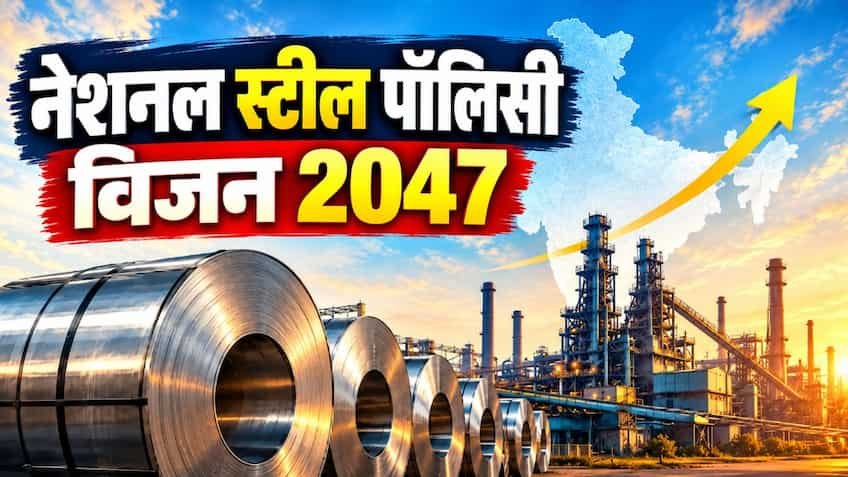
The Steel Ministry has unveiled a historic and far-reaching industrial roadmap to make India a global manufacturing and infrastructure leader. Under the new vision of the National Steel Policy (NSP), an ambitious target of increasing the crude steel production capacity to 604 million tonnes (MT) per year has been set to implement the resolution of 'Developed India' by 2047, the centenary year of the country's independence. At present, India is the second largest steel producing country in the world, but this expansion is being considered very important to play a leadership role in the global supply chain, completely eliminate dependence on imports and bring domestic per capita steel consumption at par with developed countries. This step of the government is not limited to just increasing production, but it will prove to be a turning point in the adoption of environment-friendly 'Green Steel' technology by drastically reducing carbon emissions.
The old targets of the National Steel Policy had planned to achieve a capacity of 300 million tonnes by the year 2030-31, which has now been expanded to 604 million tonnes by the year 2047, giving new impetus. Availability of domestic steel will act as the backbone to meet the huge demand of India's rapid urbanization, national highways, railways, dedicated freight corridors, ports, airports and defense manufacturing. According to steel experts, to achieve this target, public sector giant Maharatna companies Steel Authority of India Limited (SAIL) and Rashtriya Ispat Nigam Limited (RINL) as well as private sector major companies like Tata Steel, JSW Steel, and Jindal Steel & Power will have to expand their production units through huge capital investment (Capex). This mega industrial expansion will directly and indirectly create lakhs of skilled and semi-skilled employment opportunities, which will give a tremendous boost to the regional economy of the industrialized states, especially Odisha, Jharkhand, Chhattisgarh, West Bengal and Andhra Pradesh.
The traditional steel production process is highly dependent on coal and coke, making the sector one of the largest carbon emitters globally. In the new guidelines of the National Steel Policy, it has been made clear that the step towards 604 metric tons will not be taken ignoring the environment. Decarbonization of the steel sector is the most important pillar for India to achieve its target of net-zero carbon emissions by 2070. For this, the Steel Ministry has included 'Green Steel' manufacturing as a mandatory priority. Green steel is steel in which renewable energy (solar and wind) and green hydrogen are used instead of traditional fossil fuels. Steel plants are being linked with the National Green Hydrogen Mission so that the consumption of coking coal in blast furnaces can be gradually reduced to the minimum level. Apart from this, concessions and incentives are being given towards implementing Carbon Capture, Utilization and Storage (CCUS) technologies beyond pilot projects in large plants to commercial scale.
The government is aggressively implementing steel scrap recycling policy to reduce pressure on raw iron ore and reduce energy consumption. The collection of high quality steel scrap is being increased in the country through vehicle scrappage policy and industrial scrap management. Making steel through scrap-based electric arc furnace (EAF) and induction furnace (IF) directly reduces carbon emissions by 60 to 70 percent. Modern automated shredding and segregation centers are being set up in major industrial centers to provide adequate scrap domestically. This is not only giving impetus to the circular economy but also helping secondary steel producers to produce high quality bars, rods and structural steel at international standards.
To achieve the target of steel production of 604 million tonnes, the country will have to ensure continuous supply of billions of tonnes of high quality iron ore and coking coal. At present India is largely dependent on imports from Australia and other countries for coking coal, which leads to a large outflow of foreign exchange. To break this dependence, the technology of domestic coking coal washeries is being upgraded and work on coal gasification technologies has been expedited to make non-coking coal usable at higher temperatures. Along with this, with the cooperation of the Ministry of Mines, transparent auction of new iron ore blocks is being done within the country and a network of slurry pipelines is being built so that the transportation of raw material directly from the mines to the steel plants can be done in a cheap, safe and pollution-free manner.
Global regulations like the Carbon Border Adjustment Mechanism (CBAM) being implemented by the European Union have created new challenges for the Indian steel industry. If Indian exporters do not comply with green standards, their products may face heavy carbon tax in international markets. This vision of 2047 of the National Steel Policy is a protective shield to convert this threat into an opportunity. When green steel production takes place on a large scale in India, Indian steel will not only strengthen its hold in the domestic market but will also gain top preference in the US, Europe and Middle East countries without any trade barriers. The government is also integrating the next phases of the Production Linked Incentive (PLI) Scheme with this policy to incentivize the production of high-grade specialty steel and automobile-grade steel, which will transform India from an importer to the most reliable exporter of global steel.