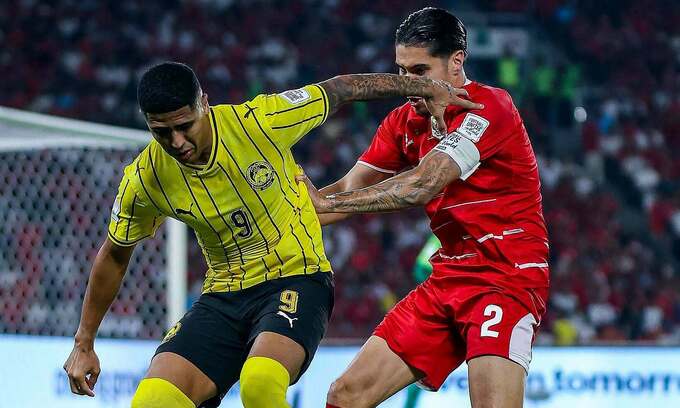
At the 2026 FIFA ASEAN Cup in Indonesia, all six of the region’s leading national teams featured a large number of players of mixed heritage.
The Philippines led with 19, followed by Indonesia with 18, Malaysia with nine, Vietnam with five, and Singapore and Thailand with three each. Three teams also fielded naturalized players without ancestral ties to their countries: Vietnam, Malaysia, with three, and Singapore, with two.
Commenting on the trend in The New Straits TimesSingh likened many national teams to “United Nations teams,” while describing Indonesia as looking “like the Netherlands’ B team,” with all 18 of its heritage players being Dutch.
|
Indonesia’s English-born center-back Elkan Baggott (20) and Dutch-born midfielder Joey Pelupessy (14) play during their team’s victory over Thailand in the 2026 FIFA ASEAN Cup final at Gelora Bung Karno Stadium in Jakarta, Indonesia, on Oct. 5, 2026. Photo by Read/Hai Tu |
In theory, the use of players of mixed heritage resembles France, a European team with many players of African descent, or Morocco, an African team with many players of European descent.
“It is about whether naturalization is part of a football ecosystem or a substitute for one.”
“France’s player pool comes from generations of immigration and an enormous domestic football system. It is not the same as ASEAN countries going shopping for players because its own development pipeline is not producing enough quality,” he wrote.
The 51-year-old expert, who won the Best Sports Columnist award from the Sportswriters Association of Malaysia (SAM) in 2009, believes Southeast Asia is increasingly becoming a destination for naturalized players.
The football associations of Indonesia (PSSI), Vietnam (VFF) and Malaysia (FAM) have all maintained that naturalization is only a short-term solution. Singh, however, warned that governing bodies must establish safeguards to ensure it does not become a long-term strategy.
Naturalization should be limited to strengthening national teams and complementing youth development, he said, rather than serving as the foundation for sustainable growth.
He questioned what football associations were developing if every weakness in their national teams could be addressed by recruiting naturalized players.
“Associations may eventually stop asking why they are not producing enough players and simply start looking for the next foreign player to solve the problem,” he said.
 |
|
Malaysian football expert and New Straits Times editor Ajitpal Singh. Photo by LinkedIn/Ajitpal Singh Dhaliwal |
A national team should represent the strength of a country’s football system, not conceal its weaknesses.
At club level, fans accept players recruited from anywhere in the world, but national teams are different, Singh said.
He argued that national pride comes from an emotional connection to a place, language, upbringing, culture and identity. This does not mean a naturalized player cannot become a Malaysian, Indonesian, Thai or Vietnamese citizen. However, the growing number of such players is changing how supporters perceive their national teams.
Fans may accept clubs recruiting players from all over the world, because that is how club football works. But when it comes to national teams like Malaysia, Indonesia, Thailand or the Philippines, “there is an emotional connection to place, language, upbringing, culture, and identity,” he said.
Singh said that seeing a Brazilian playing for Malaysia and a Dutchman playing for Indonesia contesting the ball in a match between two ASEAN national teams might make fans wonder whether they were watching a game between South American and European sides.
Singh acknowledged Bergson’s contribution as Malaysia’s leading football at the tournament, with four goals, but said “it still looks strange seeing him in Harimau Malaya colors.”
Born in 1991, Bergson has played for Malaysia’s leading club, Johor Darul Ta’zim, since 2021, scoring nearly one goal per game across more than 200 appearances.
Malaysia also has several naturalized players without ancestral links to the country, including Gambia-born Mohamadou Sumareh; Brazil-born Paulo Josue and Endrick; Argentina-born Manuel Hidalgo and Sergio Aguero; and Colombia-born Romel Morales. The country has around 15 players of mixed heritage.
 |
|
Malaysia's Bergson (L) challenges Indonesia's Kevin Diks during their Group A match at the 2026 FIFA ASEAN Cup at Gelora Bung Karno Stadium in Jakarta, Indonesia, on Sept. 28, 2026. Photo by Malaysia national team |
Naturalization has also become a subject of parliamentary debate in Malaysia during discussions on amendments to the Sports Development Act. Lawmaker Azli Yusof warned against overreliance on naturalized players, while RSN Rayer, a member of Parliament for Jelutong, questioned the country’s pathway for developing homegrown talent.
Rayer pointed to Malaysian greats such as Datuk Mokhtar Dahari, Datuk Soh Chin Ann and Datuk Arumugam. The fallout from a case involving seven naturalized players accused of eligibility fraud in the final round of qualifying for the 2027 Asian Cup has added to the controversy.
However, Malaysian football analyst Richard Scully defended the inclusion of heritage and naturalized players in Malaysia’s national team. He argued that naturalized players do not necessarily restrict opportunities for local players and can instead raise competitive standards.
He told The New Straits Times that the trio of Bergson da Silva, Brad Tapp and Manuel Hidalgo helped raise the team’s standard during its undefeated run to third place in the FIFA ASEAN Cup.
Bergson’s presence, for example, attracts defenders and creates space on the flanks for Arif Aiman and Faisal Halim to operate more freely, he said, calling it “a big plus point.”
As a result, local players, both starters and substitutes, are pushed to improve their performances, he said.
“They were brave enough to play positive football. They were not parking the bus or sitting back,” he said.
Southeast Asian countries generally remain open to selecting players of mixed heritage, but their policies on naturalized players without ancestral ties differ.
Thailand has maintained its opposition to using such players in the national team, while Singapore and the Philippines impose no restrictions.
Vietnam, meanwhile, maintains that naturalized players must be of sufficient quality and address weaknesses in specific positions.
VFF Vice President Tran Anh Tu said that after the national team coach makes selections, the federation will conduct its own assessment to maintain balance and avoid reducing opportunities for young domestic players.