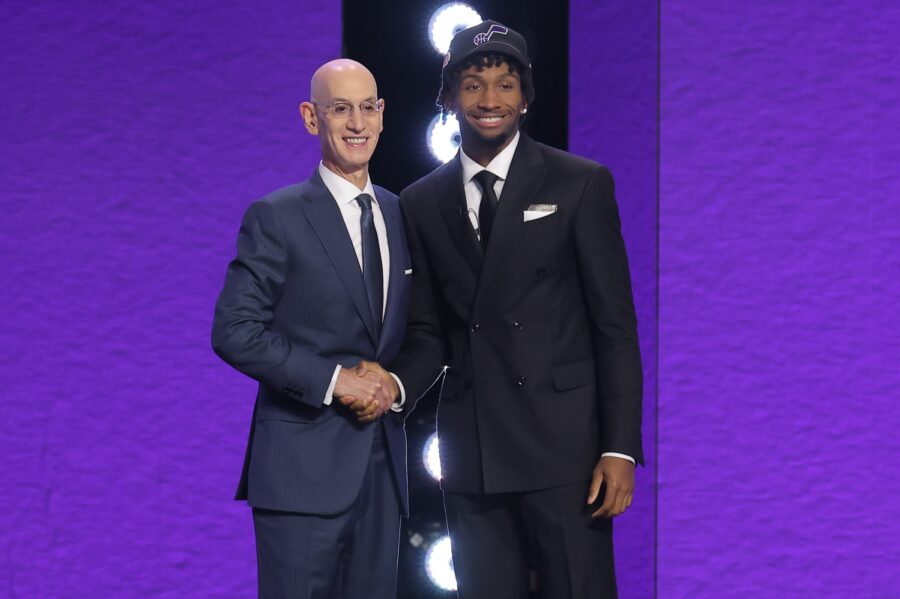
Hoops Rumors is checking in on the 2026 offseason for all 30 NBA teams, recapping the summer’s free agent signings, trades, draft picks, departures, and more. We’ll take a look at each team’s offseason moves and consider what might still be coming before the regular season begins. Today, we’re focusing on the Utah Jazz.
Free agent signings
- Jusuf Nurkic: Two years, $22,000,000. Fully guaranteed. Re-signed using Bird rights.
- Jaxson Hayes: Two years, $12,000,000. Second-year team option. Signed using non-taxpayer mid-level exception.
- Josh Okogie: Two years, $12,000,000. Second-year team option. Signed using non-taxpayer mid-level exception.
- Mo Bamba: Two years, minimum salary. First year partially guaranteed ($200K). Second-year team option. Signed using minimum salary exception. Waived right to veto trade.
- Harrison Ingram: One year, minimum salary. Non-guaranteed (Exhibit 9/10). Signed using minimum salary exception.
Trades
- Acquired the Lakers’ 2031 first-round pick, the Lakers’ 2033 first-round pick, the right to swap 2028 first-round picks, and the right to swap 2030 first-round picks from the Lakers in exchange for Walker Kessler (via sign-and-trade).
Draft picks
- 1-2: Darryn Peterson
- Signed to rookie scale contract (four years, $59,884,294). First two years guaranteed. Third- and fourth-year team options.
Two-way signings
- Trey Alexander
- One year, $91,000 partial guarantee.
- Tamar Bates
- Two years, $91,000 partial guarantee; second year non-guaranteed.
Note: The Jazz carried over Blake Hinson on a two-way contract from 2025/26.
Departed/unsigned free agents
Other roster moves
Salary cap situation
Note: Figures are rounded to one decimal place.
- Operating over the cap ($165MM) and below the first tax apron ($209MM).
- Hard-capped at first apron.
- Team salary: $178MM (tax/apron).
- Below luxury tax line by $22.4MM; below hard cap by $30.7MM.
- Partial non-taxpayer mid-level exception ($3MM) available.
- Two traded player exceptions available (largest worth $15.1MM).
The offseason so far
After embarking on a multiyear tanking project, the Jazz didn’t have a ton to show for their efforts entering the 2026 offseason, at least in terms of draft lottery success. Ace Baileylast year’s fifth overall pick, had a solid rookie season in 2025/26, but Taylor Hendricks and Cody WilliamsUtah’s lottery selections in 2023 and 2024, didn’t take the steps forward the team hoped they would during their first few years in the league. Hendricks was traded to Memphis in February as part of the package the Jazz gave up for Jaren Jackson Jr.
In other words, after wrapping up their fourth consecutive sub-.500 season this spring, the Jazz’s primary goal was one they had no real control over: Securing a top-four pick in a loaded 2026 draft to ensure they’d have a chance to add a legitimate franchise cornerstone to their roster.
Lottery luck was on Utah’s side in May, as the team managed to snag the No. 2 overall pick despite finishing the season in a tie for the NBA’s fourth-worst record. A pre-lottery draft tiebreaker win over the Kings turned out to be crucial — after losing that tiebreaker to a Utah team with an identical 22-60 record, Sacramento dropped to seventh in the draft.
 With their No. 2 pick, the Jazz selected a prospect who could end up being the best player in the 2026 draft class. Kansas guard Darryn Peterson was widely viewed as the frontrunner to be the first overall pick before facing questions about his health and his compete level during his lone college season. Even in a “disappointing” freshman year, Peterson averaged 20.2 points per game while making 38.2% of his three-point tries.
Whether Peterson’s play-making will develop enough to make him a viable starting point guard is an open question, but as long as he stays healthy, it’s hard not to imagine him becoming an impact NBA player. If he reaches his ceiling, he’ll be in the All-Star and All-NBA conversations on an annual basis.
After drafting Peterson, it looked like the most pressing item on the Jazz’s offseason to-do list would be re-signing restricted free agent center Walker Kessler to a long-term contract. But after the big man balked at a five-year offer in the range of $140MM, Utah pivoted to working out a sign-and-trade deal with the Lakers, who badly wanted a young center to pair with Luka Doncic and zeroed in on Kessler early in free agency.
The return for Kessler was massive, especially given that he was limited to five games last season due to shoulder surgery. The Jazz will now essentially control four of the Lakers’ six first-round picks from 2028-33, having acquired two unprotected first-rounders and two swaps during that window. They also didn’t have to take back any unwanted salary from Los Angeles in the deal, giving them the flexibility to be active in free agency without coming close to the luxury tax line.
Still, as impressive as the return for Kessler was, it’s fair to wonder if the Jazz’s front office – led by president of basketball operations Austin Ainge and CEO Danny Ainge – were right to prioritize “winning” the trade over simply signing a player who looked like he was going to be a big part of the club’s future. This is a team ready to get back into the playoff mix, and a young center like Kessler, who is one of the NBA’s best rebounders and rim protectors, was primed to complement Jackson and Lauri Markkanen in a frontcourt that had the size and talent to match up with the Western Conference’s top teams.
Instead, Utah filled its gap at the five by signing Jusuf Nurkic, Jaxson Hayesand Mo Bamba to short-term contracts. Despite having a Defensive Player of the Year award on his résumé, Jackson isn’t a good enough rebounder to be a full-time center. But the Jazz may have to ask him to spend more time in that role than expected unless they’re comfortable leaning on Nurkic or Hayes to close games.
In addition to their center signings, the Jazz’s other free agent addition of note was veteran swingman Josh Okogiewho will give the team a versatile, defensive-minded option on the wing. He and Hayes signed identical two-year, $12MM deals that include second-year team options, while Nurkic got two guaranteed seasons at $11MM annually and Bamba is on a very lightly guaranteed minimum-salary contract.
Up next
If the Jazz expect Bamba to make the team, the 15-man regular season roster is full. Still, I’d expect Utah’s front office to be very open to trade discussions during the preseason and season. With $22MM+ in breathing room below the luxury tax line and a $15MM+ trade exception on hand, the club is well positioned to take on additional salary, which should come in handy at some point, given how many teams around the league are dealing with unfavorable tax or apron situations.
John Konchar is one player to watch in trade talks. He has an expiring $6.2MM contract and was essentially a throw-in for salary purposes in last season’s Jackson blockbuster. I’d be a little surprised if he finishes the season with the Jazz.
Konchar is one of several players on the roster who are extension-eligible, but I don’t expect him to re-up with Utah. All Mykhailiuk and Kyle Filipowski are more intriguing veteran extension candidates, though the Jazz hold team-friendly 2027/28 options on both players, so there’s no rush to get anything done right away unless the price is right.
Utah’s most interesting extension candidates are the ones who are entering the final year of their respective rookie scale contracts, starting with Keyonte George. The former 16th overall pick is coming off a breakout season in which he posted monster offensive numbers (23.6 PPG, 6.1 APG, .456/.371/.892 shooting).
 Still, the Jazz will likely approach those extension negotiations with caution, since they probably can’t afford to give a maximum-salary or near-max deal to a player who has been such a defensive liability — at least not until George shows that the offensive strides he made on a tanking team last year are sustainable as Utah looks to become more competitive.
The Jazz may also wants to assess how George coexists alongside Peterson in 2026/27 before making a significant long-term commitment to him. Neither player is a traditional point guard, but if they can capably share ball-handling and play-making duties, there will be spots for both of them in the Jazz’s long-term plans.
The other player eligible for a rookie scale extension until October 19 is Brice Sensabaughanother offense-first 22-year-old whose defensive shortcomings may dissuade the Jazz from making a substantial long-term investment at this point. Sensabaugh, who averaged 14.9 PPG last season and is a career 38.0% three-point shooter, is more of a complementary option than George, which could make it even more difficult for he and the team to agree on what his value over the next few seasons should be.
I don’t think the odds of a preseason extension for either George or Sensabaugh are better than about 50/50, especially given the advantage teams have had over players in restricted free agency as of late. The Jazz probably won’t mind taking their chances next summer if they don’t get a price they like this October.