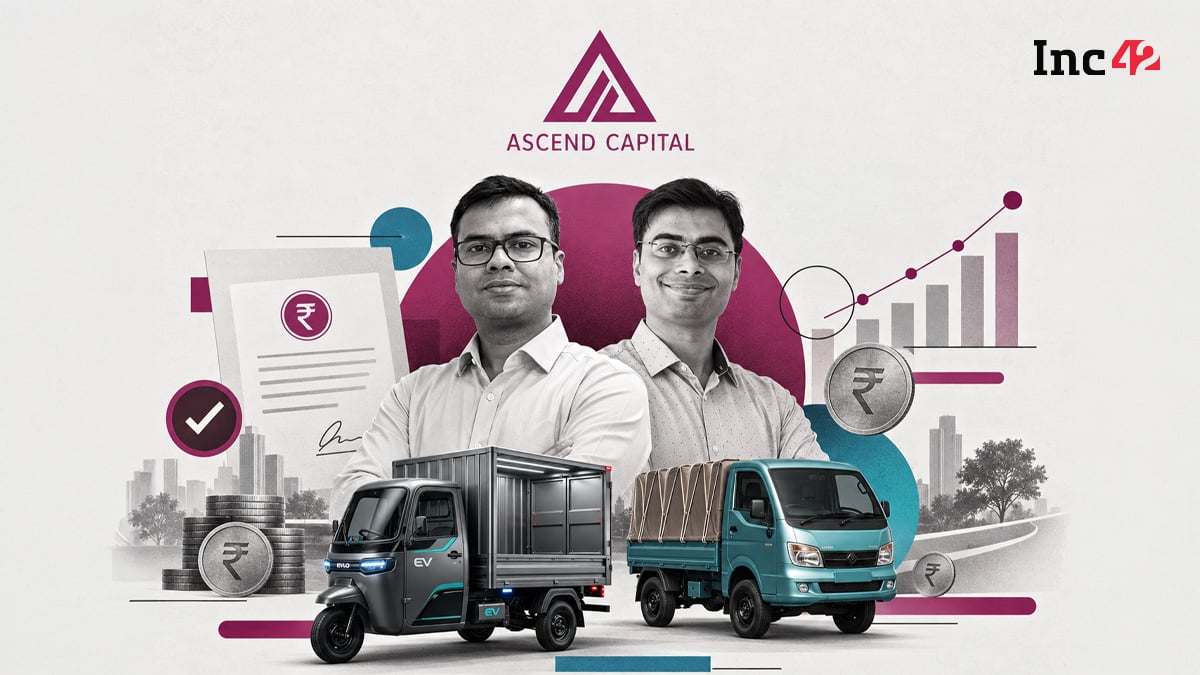
Ascend Bizcap’s total income more than doubled to ₹50.3 Cr in FY26, while profit after tax jumped over sixfold to ₹10 Cr, according to ICRA.
As more lenders enter India’s EV financing market, Ascend Bizcap’s growth highlights the opportunity in financing underserved commercial EV buyers beyond the traditional urban consumer market.
The NBFC’s total managed assets rose 46% YoY to ₹238.6 Cr, although gross NPA increased to 2.6% from 1.7% in FY25.
Info Edge Ventures backed NBFC Ascend Capital’s profitability improved significantly in the fiscal year FY26, growing 6.25X to ₹10 Cr from ₹1.6 Cr in FY25.
As per ratings assigned by ICRA, the Jaipur-based EV-focused lender’s total income for the fiscal jumped about 131% to ₹50.3 Cr in FY26 from ₹21.8 Cr in FY25. Its total managed assets (AUM) also expanded 46% to ₹238.6 Cr from ₹163.7 Cr during the period.
ICRA noted that the cumulative collection efficiency from Ascend’s securitised EV loan portfolio, comprising of three-wheeler EVs like e-autos, loaders and L5 vehicles, stood at 97.5% as on July 2026, while the 90+ days past due (dpd) delinquency stood at 1.3%.
Its gross non-performing assets (GNPA) increased to 2.6% in FY26 from 1.7% in FY25 while capital-to-risk weighted assets ratio (CRAR moderated to 34.8% from 41% a year earlier, though it remained well above the regulatory capital requirement.
Despite the healthy pool performance, ICRA highlighted that the NBFC poses risks such as limited operational history and geographical concentration.

As of September 2025, Ascend Capital was present across 60 cities in five states and UTs, although its top three states made up for 87.5% of the portfolio. Its total borrower base stood at 18,975 at the time.
Tapping The Growing EV Demand
Founded in 2019 by Lokesh Chandra and Gaurav Maheshwari, Ascend Capital extends loans of up to ₹2-4 Lakh to consumers looking to buy EVs and batteries for e-rickshaw and L5 vehicles.
Ascend originates EV loans through its NBFC and funds its lending book through a mix of institutional debt and securitisation, where pools of EV loans are packaged into securities and sold to investors, allowing the lender to recycle capital into fresh loans.
To overcome underwriting and collection challenges related to EV financing, the NBFC has developed an internal benchmark for valuing batteries and maintains a data repository covering OEMs, distributors and drivers.
It started disbursing loans against e-autos and e-loaders in January 2024. The NBFC’s PAT stood at just ₹0.1 Cr in FY24, while income stood at ₹13.7 Cr, highlighting a notable acceleration in its scale over the past two years.
It also raised ₹50 Cr in equity funding from Info Edge Ventures and Asha Ventures in 2024. The investors own a 24.8% stake in the NBFC as of now.
The development comes as a growing set of specialised lenders targets the financing gap in India’s EV ecosystem. A record 24.5 Lakh EVs were sold in India in FY26, up 25% YoY, with electric three-wheelers accounting for 8.31 Lakh units, or 34% of total EV sales, as per Vahan data. E3Ws also crossed a 60% share of India’s overall three-wheeler sales during the year.