
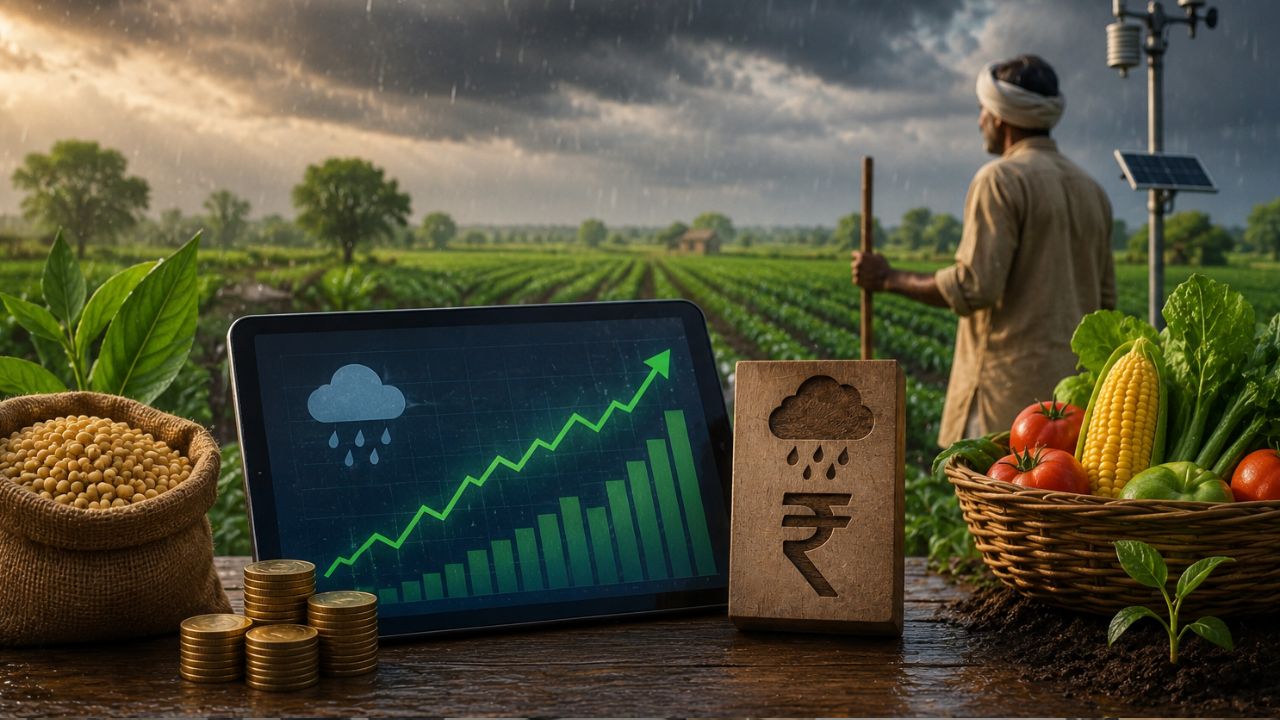
Neither gold, nor land, why are people now investing money on seasonal rains? understand the whole game

Till now people in India used to invest money on the fluctuations of gold, silver, crude oil or wheat-rice. Now a completely new and unique way of earning has come where people can bet on whether the rain will be less or more. National Commodity and Derivatives Exchange (NCDEX), the leading exchange of India’s commodity market, has launched ‘Weather Futures Contracts’ for the first time in the country. Through this new system, now farmers, traders and common investors can earn profits by watching the trend of monsoon. It started on 28 May 2026 when the first contract named ‘Rain Mumbai’ was launched in the market for trading. There was so much enthusiasm among the people about this new business that in the very first hour about 380 lots were traded, the total value of which was around Rs 4 crore. NCDEX MD and CEO Arun Raste said that even without any big publicity, this contract has received an excellent response from the very first day.
Till now people used to trade on the price of gold, silver or wheat-rice. In this new system you only have to pay attention to the rain. The market has calculated an average of Mumbai’s rainfall over the last 30 years. Traders just have to guess whether this time the rainfall in Mumbai will be less or more than this average. For example, if the market average is 100 points and you think that this time there will be drought or less rain, then you invest your money towards less rain. On the other hand, someone who feels that there will be heavy rain, invests money towards more rain. Later, as it rains, the person who guesses correctly gets direct benefit as per his chosen side.
Also read: Now no need for bank statement? Loan can be availed within minutes by data sharing
How to earn money from this unique market?
The method of earning in this market is similar to futures contracts in the stock market or commodity market. As if any trader feels that this time during monsoon there will be much less rainfall in Mumbai than expected. He takes his position accordingly. Later, if the meteorological department’s data proves that rainfall has indeed reduced, then the value of that contract will change in favor of that trader and he will make profit. Those who are expecting heavy rains or strong monsoon can bet on the other side.
The best part is that its settlement is done completely automatically at the end of the month based on the government and official rainfall data. In this, like crop insurance, there is no need for any government announcement or going to the fields to check the damage. In this it is only seen whether it rained as per the data or not.
Why was Mumbai chosen?
There is a very big reason behind this. In India, monsoon first reaches Kerala and then reaches Mumbai. Only after reaching Mumbai the rains advance across the country. Company official Arun Raste said that by looking at the rain in Mumbai, one can get an idea of the weather of the entire country, what will be the speed of rain this year and how long will it last. Apart from this, this system measures daily rainfall. Therefore, even if there is sudden heavy rain one day, there can be benefit on that day.
Also read: Now inflation will be measured by PPI, not WPI, understand the difference between the two.
How will farmers and companies get the benefit?
Farmer organizations from Maharashtra, Madhya Pradesh and Rajasthan participated in it on the very first day. Farmers are not using it like gambling, but to avoid their losses. If there is a fear of drought, farmers can compensate their losses by placing bets here.
Apart from this, sugar mills, spice traders, power generation companies, transport companies, ice cream companies and cab companies like Ola-Uber can also use it to keep their business safe. For example, if low rains cause damage to crops or power companies, or heavy rains reduce the earnings of ice cream makers and cabbies, they can recover their losses by earning profits from here.

Comments are closed.