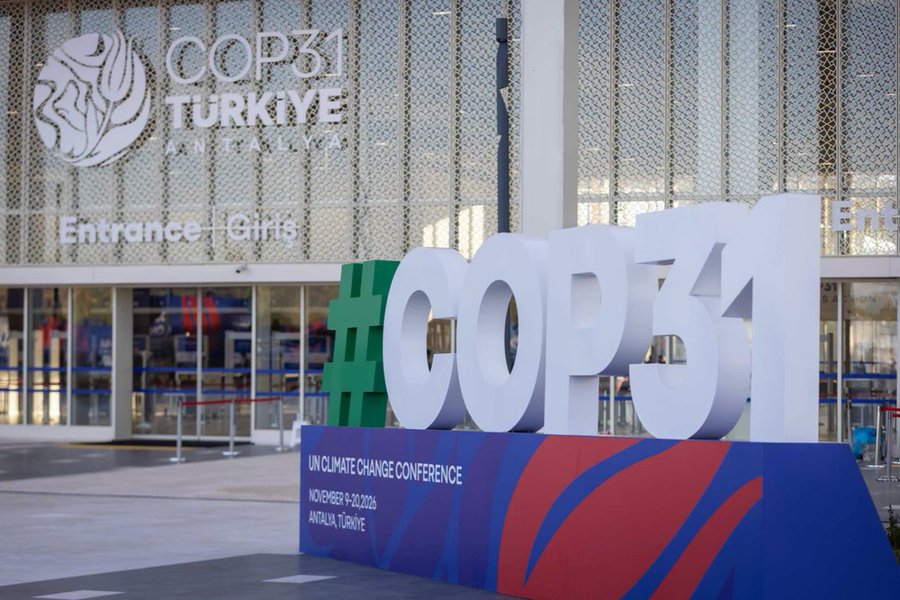
Antalya (Turkey): Proposals by Nepal and Bhutan, and separately by Kyrgyzstan, to secure formal agenda items on mountain-related issues at the 31st UN Climate Change Conference (COP31) failed to secure the backing of major negotiating blocs, Nepal’s Foreign Minister Shisir Khanal has said.
Speaking to PTI at COP31 Tuesday, Khanal said the three countries would continue to face challenges in securing stronger formal recognition of mountain-related issues without the support of major countries.
He said some nations explicitly backed the proposals, while others remained reluctant.
Nepal and Bhutan had sought a dedicated discussion on the impacts of 1.5 degrees Celsius warming and temperature overshoot on mountain ecosystems, including glaciers, water systems and mountain communities.
The two countries also proposed a scientific assessment, an annual high-level political dialogue and a dedicated UN climate work programme on mountain ecosystems, besides integrating mountain-specific priorities into global climate adaptation and finance frameworks.
Kyrgyzstan separately proposed institutionalising an annual dialogue on mountains and climate change as a standing agenda item at meetings of the UN climate body’s subsidiary bodies, with its outcomes reported to the Conference of the Parties.
COP31 commenced Monday in Antalya, Turkiye.
The two proposals were listed as items 20 and 18, respectively, in the supplementary provisional agenda issued by the UN Framework Convention on Climate Change (UNFCCC) November 6.
But they were not retained as separate agenda items when parties adopted the agenda Monday.
However, parties agreed that the COP31 presidency would hold consultations on mountain-related issues, with the theme also to feature in an upcoming research dialogue and a series of discussions at meetings of the subsidiary bodies in 2027 and 2028.
This is part of a big negotiation. Different major blocs did not support it, and that made it difficult for the agenda to go through. From our side, we pushed as hard as we could. There were different voices in the room. Some explicitly supported our agenda, while others were quite reluctant, Khanal told PTI.
A source with direct knowledge of the discussions said developed nations did not show interest when the three countries formally pushed the proposals.
The agenda focused on the Himalayas was clearly diluted, and it was the European Union which did not show any interest in this agenda. Even though the issue is not completely off the charts, a high-level dialogue is expected on it soon, the source said.
The source added that developing nations did not object to or block the proposals when they were raised.
Asked which countries supported the proposals, Khanal said several Least Developed Countries (LDCs) and mountain nations were positive, while developed countries were reluctant to take up new agenda items.
According to the Nepal government, a research dialogue on mountain-related issues is expected during COP31, while the presidency has agreed to hold consultations and include the theme in further discussions.
Compared to the past, we feel there is positive momentum, with the world community increasingly seeing the mountain issue as one of the core issues. That recognition is building. It may take some time to get where we really want to be, but we feel we are on a positive track, Khanal said.
Asked why Nepal was emphasising the 1.5 degrees Celsius temperature threshold in its proposal, Khanal said there was an urgent need to understand the consequences for mountain regions as global temperatures approach that level.
He also highlighted the August 2026 mountain collapse and flash floods along Nepal’s border with China, which Nepal has cited as an example of the growing climate risks facing mountain regions.
November 3, a report by the International Cryosphere Climate Initiative (ICCI), produced in collaboration with the UN Environment Programme (UNEP), warned that even a temporary breach of the 1.5 degrees Celsius threshold could trigger large-scale and, in some cases, irreversible ice loss across glaciers, ice sheets, permafrost and polar oceans.
The report cited the devastating August 2026 glacial lake outburst floods along the Nepal-China border as a warning of what could lie ahead for other glacier-dependent regions globally.
It warned that overshoot-driven impacts on the cryosphere in Nepal were already exceeding the limits of local adaptation and causing irreversible loss and damage.
Khanal said the Nepali delegation was seeking two primary forms of support at COP31: research assistance to better understand the changes unfolding in mountain regions and financial support for adaptation, mitigation and post-disaster reconstruction.
Technology transfer is a part of it. We see it as part of our early warning systems and adaptation. Where we need technology, we need satellites to monitor mountains and glaciers. So, we treat it as part of our research and adaptation needs, he said.
In October 2026, the Board of the Fund for responding to Loss and Damage (FRLD) provisionally set aside USD 21.6 million for Nepal’s recovery following the devastating Bhote Koshi flash floods.
Highlighting the issue as a matter of climate justice, Rajendra Prasad Mishra, Secretary of Nepal’s Ministry of Agriculture, Forest and Environment and co-leader of the country’s delegation, said Nepal contributes a negligible share of global emissions, yet the Himalayas, which sustain lives and livelihoods, are melting at breakneck speed.
I come here from a nation still in grief. In August 2026, mountain collapse unleashed what we have called the Himalayan tsunami. Critical infrastructure was swept away in minutes. Between August and October alone, Nepal experienced three major climate disasters, Mishra said.
According to UNDP, citing Nepal’s National Disaster Risk Reduction and Management Authority, the August disaster killed 1,451 people and left more than 5,600 missing.
Nepal’s recovery and reconstruction requirements have been estimated at USD 4.7 billion, equivalent to about 10 per cent of its GDP.
Yet Nepal acts with conviction: about half of our land is community-conserved forest, our energy runs on hydropower and over 70 per cent of new consumer vehicles are EVs, he added.
He emphasised that climate justice must not remain an aspiration on paper, but become a reality for those on the front lines.
Host Turkiye’s Environment, Urbanisation and Climate Change Minister Murat Kurum is serving as COP31 President alongside Australia’s Climate.