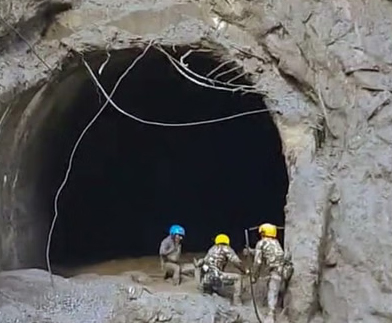
Kathmandu. Relief and rescue operations are continuing after the massive floods and landslides that occurred in Nepal on Wednesday. The biggest challenge is to rescue the employees and engineers trapped in the tunnel of the Upper Trishuli-3A Hydroelectric Project. Rescue teams are drilling, digging and controlled blasting to access the tunnel. According to the Nepali Army, the rescue team managed to reach the main part of the tunnel on Sunday. A joint team of about 90 members is engaged in this campaign. This includes 66 Nepali Army personnel, specialist search and rescue teams with trained dogs, 18 Armed Police Forces personnel and six Nepal Police personnel.
At around 2 pm on Sunday afternoon, the rescue team reached the upper part of the tunnel i.e. 'Crown Head'. A path of about 2×3 feet was made there. After this, the rescue workers descended inside the tunnel with the help of ropes and called out to the people inside. However, no response was received from inside. After this, the rescue team intensified the work of widening the tunnel path. Efforts are being made to gain access inside with the help of heavy machines and controlled explosions. Officials hope that once the entry route into the tunnel is completely opened, the operation to search for and rescue the people trapped inside will be able to proceed rapidly.
The rescue team has started supplying air and oxygen inside the tunnel. Oxygen has already been introduced through a vertical path. Apart from this, a camera has also been sent to know the situation inside. The rescue team is trying to establish contact with the people trapped inside and ascertain their condition. However, no one has been contacted yet. Rescue workers are continuously digging to reach the tunnels of the hydroelectric project filled with debris. In the hope that people trapped in a tunnel would be alive, air was supplied inside and food items were also sent. However, the rescue team has not yet been able to establish contact with anyone present inside the tunnel. Despite this, the operation is continuing and efforts are being made to reach the people trapped inside the tunnel.
More than 900 employees working in different hydropower projects of Nepal are missing after this disaster. Many of them are feared to be trapped in the tunnels. The biggest challenges facing the rescue operation are heavy debris, strong river flow and bad weather. Despite these difficult conditions, work to gain access to the tunnels is continuing.
The road leading to the hydroelectric project has been badly damaged due to the flood. This made it difficult to transport heavy machines to the spot. After this, Nepali Army opened digging machines and bulldozers in different parts. These were airlifted to Battar in Nuwakot by helicopter and from there to the project site. With the help of these machines, the work of opening the tunnel and removing debris is being done.
Weather and river water remain a constant challenge during the rescue operation. Due to the rain on Saturday night and the rise in the water level of the river, the excavation site near the tunnel was flooded with water. This affected the campaign for some time. Later, when the flood water receded, the rescue team again started searching for the entrance of the tunnel with drilling machines, excavators, hydraulic cutters and other equipment. Army officials say that despite the strong current of the river and difficult conditions, the joint rescue team is working continuously.
The death toll in Nepal in this natural disaster has increased to 752. According to Nepal's Disaster Management Agency, about 2,502 people are still missing. About 20 thousand security personnel have been deployed in relief and rescue operations. So far, about 8,730 people have been evacuated safely. A large number of people working in hydropower projects are reported missing. According to Nepal's Disaster Management Agency, 933 hydropower workers are also among the missing.
On Wednesday, a part of the glacier broke and fell down at an altitude of about 5,200 meters in the Himalayas. Due to this, a huge amount of rock and debris accumulated and it fell into the Lende river with strong current. After this, the heavy flood of water and debris moved towards Rasuwa, Nuwakot and Dhading districts of Nepal. There was massive destruction in many areas. The water level of Trishuli river rose by about 9 meters in just 30 minutes. Initially the US Geological Survey linked it to an earthquake, but later investigation found that the recorded seismic signal was itself caused by a landslide.
Along with Nepal, this disaster has also affected Tibet region of China. According to Chinese officials, at least 16 people have died there and 546 people are missing. These also include 261 foreign citizens from 23 countries. According to China, the missing foreign nationals include 104 Nepalese, 49 Indians, 33 Latvians, 18 Americans and 15 British citizens.
Many countries and international organizations have offered help for relief and rescue in Nepal. Many organizations including India, America, Australia, South Korea, United Nations and Red Cross are cooperating in relief work. America and Canada have announced humanitarian aid worth $3.6-3.6 million. Britain has announced assistance of about $6.8 million, United Nations about $2.5 million and European Union about $2.3 million. The Nepal government has also sought cooperation from India and China for expert help in the rescue operation. At present, the biggest focus is on safely evacuating the people trapped in the tunnels of hydroelectric projects.