
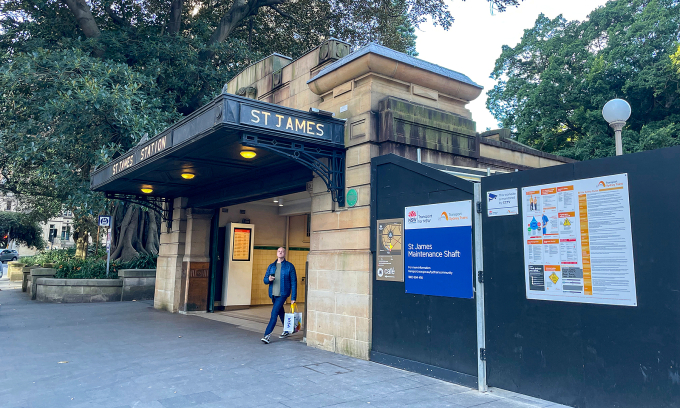

Bikram Lama, who grew up in a remote village in Nepal’s Makwanpur district, was found just before noon on Dec. 7, 2025, near the entrance to the St. James station tunnel that runs beneath Sydney’s Hyde Park, the Guardian reported.
Around 100,000 people went in or out of the station during the time he lay there, the publication reported, citing Opal transit card data. By the time station staff discovered him, his body had decomposed so badly that police could not visually identify him.
“It’s like he’s an invisible person and that’s just completely devastating,” Erin Longbottom, nursing unit manager at St Vincent’s Homelessness Health Service, told the Guardianadding that Lama had clearly been frightened and without any form of support.
In the months before he died, Lama had become a quiet fixture of Hyde Park’s homeless community. Rough sleepers there nicknamed him “the Birdman” for his daily ritual of returning from breakfast with a bag of breadcrumbs and walking straight to the flock of pigeons that lived in the tunnel, the Guardian found.
A former rough sleeper who now busks at the station told the publication that the birds would gather on the steps each morning to wait for him.
Entrance of St. James Station on Elizabeth St., Sydney, Australia. Photo by Windmemories |
Lama died during a severe heatwave that swept New South Wales in early December 2025, with news.com.au and the Sydney Morning Herald reporting temperatures more than 10 degrees Celsius above average along the Sydney coast and the Bureau of Meteorology issuing severe heatwave warnings. His death has been deemed non-suspicious and referred to the coroner.
His path to that tunnel began in 2013, when his family in Nepal sold roughly 3,000 sq.m of farmland, their most valuable possession, to send him to Australia to study computer science, according to the Guardian. His sister-in-law, speaking to the publication from Makwanpur, said the family had no money and had to part with nine kattha of land to fund his education.
The family had not heard from Lama in roughly seven years when Nepal’s foreign ministry contacted his elderly mother in March 2026 to request a DNA test. Sanjeev Kumar Sharma, Nepal’s consul to New South Wales, told the Guardian that DNA testing coordinated by Nepal’s government had confirmed Lama’s identity, and that the body was estimated to have been there about a week.
Records seen by Guardian Australia show Lama’s student visa had expired and his Nepali passport was not renewed when it fell due in 2023. Without legal status, he was deemed a non-resident and shut out of most housing support, healthcare and Centrelink welfare payments.
Lama’s case has drawn renewed attention to a growing population in Australia who arrived legally but later lost or never obtained permanent residency, leaving them ineligible for the social safety net most Australians take for granted.
Sydney’s most recent inner-city street count showed rough sleeper numbers up 24% in a single year, news.com.au reported.
The Australian Homelessness Monitor 2024, led by University of New South Wales researchers in partnership with Homelessness Australia, found rough sleeping rose 22% nationwide in the three years to 2023-24, with New South Wales up 51% since 2020.
“Rental affordability stress has deepened to such a degree that more people are being forced into situations of severe instability and rough sleeping,” the report’s lead author, UNSW housing professor Hal Pawson, said in a statement accompanying its release. The report linked the surge to a 51% jump in median asking rents nationwide between March 2020 and September 2024, far outpacing wage growth and inflation.
Pressure on the rental market has only intensified. Property analytics firm Cotality reported in February that Australian rents climbed 43.9% over the five years to September 2025, while wages rose just 17.5%, a gap of more than two and a half times. Renters now spend a record 33.4% of their pre-tax income on housing, Cotality said, with Bloomberg reporting the data had pushed rental affordability to its lowest level on record.
Sydney sits at the punishing end of that strain. The average monthly rent for a one-bedroom apartment in the city was about A$2,900 ($2,070) in January, with most rents falling between A$2,200 and A$3,600, according to figures from property research firm Bamboo Routes drawing on SQM Research and NSW government bond data.
International student tuition at Australian universities typically runs A$30,000 to A$60,000 ($21,400 to $42,900) a year, according to consultancy Hotcourses Abroad, on top of the A$24,505 in living costs the federal government requires student visa holders to demonstrate.
Comments are closed.