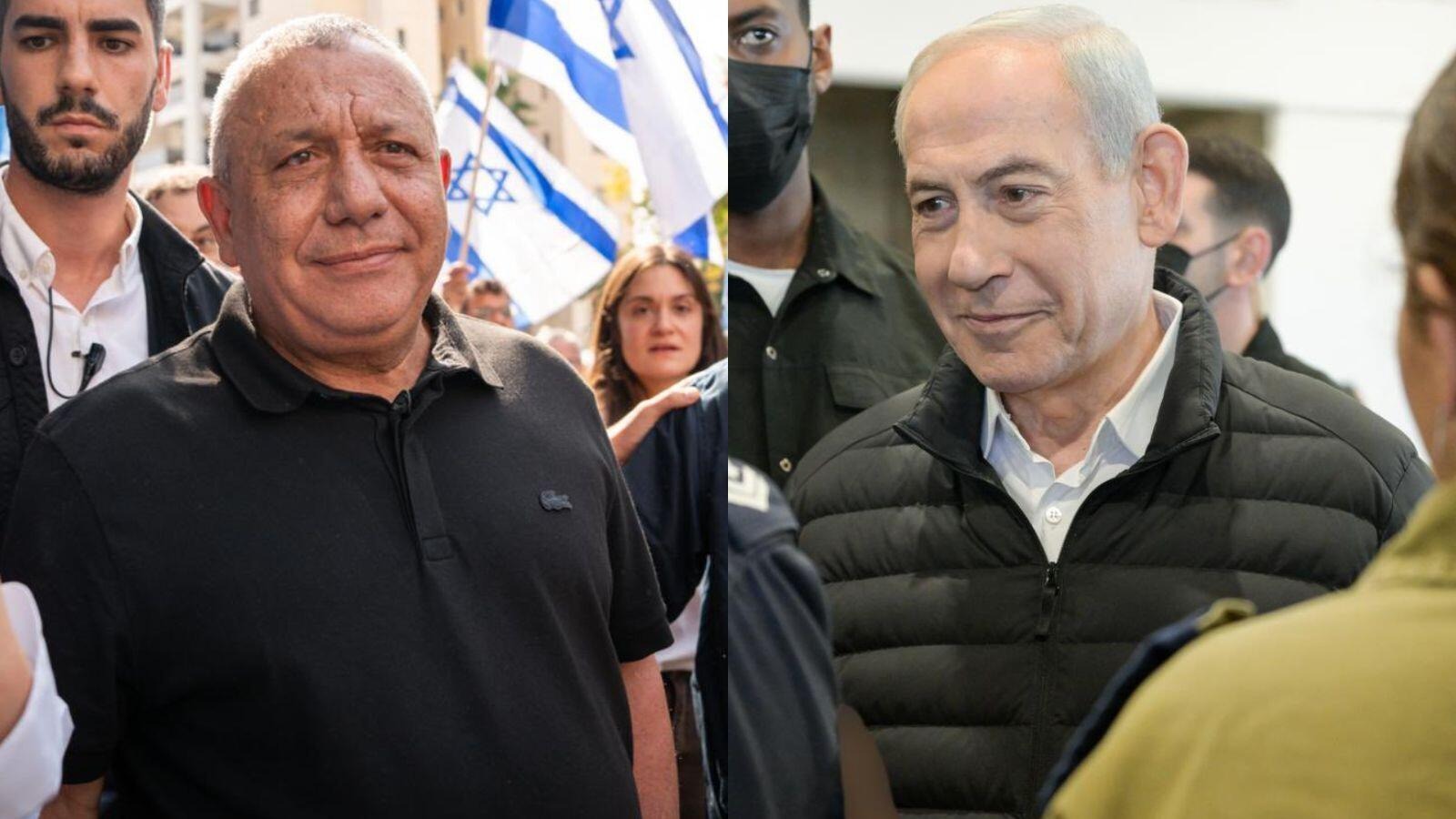
To break the long deadlock in Israeli politics, discussions about a national unity government have gained momentum. New hopes have arisen in political circles regarding the dialogue and possible meeting between acting Prime Minister Benjamin Netanyahu and Gadi Eiseenkot, one of the leading faces of the opposition. The proposed meeting at the Army Headquarters and the formula of taking charge of the post of Prime Minister by rotation has brought Israel's power equations to a new turn. The biggest change has come in Benjamin Netanyahu's stance towards forming a national unity government in Israel. Netanyahu has proposed that Gadi Eiseenkot become prime minister initially in the proposed unity government, while he himself serves as alternate prime minister. Discussions are going on between the two leaders on the idea of taking over the leadership by turns for a two-year tenure each. After this offer, Gadi Eiseenkot has given a direct message to Netanyahu's Likud party. Eysenkot says that if Likud is really serious about forming a new government, then it should come forward for talks without delay and prove it with concrete steps. He has given Likud 24 hours to proceed with the talks. Eizenkot stressed that there must be serious and rapid discussion on basic guidelines and policy issues, in order to form a government that represents all Israeli citizens and provides a strong foundation for national security. Political calculation of 61 seats after the election results: This situation in Israeli politics arose after the general elections held on October 27, when no coalition could get a clear majority in the 120-member Knesset parliament. The figure of 61 seats is necessary to form the government, but the results made the political picture extremely complicated. Netanyahu's Likud party emerged as the largest party in the elections with 27 seats, but his coalition of traditional right-wing and religious parties could get only 53 seats. On the other hand, Gadi Eiseenkot's Yashar Party got 21 seats and the alliance led by him has 48 seats. Apart from this, Arab parties demonstrated on 19 seats. This lack of numbers has forced both the camps to think about compromise and broad alliance. Meeting at Army Headquarters and the Pressure of Security Priorities National security and military strategy are always at the center of Israeli politics. In such a situation, the eyes of the entire country remain focused on the meetings held at the Army Headquarters and the developments related to the security establishment. Gadi Eiseenkot himself is a former military officer and describes national security as the basic requirement of a unity government. When the discussions of dialogue and meeting between Netanyahu and Eizenkot intensify, behind it is seen not only the sharing of power but also an effort to deal with regional security challenges. Eiseenkot has already made it clear that issues like recognizing Hamas as a terrorist organization and supporting its elimination are important for the parties joining the government. At the same time, he is firm on the principle of recognizing Israel as a Jewish and democratic country. The tussle within the alliance and the December 6 deadline The path to a unity government is not entirely easy, as differences have also come to the fore between the allies of the two parties. Some of Eysencott's coalition partners have registered their strict conditions and opposition to any arrangement led by Netanyahu. At the same time, there was a round of accusations and counter-accusations during the talks between the Likud and Eiseenkot camps, in which one side accused the delay and the other mentioned the efforts of alternative alliances. President Isaac Herzog handed the opportunity to form a government to Gadi Eiseenkot on 8 November. Under this, they have time till December 6, and if needed, they can also get an additional extension of 14 days. Now all eyes are on whether Netanyahu and Eizenkot reach a final agreement amid the 24-hour deadline and the turmoil related to the army headquarters, or whether Israeli politics takes a new turn. Potential impact on India and global geopolitics Any major change in Middle East politics impacts the global economy, energy markets and diplomatic balance. Israel is an important partner for India in terms of defense technology, agriculture, innovation and trade, while India also has close relations with other countries in West Asia. If a stable national unity government is formed in Israel, it could foster policy continuity and long-term strategic decisions. In case of increasing political uncertainty or deadlock, regional tensions and diplomatic sensitivities will be closely monitored. Analysts and policy makers around the world, including India, are keeping an eye on every political signal coming out of Tel Aviv and Jerusalem.