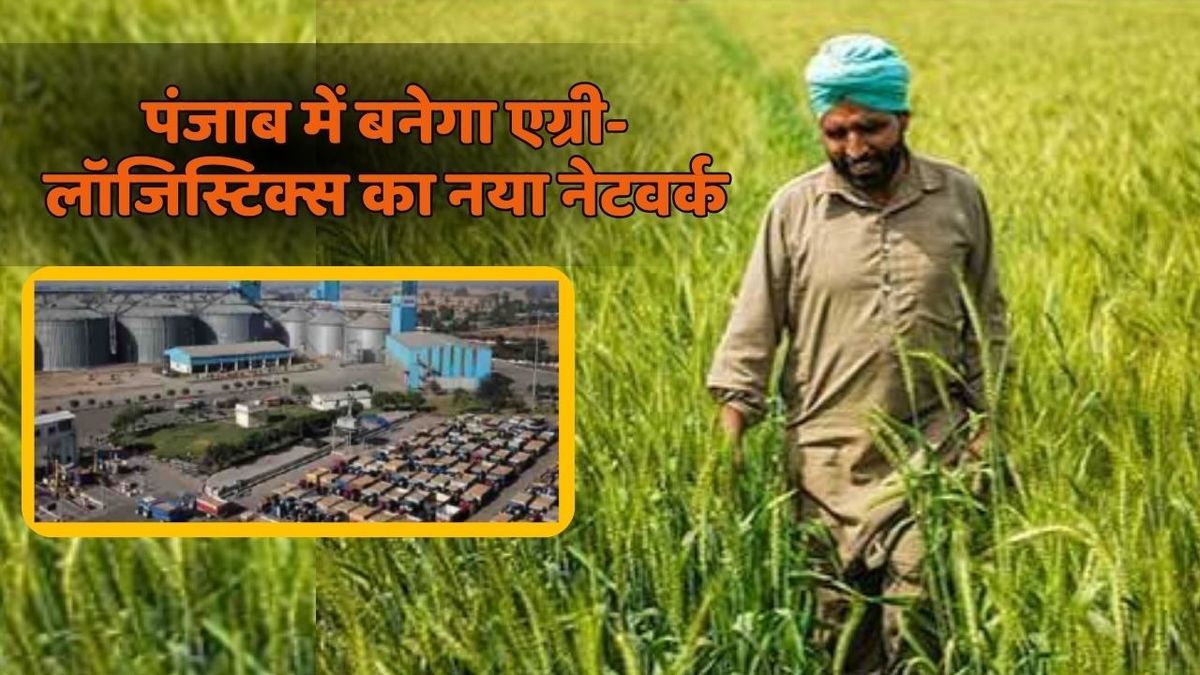
Punjab is considered to be the major agricultural producing state of the country. Along with wheat and paddy, potatoes, maize, fruits, vegetables and other commercial crops are also produced here. But achieving good yields in farming is not enough. It is equally important to maintain the quality of the crop while it reaches the market, make proper storage arrangements and supply the goods on time.
To convert this challenge into an opportunity, the proposal to develop advanced agro-logistics and global cold chain network in Punjab can be important.
Proposal: Under this proposal, it is envisaged to create smart logistics and refrigerated hubs near expressways and railway corridors. Its objective is to connect the storage, sorting, packaging, processing and transportation of agricultural products in a systematic network. If a concrete plan is made in this direction, Punjab can be made more attractive for the food processing industry. However, for now this idea should be understood as a proposal; For this, it will be necessary to come up with a detailed outline of investment, location, time limit and government incentives.
What is the idea of Smart Agro-Logistics Hub?
Smart Agro-Logistics Hub will be such a center where after collecting agricultural products from the fields, arrangements can be made for sorting, grading, packing, cold temperature storage and further supply as per their quality. Compared to normal warehouses, refrigerated hubs have the facility to control temperature and humidity, which helps in maintaining the quality of perishable products for a longer period.
The proposal to develop this network close to expressways and railway corridors is important because time and transportation costs play a big role in the supply of agricultural products. Road connectivity can make it easier to transport goods to farms and processing units, while railways can provide options for shipping large quantities of products over long distances.
However, merely building a hub near a highway or railway will not be enough. Its success will depend on whether there is reliable supply of electricity, modern refrigeration, digital tracking, packing facilities, hygiene standards and adequate availability of transport.
Preventing crop wastage is the biggest priority
Spoilage of crops after harvesting is one of the major challenges in the agriculture sector. Products like fruits and vegetables may suffer losses due to lack of temperature control, lack of proper packing, delay in transportation and poor storage arrangements. This is called post-harvest loss.
One of the main objectives of developing smart cold chain network in Punjab can be to reduce this loss. For example, if the potato crop is stored scientifically, the compulsion to sell it immediately can be reduced. Similarly, if fruits and vegetables are kept in controlled temperature, then more time can be given to send them to distant markets.
This can give farmers an opportunity to choose better time in the market. But its benefits will be widespread only when small farmers and farmer producer organizations (FPOs) also get affordable access to these facilities. If the hub can be used only by big buyers and big companies, then its benefits for small farmers may be limited.
Strategy to attract companies like Nestle, PepsiCo and McCann
Another important aspect of this proposal is to invite global food processing companies to invest in Punjab. Companies like Nestle, PepsiCo and McCain are involved in manufacturing and processing of food products. Such companies require regular supply of raw materials, clear quality standards, safe storage and efficient transportation.
If modern cold chain and logistics network is available in Punjab, the prospects for food processing companies to set up production units or expand existing activities may improve. Units involved in processing potato-based products, frozen foods, dairy, grains and other agricultural products can benefit from such infrastructure.
However, merely providing land and warehouse will not be enough to attract these companies. Investors also value stable policies, reasonable costs, skilled workers, availability of water and electricity, quality control, and access to markets. Therefore, the government will also have to focus on simplifying the investment process along with infrastructure and creating a reliable business environment for industries.
It is also important to clarify that the names of these companies are examples of the proposed strategy. Until a formal announcement of investment by the concerned companies or information about the agreement is revealed by the government, it cannot be assumed that they have decided to build new hubs in Punjab.
Beneficial for farmers and rural economy
If the logistics network is developed properly, its impact can be visible from farms to processing industries and retail markets. The first potential benefit is reduction in crop wastage.
Second, farmers can get options to sell their produce in different markets after sorting and grading.
The third benefit may come in the form of employment opportunities in rural areas. Work may increase in cold storage operations, packaging, quality checking, food processing, truck transportation and digital supply chain management. This can also create non-agricultural employment opportunities for families dependent on agriculture.
Moreover, if processing units are set up locally, the supply of value-added products instead of raw agricultural products can increase. For example, instead of just selling potatoes, they could be used to make frozen or processed food products.
This may provide an opportunity for expansion to the agriculture-based industries of the state. But to provide real benefits to farmers, a transparent procurement system, fair payments, clear quality standards and fair contracts with small producers will be necessary. Mere increase in investment by industries does not automatically guarantee increase in farmers' income.
Punjab will also benefit
The proposal for advanced agro-logistics and global cold chain network can provide an opportunity to move Punjab's agriculture from a production-centric model to a storage, processing and market-centric model. Creating smart hubs near expressways and railways can streamline the movement of agricultural products and increase the state's usefulness to food processing companies.
Not only this, Punjab will rise above being a state selling only raw grains and will also develop into a center of global 'food processing and supply chain'. The biggest benefit of this will be to the farmers of the state. Because under this scheme the income of farmers will also double.
These are the challenges before the government
The initial investment to develop such a network can be large. A balance will have to be struck between public and private investment considering the cost of land, refrigeration equipment, electricity, transportation and digital management. Besides, it will be necessary to make the use of these facilities economical for small and medium enterprises also.
The operation of cold chain depends on energy. Therefore, disruption in power cost and supply may affect the economic feasibility of the project. Renewable energy, energy-efficient appliances and modern temperature monitoring systems can help mitigate this challenge.
Another important question is which kind of facilities are required for which crops. Potatoes, dairy, fruits, vegetables and processed foods do not have the same storage requirements. Therefore, before deciding the location and capacity of the hub, crop production, seasonal demand, market and existing storage capacity will have to be studied.
If these aspects are given attention, then Punjab's agriculture sector can definitely move towards value-added food products, modern supply chain and connectivity with international markets instead of being limited to just grain production.
Also read – Defense and drone manufacturing hub can be built in the border districts of Punjab, youth will get hi-tech jobs.