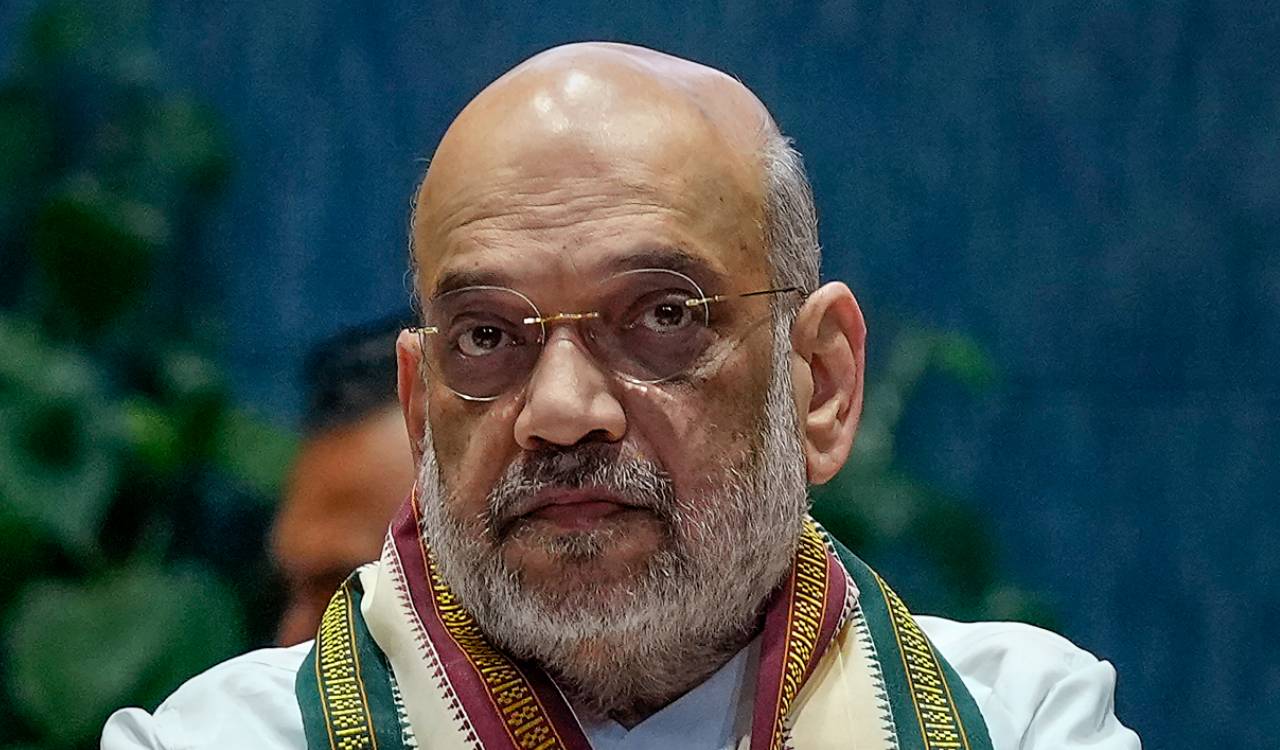
Union Home Minister Amit Shah set a one-year deadline for 100 per cent implementation of India’s three new criminal laws, aiming for criminal case disposal up to the Supreme Court within three years and a 25 per cent rise in conviction rates
Published Date – 26 August 2026, 01:02 AM
New Delhi: Union Home Minister Amit Shah on Tuesday set a one-year deadline for 100 per cent implementation of the three new criminal laws, saying the move will enable disposal of criminal cases up to the Supreme Court within three years and raise the conviction rate by 25 per cent.
Addressing the valedictory session of the Intelligence Bureau’s two-day ninth National Security Strategies (NSS) Conference-2026 that concluded on Tuesday, Shah said the forum of NSS needs to anticipate security challenges 15-20 years ahead and devise strategies to prevent them from becoming major threats.
The Bharatiya Nyaya Sanhita (BNS), Bharatiya Nagarik Suraksha Sanhita (BNSS) and the Bharatiya Sakshya Adhiniyam (BSA) came into effect on July 1, 2024. The new laws replaced the British-era Indian Penal Code, Code of Criminal Procedure and the Indian Evidence Act respectively.
“There will be 100 per cent implementation of three new laws in the next one year, so that criminal cases can be disposed of up to the Supreme Court within three years and the conviction rate will increase by 25 per cent,” the home minister said.
He said integrated data bank of Crime and Criminal Tracking Network and Systems (CCTNS), Inter-Operable Criminal Justice System (ICJS), NatGrid and National Automated Fingerprint Identification System (NAFIS) has been created.
Shah said all young officers should develop actionable intelligence through data integration, analysis and identification of modus operandi through AI, so that future challenges can be prevented.
He said the government has “ended” the challenges posed by three major internal-security hotspots– Naxals, Jammu and Kashmir terror and Northeast insurgency– and credited the police forces of all states, central agencies and Central Armed Police Forces for the achievement.
He said that had earlier governments visualised the problems of narcotics, Naxalism and the Northeast before they became acute, the country would not have had to bear the brunt of them for decades..
Shah said the destruction of the entire cadre and banning of the Popular Front of India (PFI) in one night was an “excellent example” of Centre-state coordination.
The home minister said he had visited all land-border states over the past eight months and shared with them a document outlining a quadrangular approach to border security.
“Our aim is to make the country free of infiltrators in a very short time,” he said. Calling infiltrators a threat to national security, the economy and demographic change, Shah said only citizens of the country have the right to live in India.
“This country is not a dharamshala and only the citizens of the country have the right to live in this country, infiltrators are a threat to the country’s security, economy and demographic change,” he said.
On terrorism, the home minister called for translating the ‘PRAHAR’ document into everyday practice to completely eradicate terrorism and dismantle its 360 degree networks.
“Modi Ji has set the target of developed India in 2047, and the first condition of developed India is strong internal security, if we want to become first in every field then internal security will have to be strengthened further,” he said.
Shah said that whenever a country decides to move forward, challenges inevitably emerge both from within the country and from across the world, and we must visualize them in advance.
On narcotics, he asked police forces in all states to implement the Narcotics Control Vision Document 2026-2029 on the ground to protect the younger generation.
He called for a three-pronged approach of “Detect, Disrupt and Destroy” to achieve a drug-free India, saying only India can mount the most successful fight against narcotics.
“This fight will be fought together by the Government of India and every department of every state government and we will win,” he said.
He said the government has strengthened the anti-fugitive system, with about 274 fugitives brought back from abroad between 2019 and 2026.
Shah urged all states to set a goal of ensuring that fugitives sitting abroad are brought under the law of the country. He said the Modi government has also upgraded the Multi Agency Centre to create a platform capable of providing multi-dimensional results.
The home minister said security policy cannot be framed in isolation and must take into account global instability, energy and resource insecurity, supply-chain disruptions, increasing radicalisation and cyber-misinformation warfare.
Shah said the country must identify challenges early and destroy them before they become major problems. “By creating such an ecosystem, we will be able to create a secure, infiltrator-free and narcotics-free India,” he said.
The conference was held in hybrid mode and attended by 850 senior security and police officers from across the country, besides Union Home Secretary Govind Mohan, Intelligence Bureau Director Mahesh Dixit, CBI Director Praveen Sood and Secretary of the Research and Analysis Wing Parag Jain, among others.
“On the first day of the conference, discussions focussed on critical aspects of national security, including response to counter-terrorism challenges, fusion, analysis and operationalisation of intelligence through the Multi Agency Centre, vision document on narcotics control, detection and deportation of illegal migrants, a policy framework to combat cyber-crime and proxy warfare by Pakistan,” a statement from Union Home Ministry had said.
Pursuant to the directions of Prime Minister Narendra Modi, the conference is being held in a hybrid mode every year since 2021. The objective of the conference is finding solutions to major national-security challenges, using the extensive experience of officers working at the grassroots level in collaboration with domain experts.