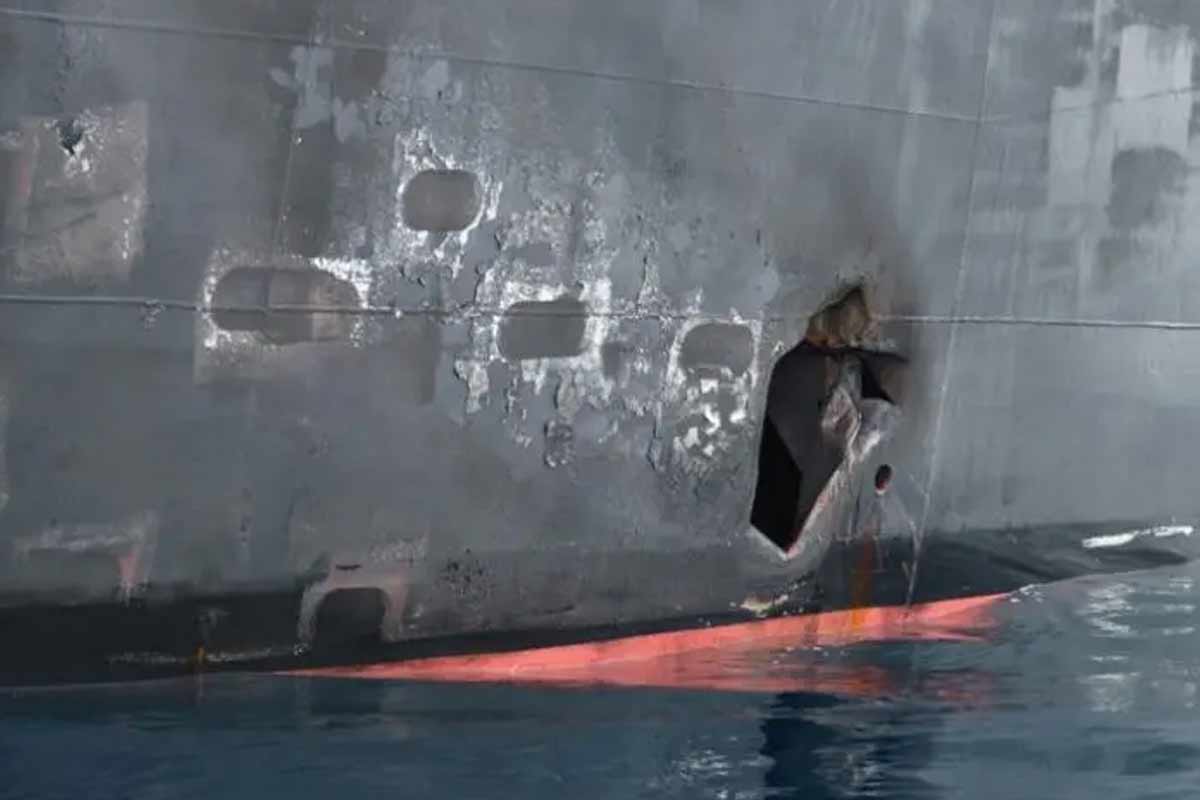
Iran-America war new tool! Limpet mine explosions targeting tankers in the Strait of Hormuz, which experts say is a new dimension in naval warfare. There were 27 Indian sailors in the Panama flagged tanker. All of them escaped with their lives. Union Shipping Minister Sarbananda Sonowal informed about the safety of Indians. It is reported that the engine of the tanker caught fire due to the explosion and it was shut down. As a result, the tanker stopped in the middle of the sea. Indians are also getting offended by any attack, counter attack in Hormuz. Therefore, the overall situation is being monitored all the time, said the Union Minister.
IMPORTANT UPDATE
On Oct 29, Liberia-flagged VLCC MT ARZANAH, carrying 2 Indian nationals, and on Oct 30, Panama-flagged crude oil tanker MT LOUISE 1, carrying 27 Indian seafarers, were targeted in projectile attacks in the Strait of Hormuz. All 29 Indian seafarers across both vessels are completely safe with no injuries. We are continuously monitoring the situations & coordinating with the ship management companies to ensure the ongoing security and well-being of our crew.
— Sarbananda Sonowal (@sarbanandsonwal) October 30, 2026
According to Minister Sarbananda Sonowal's X handle post, on October 29 i.e. Thursday, a large oil carrier carrying the Liberian flag was hit by a projectile explosion while passing through the Strait of Hormuz. There were 2 Indian sailors in it. They were rescued completely safely. The very next day, on October 30, Friday, new weapons were deployed in Hormuz. A Panamanian tanker named MT LOUISE 1 carrying 27 Indian sailors was crossing Hormuz when a limpet mine exploded. However, the Indian sailors were not harmed. Minister Sonowal said that 29 sailors are completely safe despite being under attack for two consecutive days.
What is this limpet mine explosion? Why is it being identified as a new tool of water warfare? According to military experts, the smaller the size of this explosive, the greater the power of destruction. It is named limpet because of its similarity in size to small sea snails. Explosives are attached to a very small device, which mainly works on magnetic fields. This explosive is active in shallow or deep water. The limpet mine detonated targeting the ship's main structure.
Now the question is, what is this limpet mine explosion? Why is it being identified as a new tool of water warfare? According to military experts, the smaller the size of this explosive, the greater the power of destruction. It is named limpet because of its similarity in size to small sea snails. Explosives are attached to a very small device, which mainly works on magnetic fields. This explosive is active in shallow or deep water. The limpet mine detonated targeting the ship's main structure.
Realizing that it is difficult to fight at sea with explosives in a heavy object, in 1939 the head of a certain unit of the British Army, Joe Holland, planned to install explosives in small objects. Uses material magnetism. Today's limpet mine is his brainchild. It is said that it can be successfully applied to the enemy at any depth of water very easily. If or for any reason the adversary tries to defuse the explosive, it will still detonate. According to informed sources, such explosives have not been used in Hormuz so far.