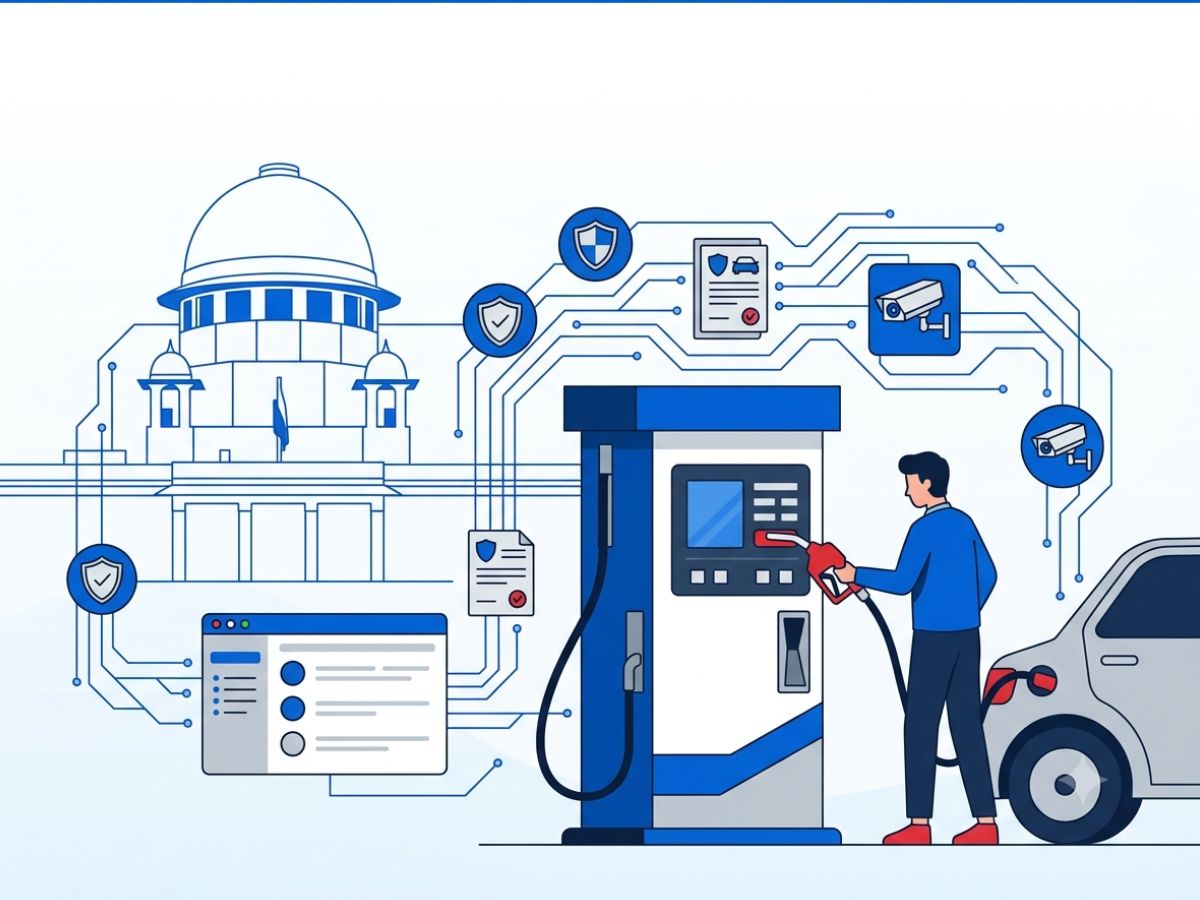
Imagine pulling into a petrol pump to fill your vehicle. Just as you are about to refuel, the attendant checks your vehicle details and refuses service because your insurance has expired. This may sound unusual today, but it is an idea that could become reality if a proposal backed by the Supreme Court eventually takes shape.
However, there is an important clarification. It is pertinent to note that the Supreme Court of India has not mandated the “No Insurance, No Fuel” regime throughout the country. Rather, the MoRTH and IRDAI have been asked by the Court to devise a pilot project in this regard, and the court also sought out a technological measure through which it would be possible to identify vehicles without insurance.
Why is the Supreme Court concerned?
The biggest concern is the large number of uninsured vehicles on Indian roads. According to the latest parliamentary reply based on active VAHAN records, 44.31% of active vehicles were uninsured as of March 6, 2026. The Supreme Court has also pointed out to the previous national-level estimation according to which almost 16.54 crores of the total number of vehicles—about 56%—were uninsured. Both these numbers have been obtained from two different sources, but still they highlight the problem of non-compliance with vehicle insurance.
The Court believes that weak enforcement of compulsory insurance leaves millions of road users vulnerable. When an uninsured vehicle causes an accident, victims often face delays in receiving compensation because there is no insurance company to settle the claim. Instead, they may have to pursue the owner through lengthy legal proceedings. This defeats the very purpose of making insurance mandatory.
Why is vehicle insurance mandatory?
Many people assume motor insurance is meant to protect their own vehicle. That is only partly true.
In fact, the law does make it mandatory to have third-party insurance since it provides protection for other people who can be injured or even killed in an accident resulting from your motor vehicle. The provision is made in Section 146 of the Motor Vehicles Act, 1988.
On the other hand, comprehensive insurance, which covers damage to your own vehicle along with additional benefits, is optional. It offers greater financial protection, but the law does not require every vehicle owner to buy it. The legal obligation is only for third-party insurance because the primary objective is to safeguard accident victims.
What happens if you drive without insurance?
Driving an uninsured vehicle is, itself, a crime according to the Motor Vehicles Act.
Currently, for the first offence, there can be a penalty in the form of either a fine of ₹2,000, or imprisonment up to three months, or both. In case of a second offense, the penalty will be a fine of ₹4,000, besides the risk of imprisonment. The government has made proposals for increased penalties but those haven’t yet been announced.
Consequences can be even more grave from the financial perspective.
In case of an accident caused due to an uninsured vehicle, the owner will have to compensate for the amount that the Motor Accident Claims Tribunal may decide in favor of the complainants. Such a compensation can easily go into several lakhs or even crores of rupees. Moreover, without the help of insurance company, the victim might take longer to get compensation.
What exactly has the Supreme Court proposed?
The court has requested authorities to come up with a technology-based enforcement mechanism in place of using only roadside enforcement.
This can be done by linking the ANPR cameras to the VAHAN database and the Insurance Information Bureau. In this way, the authorities will be able to detect uninsured vehicles automatically and issue them with e-challans.
The Court has also suggested developing a pilot project under which vehicles without valid insurance could eventually be denied fuel at petrol pumps until insurance is renewed. However, this is only a pilot proposal at this stage. There is no nationwide fuel restriction in force today.
Apart from this, the Court has directed authorities to create systems that allow police officers to verify insurance status instantly through handheld devices. It has also recommended a public verification platform so that citizens can check whether a vehicle has valid insurance. These measures are aimed at improving compliance through digital enforcement.
Why does the Court believe stricter enforcement is necessary?
The Court noted that India records more than four lakh road accidents every year. It also referred to data provided by the Ministry of Road Transport and Highways showing that around 22% of road accidents involved uninsured vehicles. This means a significant number of accident victims may struggle to receive timely compensation because there is no insurer involved. Strengthening insurance compliance, therefore, is seen as a way to improve protection for victims rather than merely increasing penalties for vehicle owners.
Can the proposal be implemented easily?
Not immediately.
Several practical issues still need to be addressed before any such system can work across the country.
Authorities will need to ensure that insurance databases are updated in real time. They must also account for situations where a policy has just been renewed but has not yet appeared in government records. Incorrect number-plate recognition, data errors and cloned registration plates could also result in wrongful denial of fuel.
Privacy issues are another problem with regard to this technology because this can connect vehicle movements, insurance and even fuel purchases. Proper measures need to be taken with regards to this matter before a nationwide implementation is done.
The road ahead
The Supreme Court has sent a strong message that compulsory insurance laws must be enforced more effectively. At the same time, it has stopped short of imposing an immediate “No Insurance, No Fuel” policy.
For now, the Court has directed MoRTH and IRDAI to develop and examine a pilot project while improving technology-based enforcement through ANPR cameras, integrated databases and automatic verification systems.
Whether uninsured vehicles will eventually be denied fuel depends on how the government designs, tests and implements the proposed pilot. Until then, the existing law remains unchanged: every vehicle used on public roads must have valid third-party insurance, and driving without it continues to be a punishable offence.
Also Read: Third-Party Or Comprehensive Insurance Policies? Supreme Court Explains Which Motor Insurance Actually Covers Passengers
Prabhat Gupta is Senior Copy Editor of Business Segment. He has worked across broadcast and digital newsrooms, editing and producing stories on politics, business, regulation and current affairs. His work has included writing on global markets and regulatory developments, along with long-form editorial content on business and governance.
He holds a master’s degree in Political Science from the University of Delhi and qualified UGC-NET in the subject, bringing an academic grounding to public affairs and policy coverage.
The post No Insurance, No Fuel? Why the Supreme Court Wants Tougher Action Against Uninsured Vehicles appeared first on NewsX.