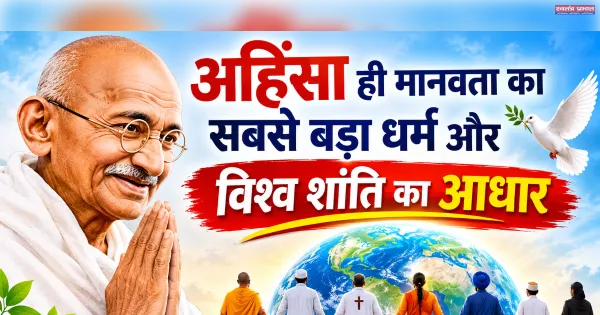
Non-violence is the soul of Indian culture and the biggest moral ideal of human life. It is not limited only to not causing physical pain to living beings, but not having bad feelings towards anyone through thought, word and deed is also non-violence. The real form of non-violence is to understand the suffering of others, to participate in their happiness, to have compassion towards every living being and to live life with mutual love and harmony. Non-violence makes a person strong from within, whereas violence gives rise to anger, hatred, fear and unrest in the mind. Today, when the world is struggling with war, terrorism, mutual conflict and ideological conflict, the importance of non-violence has increased more than ever.
Father of the Nation Mahatma Gandhi had described truth and non-violence as complementary to each other. He believed that truth and non-violence cannot be separated in practice. Non-violence does not only mean not hurting anyone, but also having immense love and immense capacity to bear suffering. Gandhiji considered non-violence not as cowardice, but as the supreme symbol of bravery and self-confidence. Through his life and movements, he showed the world that a big fight can be fought against injustice and oppression even without taking up arms. His non-violent struggle from South Africa to India's freedom movement is proof of this.
Non-violence is a natural quality of man. Just as the nature of water is coolness and the nature of sugar is sweetness, similarly the nature of the soul is compassion and non-violence. Violence is a disorder that arises within humans, which arises from anger, greed, ego and selfishness. When a man recognizes his true nature, feelings of compassion, forgiveness, love and tolerance develop within him. These feelings create an environment of peace from family to society and from society to nation.
Lord Mahavir described non-violence as the supreme religion. His message was that all living beings love their life. Every living being wants happiness and wants to avoid sorrow. Just as man wants to protect his life, similarly animals, birds and even the smallest creatures have the right to live. Therefore, it is not right to cause unnecessary suffering to any living being. The basic principle of Jain philosophy, live and let live, expresses this sentiment. This message of Lord Mahavir is a guide for the entire humanity even today.
The life of Emperor Ashoka is a remarkable example of the power of non-violence in Indian history. The massive massacre and destruction in the Kalinga war shocked his heart. Despite the victory of the war, he did not get spiritual peace. After this he left the path of violence and adopted the path of Dhamma, compassion and public welfare. His life tells that the kingdom can be won by the sword, but the hearts of the people can be won only by love and harmony.
The biggest challenge facing the world today is war and increasing international tension. Border disputes, political competition, religious fanaticism and the fight for supremacy between many countries have put humanity in crisis. In war, not only soldiers are affected, but innocent civilians, women, children, elderly and future generations also pay its price. The money spent for development gets spent on weapons and military preparations. The works of education, health, employment, science and public welfare are left behind. War is not a permanent solution to any problem. When a conflict ends, new hatred and new disputes are born.
The biggest side effect of violence is that it gives rise to the feeling of vengeance. Responding to violence with violence does not end the chain of conflict. On the contrary, even the most difficult disputes can be resolved through dialogue, compromise, justice and diplomacy. This does not mean that one should remain silent in the face of injustice and oppression. Nonviolence also does not mean accepting injustice. Real courage lies in standing firm for truth, justice and rights by adopting the path of non-violence.
Nonviolence is necessary not only for nations and societies, but also for family and individual life. Harsh words, anger and insults at home are also forms of mental violence. If family members respect each other's feelings, resolve differences through dialogue and make forgiveness a part of life, then there can be happiness and peace in the family. Instead of spreading hatred on the basis of caste, language, religion and ideology, mutual respect and brotherhood should be promoted in the society.
Today, it is the responsibility of the world's powerful countries and international organizations to take peace initiatives instead of promoting war. Global forums like the United Nations should play an effective role in peaceful resolution of disputes, protecting human rights and enhancing trust between countries. Every nation must understand that its real strength lies not in military capability alone, but in economic development, education, scientific progress and improving the standard of living of its citizens.
India has given the message of non-violence, tolerance, compassion and Vasudhaiva Kutumbakam to the world for centuries. The ideology of Mahatma Gandhi and Lord Mahavir still shows the world the path to peace. There is a need that these ideals should not be limited to books and speeches only, but should be adopted in practice.
Ultimately, non-violence is not weakness, but the greatest sign of self-confidence. Violence can create fear, but not trust; It can bring destruction, but not permanent development. The future of humanity is not secured in battlefields, but in an environment of peace, cooperation and harmony. The countries of the world should leave the arms competition and start competing for human welfare. We have to understand that we cannot be happy by causing pain to others. If you want to live then let it live, if you want to be happy then give happiness to others. This is the message of non-violence and this is the strongest foundation of world peace. We don't want our life to be taken from us. So we avoid taking the lives of others, but also protect the lives of others. We do not kill anyone, this is also non-violence.
Kantilal Mandot