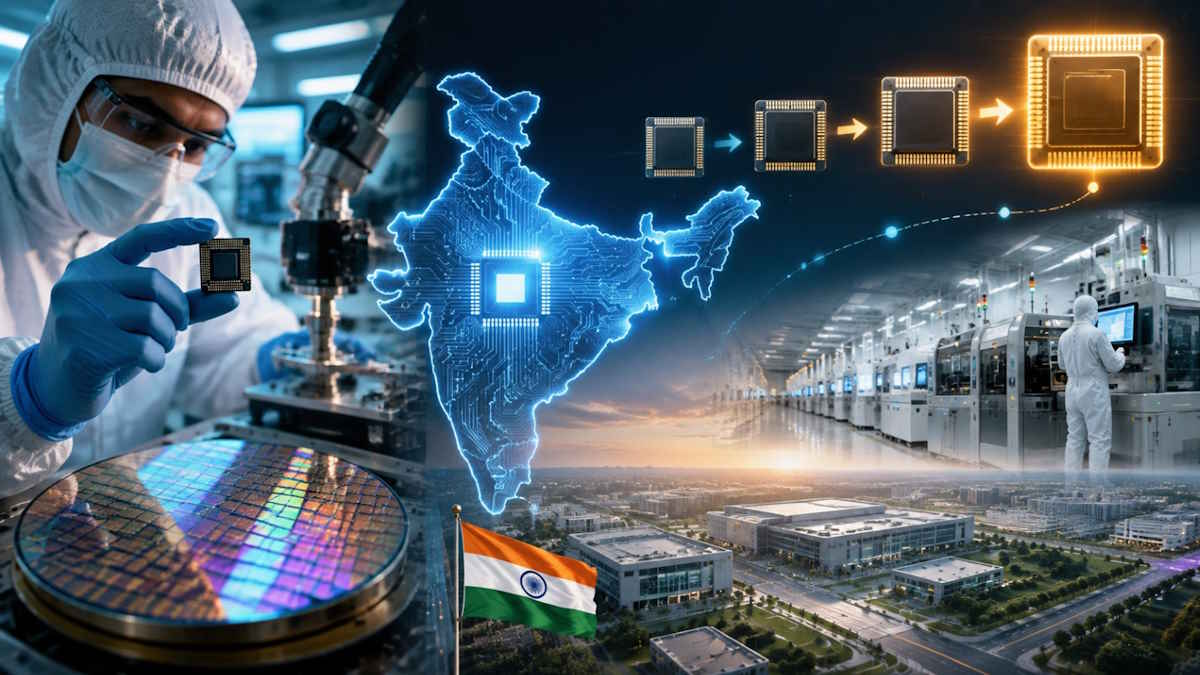
Technology Desk. India is now preparing to take a big leap in semiconductor i.e. chip manufacturing. IT Minister Ashwini Vaishnav has shared a big roadmap for India's semiconductor future. The government aims to develop advanced chip technology from 7nm to 3nm in the next 8 years.
Target from 40nm to 3nm
At present, 40nm level chip manufacturing capacity is being developed in India. But today's smartphones, AI servers, electric vehicles and other high-tech devices require more advanced chips like 7nm and 3nm.
The government is now preparing to move from 40nm to advanced nodes by focusing on research, design and manufacturing infrastructure. Reaching 3nm will not be easy, but it is being seen as a long-term technology mission.
Big investment on Semicon 2.0
The next phase of India's Semiconductor Mission is 'Semicon 2.0'. For this, a roadmap for investment of about Rs 1.275 lakh crore has been prepared.
Its focus is not just on setting up a chip factory. In this:
Chip Design and R&D
Wafer Manufacturing
Chip Packaging and Testing
semiconductor equipment
Research Infrastructure
training of skilled engineers
Areas like have been included.
Gujarat is becoming a semiconductor hub
A major part of chip manufacturing in India is developing in Gujarat. A large wafer fab facility is being built in Dholera in partnership with Tata Electronics and Taiwan's Powerchip Semiconductor Manufacturing Corporation (PSMC). There is a plan to invest about Rs 91,000 crore in this project.
At the same time, Micron's assembly and test facility in Sanand is also strengthening India's semiconductor ecosystem.
Plan to prepare 1 lakh chip design engineers
Mere factories and machines are not enough to make advanced chips. For this, a large number of chip design engineers and semiconductor experts are also required.
The government is working towards training around 1 lakh youth in semiconductor and chip designing in the coming years. Its objective is to connect India's strong IT and engineering talent with the chip industry.
What will change with 3nm chip?
If India is successful in technologies like 7nm and later 3nm, its impact will not be limited to the chip industry only.
Chips with smaller nodes can generally pack more transistors into less space, achieving better performance and power efficiency. Its benefits can be found in areas like AI, smartphones, automobiles, electric vehicles, data centers, medical technology and defense.
However, India will have to overcome many technical and industrial challenges to reach cutting-edge manufacturing technologies like 3nm. This will require huge investment as well as long-term research, advanced machinery, material supply chain and experts.
Follow the LALLURAM.COM MP channel on WhatsApp