
The event opened on November 9 at COEX in Seoul, bringing together more than 2,000 developers, startups, businesses and researchers. It continues through November 10, with sessions covering physical AI, agentic AI, open models and AI infrastructure.
The announcements go beyond demonstrations of AI software. They show how NVIDIA is working with Korean companies to apply accelerated computing and AI to industrial processes, robotic systems and large-scale inference. NVIDIA AI Day Seoul 2026 is taking place on November 9–10 at COEX in Seoul.
However, several of the company’s partnership announcements and related updates were published on November 8, ahead of the event’s opening. The developments discussed here therefore cover both the event program and NVIDIA’s announcements surrounding it.
Samsung Reports 1,600× Faster Engineering Simulation
Samsung Reports 1,600× faster engineering simulation. Samsung Electronics is expanding its work with NVIDIA on semiconductor engineering, including materials research, process development, and chip design.
The companies are using GPU acceleration and AI-based simulation tools to reduce the computational demands of selected engineering workloads. One notable result involves Samsung’s chip-scale thermal and mechanical analysis. Using NVIDIA PhysicsNeMo, the companies combined AI-predicted material properties, coarser simulation grids,s and GPU acceleration to achieve a reported speedup of approximately 1,600× in one experimental workflow.
The comparison involved a fine-grid simulation running on a 32-core CPU and an AI-assisted, GPU-accelerated coarse-grid simulation, rather than a like-for-like hardware benchmark.
NVIDIA says the calculation time fell from around 18 hours on a 32-core CPU using a fine-grid simulation to 41 seconds with a GPU-accelerated coarse-grid approach. The result applies to this particular simulation workflow and does not mean that Samsung’s processors, semiconductor manufacturing operations, or all engineering simulations are 1,600 times faster.
Samsung is also using NVIDIA’s cuISS and cuDSS technologies for computations involving sparse linear systems. Separately, selected quantum chemical calculations on Samsung’s sMOL platform have run up to five times faster end to end using NVIDIA cuEST.
LG Demonstrates CLOiD Robot Manipulation With Isaac GR00T
NVIDIA and LG Electronics demonstrated robotic manipulation and manufacturing tasks using LG’s CLOiD robot in an actual manufacturing environment.
The work uses NVIDIA Isaac GR00T, its robotics foundation model technology, as part of a broader system for training and improving robot capabilities. The companies have developed a physical AI data workflow that connects real-world data collection, synthetic data generation through NVIDIA Cosmos, GR00T model training, Jetson AGX Thor onboard computing, and simulation-based evaluation.
The demonstration showed CLOiD performing manipulation and manufacturing tasks in an actual manufacturing environment. This marks progress towards repeatable robot-learning processes, although it does not establish that the technology has been commercially deployed across LG’s factories. The development also builds on the company’s earlier robotics partnership.
Hyundai Explores More Secure Enterprise AI Agents
Hyundai Motor Group is exploring NVIDIA NemoClaw blueprints and the NVIDIA OpenShell runtime for secure enterprise AI-agent workflows. The work is focused on how AI agents can perform tasks while operating under controls designed to protect sensitive information and manage access to business tools.
OpenShell provides a runtime environment with sandboxed execution and policy-based controls. These mechanisms are designed to restrict what an agent can access and do, helping organizations govern autonomous actions. NVIDIA’s announcement describes Hyundai’s work as an exploration, not a completed deployment across its operations.
The same announcement also identifies a separate collaboration involving Korean AI security company AIM Intelligence, which is integrating its Starfort platform with OpenShell to support enterprise agents. These capabilities are designed to provide organizations with greater control over agent activity, but their inclusion in the announcement should not be interpreted as independent validation of the platform’s security or confirmation of a completed enterprise deployment.
NVIDIA and Korea Expand Sovereign AI Infrastructure
NVIDIA is also expanding its collaboration with South Korea’s Ministry of Science and ICT (MSIT). The work covers domestic AI chip development, data-center infrastructure, model deployment, technical training, and support for startups.
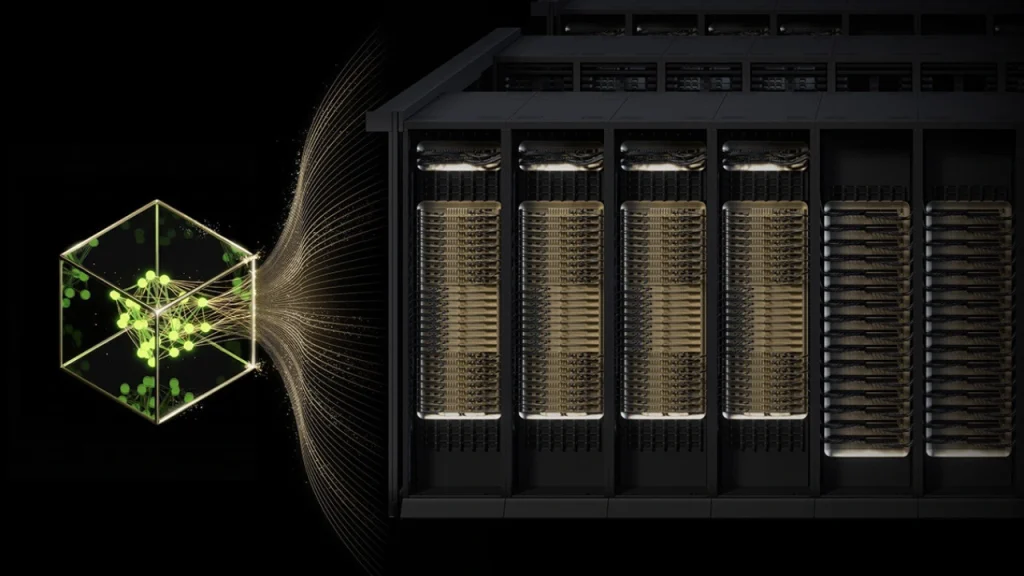
A major development involves NVIDIA, SK Telecom and Korean AI-chip company Rebellions. Under their collaboration, Rebellions plans to connect its next-generation Rebel R200 neural processing units (NPUs) to NVIDIA’s infrastructure using NVLink Fusion.
The companies also plan to use NVIDIA’s MGX rack architecture to develop integrated GPU and NPU systems. SK Telecom intends to deploy these systems in its AI data center and connect them with its own AI models and services. The proposed architecture will use NVIDIA GPUs for the prefill stage of AI inference, which processes the input prompt, while Rebellions NPUs will handle the decode stage, which generates the response.
This disaggregated inference approach is intended to improve processing efficiency and power usage, although its commercial performance has yet to be established. The collaboration is supported by MSIT and forms part of South Korea’s wider sovereign AI ambitions. However, the R200 systems are expected to be ready for deployment in 2028, so the announcement represents a development plan rather than an already operational infrastructure rollout.
Dynamo Brings Four Korean Open Models Into Optimized Deployment
NVIDIA is releasing Dynamo-optimized deployment recipes for four Korean open models:
- A.X K2: Developed by SK Telecom.
- K-EXAONE 2.0: Developed by LG AI Research.
- Solar Open 2: Developed by Upstage.
- Motif-3: Developed by Motif Technologies.
NVIDIA Dynamo is an open-source, distributed inference-serving framework. It helps manage model deployment across multiple GPUs by coordinating request routing and communication between systems. The new recipes are optimized for NVIDIA B200 GPUs, with NVIDIA reporting up to twice the performance out of the box. This figure applies to the specified optimized deployment configurations, not every model, GPU or inference workload.
The Bottom Line
NVIDIA AI Day Seoul 2026 highlights a broader shift in the company’s strategy: bringing AI into industrial environments, semiconductor engineering, robotics and national computing infrastructure. Samsung’s simulation work and LG’s CLOiD demonstration show how physical AI could support manufacturing, while Hyundai’s exploration of secure agents points towards more controlled enterprise automation.
The Rebellions and SK Telecom collaboration adds another dimension by connecting Korean-developed AI processors with NVIDIA’s infrastructure.