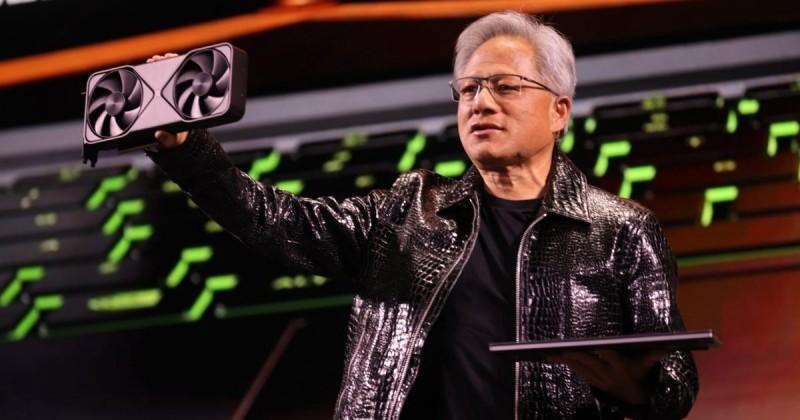
Nvidia shares suffered their sharpest single-day decline since the January 2025 DeepSeek shock, plunging 9.26 per cent on November 5 to close at $181.60. The sell-off pushed the world’s most valuable chipmaker into negative territory for 2026 and triggered a wider rout in US technology and artificial intelligence (AI) stocks.
The steep decline wiped out billions of dollars in Nvidia’s market value and contributed to a broader Wall Street sell-off that erased nearly $3 trillion in market capitalisation. The stock fell below its December 31, 2025 closing level of $186.50, leaving it down 2.63 per cent for the year at Thursday’s close.
Nvidia shares subsequently staged a partial recovery in pre-market trading on November 6, rising around 5 per cent to $190.89. However, the rebound was not enough to erase the previous session’s losses.
Jensen Huang loses $15.1 billion as Nvidia shares plunge
The sharp fall in Nvidia shares also hit CEO Jensen Huang’s personal fortune. According to Bloomberg’s Billionaires Index, Huang’s net worth declined by $15.1 billion to $150.9 billion on November 5, pushing him down from ninth to 13th position among the world’s richest people.
The decline came as investors reassessed the valuations of companies closely associated with the AI infrastructure boom. Huang’s wealth is heavily linked to Nvidia’s stock performance, making him particularly vulnerable to sharp movements in the company’s share price.
The sell-off also affected other technology billionaires. SpaceX CEO Elon Musk reportedly lost $79.7 billion, while Oracle co-founder Larry Ellison’s wealth declined by $10.1 billion.
Nvidia crash triggers wider US stock market sell-off
The Nvidia rout coincided with a major decline across Wall Street. The Nasdaq Composite plunged 5.5 per cent, its steepest single-day fall in 19 months, while the S&P 500 declined 4.4 per cent. The Dow Jones Industrial Average dropped 1,833 points, or 3.4 per cent.
The Nasdaq 100 shed approximately $2.5 trillion in market value as investors dumped technology and AI-linked stocks.
Other chipmakers also witnessed heavy losses. Advanced Micro Devices (AMD) plunged 17.3 per cent, Micron fell 17.5 per cent and Broadcom declined 10.4 per cent.
The sell-off extended beyond semiconductor manufacturers to companies involved in data centres, cloud computing and AI infrastructure, highlighting how closely the US technology market has become tied to expectations of continued AI investment.
Why are Nvidia and AI stocks falling?
One of the major triggers was growing investor concern following the US midterm election results, which strengthened Democratic control in Congress.
Investors fear that increased political scrutiny of AI infrastructure projects could slow data-centre construction in the United States. Concerns over local opposition, electricity consumption, pressure on water resources and regulatory hurdles have raised questions about whether planned investments in AI infrastructure will proceed at the expected pace.
The concerns are significant for Nvidia because its high-performance GPUs are essential to training and running advanced AI models. Any slowdown in data-centre expansion could affect future demand for its chips.
Investors are also questioning whether the enormous sums being invested in AI infrastructure will generate sufficient returns. Higher borrowing costs and tighter financial conditions have added pressure on smaller cloud and data-centre companies that depend on substantial capital expenditure.

What does the sell-off mean for the US AI industry?
The correction has exposed the risks associated with the rapid rise in AI-linked valuations. Companies supplying chips, computing capacity, cloud services and electricity to data centres have all come under pressure.
According to Reuters, UBS analysts estimated that around 30 per cent of expected US data-centre capacity additions in 2028 could be at risk from potential construction pauses.
The weakness in AI stocks also affected companies such as CoreWeave, Nebius, Applied Digital and IREN, which are closely associated with the expansion of AI computing infrastructure.
However, the sell-off does not necessarily indicate that demand for artificial intelligence is disappearing. Instead, investors are becoming more cautious about the pace of infrastructure expansion, financing requirements and the returns expected from AI investments.
For Nvidia, the immediate challenge is to maintain investor confidence in its growth outlook amid concerns about AI spending, regulation and the broader technology market.