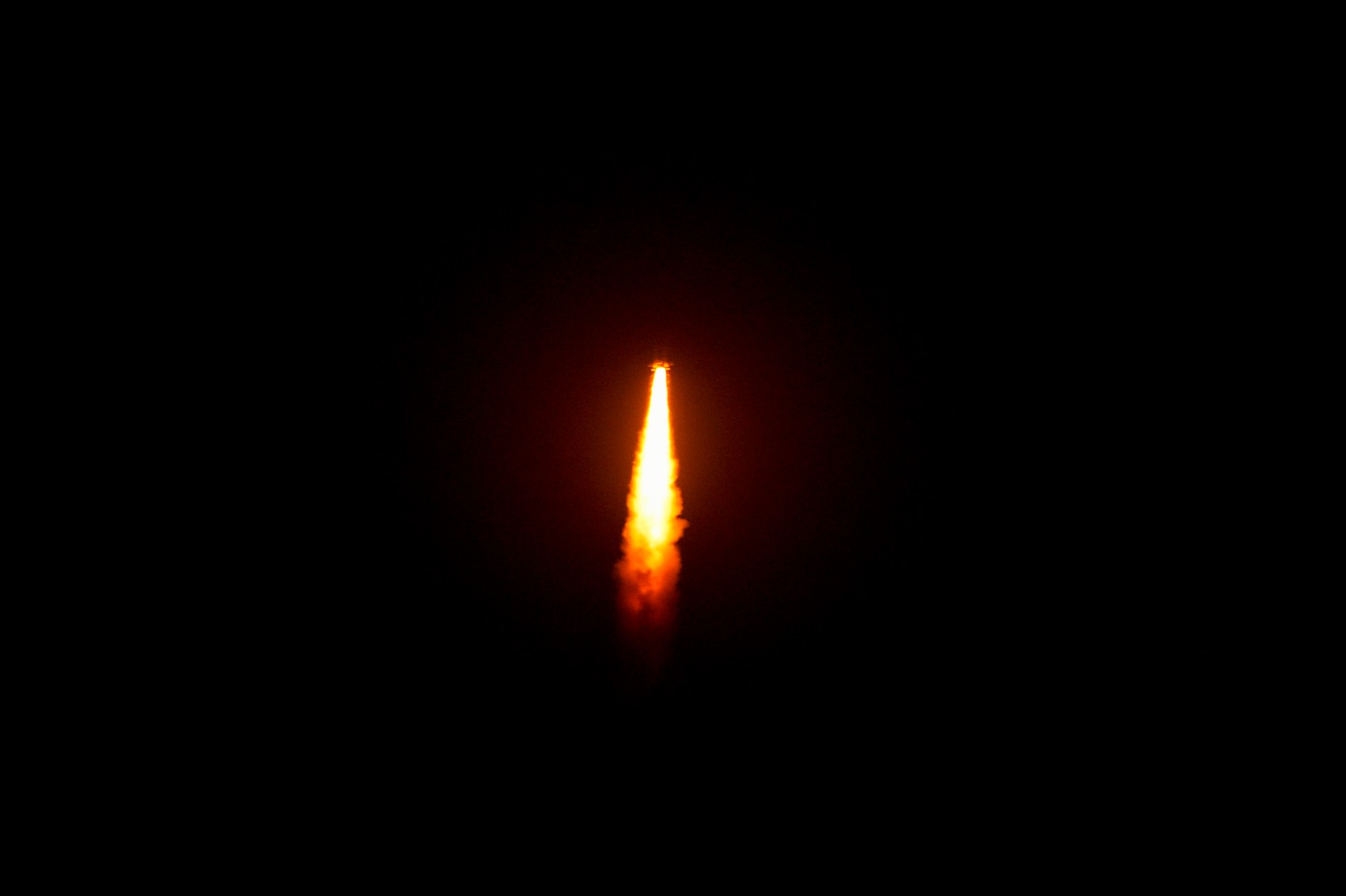
India’s independent regional navigation satellite system, NavIC, was restored to its minimum operational configuration of four satellites late Friday (October 30) after ISRO successfully launched its navigation satellite NVS-03, which a GSLV rocket placed into the designated injection orbit.
The second-generation navigation satellite NVS-03, with indigenous and procured atomic clocks, has a wide array of applications, including civilian use like real-time tracking of trains, vehicles, and shipping vessels.
Further, the NavIC constellation is an important component of the ‘one nation, one time’ project, ISRO chief V Narayanan said after the successful mission launch.
The NVS-03 satellite is all set to complement three other navigational satellites in operation, including the NVS-01, and it will strengthen infrastructure for a robust IST with the government recently notifying the Legal Metrology (Indian Standard Time) Rules, 2026.
NaVIC, Indian version of GPS
The nation’s own satellite navigation system ‘NaVIC,’ is the Indian version of GPS, albeit confined to the country and 1,500 km beyond.
On Friday, the 50-metre-tall GSLV rocket carrying NVS-03 lifted off at the scheduled time of 11.51 pm from the second launch pad at Satish Dhawan Space Centre, following a 24-hour countdown.
After a flight of about 18 minutes, which saw the successful performance of all three stages, including the complex cryogenic upper stage, the primary payload was separated from the launch vehicle and injected into a Geosynchronous Transfer Orbit (GTO).
Also Read: NVS-03 to fly with pyro valves open as ISRO seeks to avert repeat failure
In his address following the success of the crucial mission, Narayanan said already three satellites, including NVS-01 are successfully working and now, NVS-03 has restored Position, Navigation and Timing (PNT) services.
“NavIC ((Navigation with Indian Constellation) is a strategic national asset which provides independent access to Position, Navigation, Timing services, and it is also used for civilian applications like real time tracking of trains, vehicles, shipping vessels,” he said.
Further, he asserted that the NavIC constellation is an important component of the ‘one nation, one time’ project. Speaking on the constellation, he said that one of the indigenous atomic clocks had already been placed in orbit.
EOS-05 geo-imaging satellite is a huge success
He announced that the EOS-05 geo-imaging satellite, launched in September, was working perfectly and that the space agency is getting “outstanding” data from it.
On NVS-03, the ISRO chief said that all the vehicle systems performed as predicted, and as expected. The GSLV rocket, in its 20th flight, successfully, and precisely injected NVS-03 satellite into the designated orbit.
“The NVS-03 satellite mission has been accomplished with the least turnaround time of 56 days between successive GSLV missions,” he said.
He congratulated the entire ISRO team, industrial partners, and academia for the outstanding accomplishment, and for the success of the mission. Also, he said that almost 80 per cent of the budget has been “pumped into the Indian industries.”
NVS-03’s targeted orbit has a planned perigee (closest point to Earth) of 170 km and an apogee (farthest point) of 37,023 km.
Also Read: Why EOS-05 launch is more than just another rocket mission for ISRO
The 2,232 kg NVS-03 satellite will subsequently use its onboard propulsion to reach its final Geosynchronous slot at 32.5 degrees East. To ensure propulsion system reliability, ISRO flew the satellite with its pyrotechnic valves already open, an unprecedented safety measure adopted for this mission.
The satellite, which features an indigenous Rubidium atomic clock, is a crucial addition to the NavIC system and will transmit signals in the L1, L5, and S bands to strengthen India’s regional positioning services.
Meanwhile, Union MoS (Independent Charge) Science & Technology, Jitendra Singh congratulated Team ISRO for the successful launch of GSLV-F18/NVS-03 mission.
(With Agency inputs)