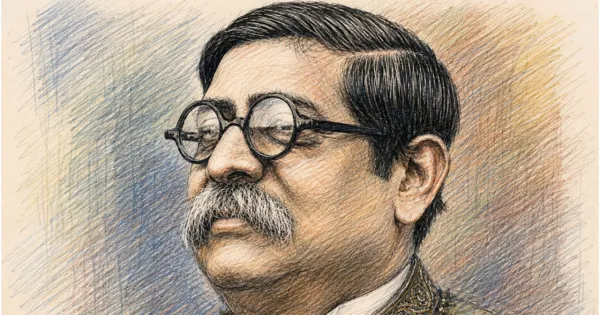
There are some names in the history of Indian modern art without whom the imagination of this history is incomplete, but the irony is that they themselves went to the margins of history. O. C. Ganguly (1881–1974) is one such name. Anand Kumaraswamy, E.B. Like Havell and Percy Brown, he also made an extraordinary contribution in the historiography, documentation and ideological establishment of Indian art, but his name is still almost unknown in the Hindi speaking society. His recognition is limited even among students of art history, although his role in the formation of the initial intellectual framework of modern Indian art was extremely important.
Ordhendra Kumar Ganguly was born in Bengal. He became active at a time when a new national discourse regarding art was emerging in India. On one hand colonial art education was considering European academic realism as ideal, on the other hand E.B. Havell and Abanindranath Tagore were trying to establish an autonomous identity of Indian art. Ganguly developed in this ideological environment. He became famous not as a painter himself, but as an art historian, critic, editor, collector and documenter.
His biggest contribution was to systematically record Indian art. He not only analyzed the artworks aesthetically, but also attempted to critically understand their history, artists, stylistic developments and cultural contexts. His study of Indian miniature painting traditions, especially Mughal, Rajasthani and Pahari painting, gave a new direction to the art discussion of that time. Today, when Indian art history naturally accepts these traditions, it should be remembered that at one time the credit for making them a subject of serious study goes to a few scholars, including O. C. Ganguly was the chief. His second important role was associated with the Indian Society of Oriental Art. In the early decades of the twentieth century, this institution was the major center of the renaissance of Indian art. It was from here that the ideological process of seeing Indian art as different from the colonial point of view was strengthened. Ganguly was not only an active worker of this organization, but he also gave direction to its publications and intellectual activities.
The discussion of his contribution will remain incomplete without mentioning the art magazine 'Rupam'. Rupam was not just a magazine, it was a document for Indian art history. The research articles published in it, introductions of artists, reprints of rare paintings and art discussions provided a serious academic basis to Indian art writing. At a time when the tradition of regular writing on art was still developing, Rupam provided a platform for dialogue between Indian and international scholars.
Ganguly wrote monographs on many artists including Abanindranath Tagore. This was a new genre at that time. He did not just present the artists at the level of biography, but analyzed their artistic philosophy and creative process. Today, monographs on artists seem common, but Ganguly was one of the pioneers in developing this tradition in India. Then the question arises that why is such an important personality almost absent from the memory of the Hindi speaking society?
There are many reasons for this, the first reason being language. Most of Ganguly's writings were in English. His intellectual world was created between Bengal and English language. His books and articles were never systematically translated into Hindi. As a result, his ideas could not reach the Hindi readers.
The second reason is the limited tradition of art writing in Hindi. In the first half of the twentieth century, systematic critical writing on art in the Hindi region was almost non-existent. Occasionally articles on art were published in literary magazines, but the independent discipline of art history and art criticism could not develop. Because of this, the work of scholars like Ganguly could not become a basis for discussion.
The third reason is the regional imbalance of art education. The initial leadership of modern Indian art remained in the hands of Bengal, Bombay and Madras. Art colleges in the Hindi heartland became active relatively late and continued to follow the educational and ideological tradition of Bengal for a long time. The irony is that he adopted that tradition, but did not systematically study its major thinkers.
The fourth reason is institutional forgetfulness. Most art colleges and universities in India did not record their intellectual sources. As a result, art history became limited to only a few famous artists, while the contributions of historians, editors, collectors and art critics gradually disappeared. Ganguly also became a victim of this forgetfulness.
Today, when Indian art history is being re-read, O. C. Ganguly needs to be seen not just as a proponent of the Bengal School, but as one of the founding historians of Indian art history. He laid the intellectual foundation for Indian art, on which many later scholars built their work. If Anand Kumaraswamy brought global intellectual prestige to Indian art, then O. C. Ganguly provided a strong foundation for its documentation, critical study and institutional discourse.
Now the time has come for the Hindi world to re-evaluate its art discussion. It is necessary to re-read not only the artists but also the historians, editors and critics who created the intellectual structure of Indian art. O. Recollecting C. Ganguly would not only be a tribute to a forgotten scholar, but would also re-establish a neglected tradition in Indian art history, without which the story of modern Indian art remains incomplete.
– Suman Kumar Singh