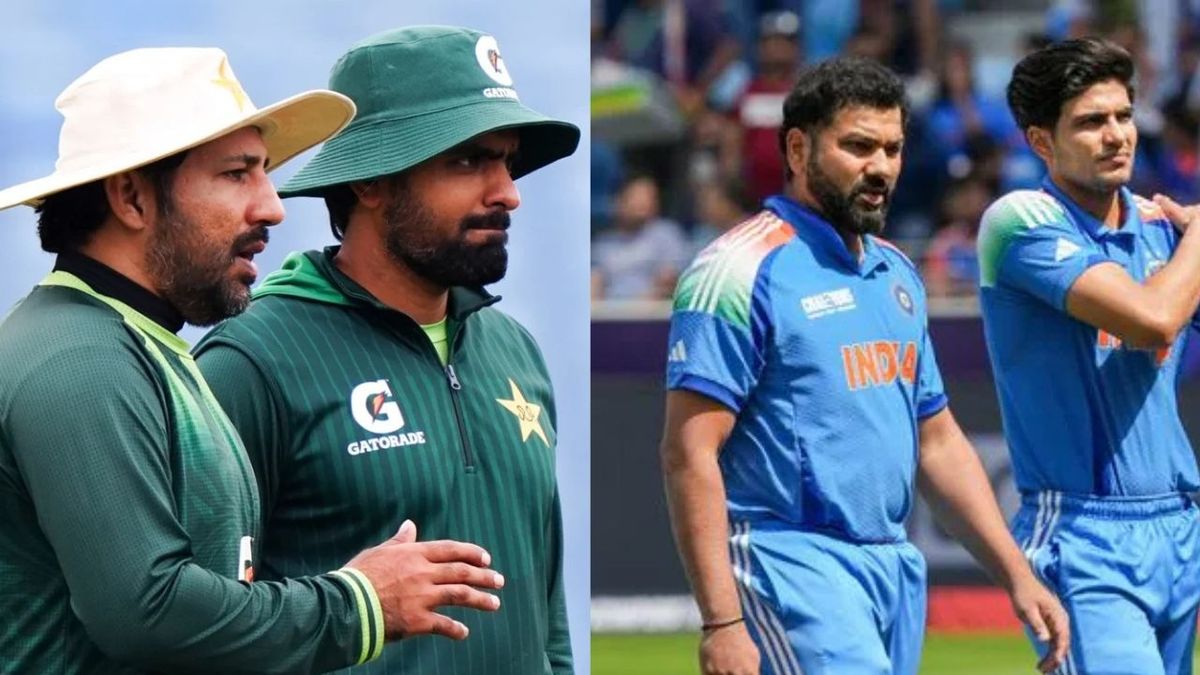
ODI Tri-Series: Pakistan Cricket Board (PCB) has started a new debate in the cricket world by announcing an ODI tri-series with Sri Lanka and England in October 2026. In the last decade, due to the increasing number of bilateral series and decreasing interest of the audience, triangular series had almost disappeared. But as the ICC ODI World Cup 2027 approaches, the importance of this format has started to be understood once again. At the same time, if the Indian team also plays a tri-series with the world's top teams like Australia, South Africa and New Zealand before the ODI World Cup 2027, then how much and how will it benefit for 'Mission 2027'? Let us try to know in this article.
What is the difference between bilateral series and tri-series?
In bilateral series only 2 teams play 3 or 5 consecutive matches. Many times it becomes mentally repetitive for the players. If a team loses the first two matches, then the excitement for both the spectators and the players in the remaining matches is lost. Whereas the tri-series is like a tournament. Here the points table changes after every match. You not only have to win, but you have to win by a big margin. Net run rate matters in this. What happens in a tri-series is that you have to prepare your strategy against not just one but two teams. For example, in one match you play against a spin attack and in the other match you play against a pacer. By playing such tri-series, you will also prepare for the ODI World Cup.
Hosting of World Cup 2027 and benefits of the circumstances
ODI World Cup 2027 is to be jointly hosted by South Africa, Zimbabwe and Namibia. South African pitches are known for their fast pace, bounce and seam movement. If Team India plays a tri-series with Australia (master of pace and bounce), New Zealand (master of swing and seam) and host South Africa just before the ODI World Cup, then India will get many strategic advantages. Indian batsmen are used to playing on the slow and turning pitches of the subcontinent. Playing a tri-series with army nations (South Africa, England, New Zealand and Australia) will give the batsmen enough time to adapt against the pace and bounce.
If India plays the ODI tri-series in South Africa or Australia, then Team India will get a great opportunity to test the nature of the official pitches of the World Cup in advance. Not only this, after playing round-robin matches in the Tri-Series, a final match is played between the top-2 teams. This final match gives pressure to the players just like the knockout match of the World Cup.
🚨 Pakistan is set to host Sri Lanka and England for T20Is, ODI tri-series and Tests in October and November this year. pic.twitter.com/54AuldgiHX
— Cricbuzz (@cricbuzz) August 19, 2026
Finding the Perfect Team Combination and Backup Plan
To win any ICC World Cup, any team must have a strong playing eleven as well as an excellent backup bench strength. In bilateral series, you often do different experiments against weaker teams, due to which the real potential of the team is not known, but when teams like Australia and New Zealand are in front, then the captain and coach will be able to try different combinations. By continuously playing against strong teams, one will also get an idea of which player can perform under pressure and which cannot withstand pressure. This will make it very easy for the selectors to choose the 15-member team for the World Cup.
Busy schedule and workload management
Another big advantage of the Tri-Series is its schedule. There are no consecutive matches in this. If India is playing Australia today, then the next match will be between Australia and New Zealand. With this, Team India will get additional 2-3 days for recovery and practice. The biggest challenge is to keep the players fit before the World Cup. The rotation format of the tri-series can help in managing the workload of senior players (like Jasprit Bumrah or Hardik Pandya). At the same time, when the opposing teams are playing among themselves, then the Indian think-tank can sit in the dugout and watch the live video of their weaknesses and strengths and make an excellent strategy, which can be beneficial in the ODI World Cup 2027.
BCCI may consider organizing tri series
Pakistan's decision to organize a tri-series with Sri Lanka and England is being considered a masterstroke in the direction of preparations for the upcoming ODI World Cup 2027. BCCI may consider organizing a tri-series for the preparations for the ODI World Cup 2027. If Team India plays at least one tri-series before the World Cup 2027, it can prove to be a milestone for India's 'Mission 2027'. This series will not only overcome the technical and mental shortcomings of the Indian team, but will also give back to the cricket fans the old thrill for which the decade of 90s and 2000s were known, because tri-series were played a lot then.
Pakistan-England and Sri Lanka ODI tri series will be of 7 matches
The ODI tri-series between Pakistan, England and Sri Lanka will be played from October 19 to October 31, in which a total of 7 matches will be played. Its 4 matches will be played in Lahore, while 3 matches will be hosted by Rawalpindi. The return of the Tri Series in ODI has filled the cricket fans with excitement.
🚨 ODI TRI-SERIES ARE BACK IN INTERNATIONAL CRICKET:
18 Oct: PAK v SL, Rawalpindi
20 Oct: PAK v ENG, Rawalpindi
22 Oct: SL v ENG, Rawalpindi
25 Oct: PAK v ENG, Lahore
27 Oct: PAK v SL, Lahore
29 Oct: SL v ENG, Lahore
31 Oct: Tri-series final, Lahore pic.twitter.com/SpPXixKnrx—Johns. (@CricCrazyJohns) August 19, 2026
Also read: Despite the defeat against India, captain Dhananjay de Silva made a big record, became the number-1 Sri Lankan player in WTC