
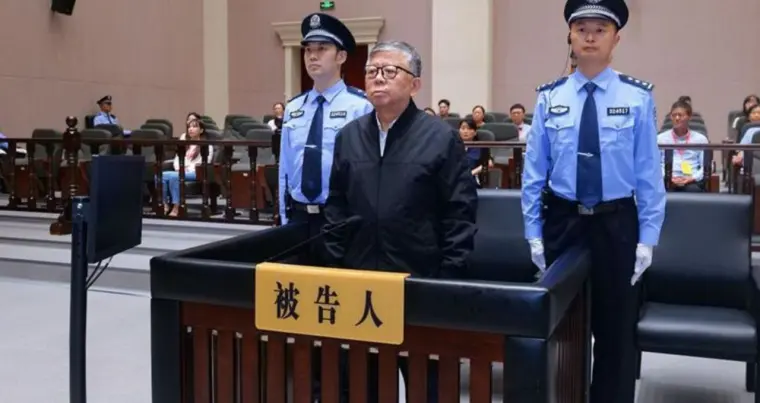

A Chinese court has sentenced former official Yang Yulin to death for bribery, embezzlement and money laundering worth more than 2.2 billion yuan. This decision is considered to be one of the biggest cases of President Xi Jinping’s anti-corruption campaign.
Beijing: A Chinese court has sentenced former senior government official Yang Youlin to death after finding him guilty of taking bribes, embezzlement, money laundering and abuse of office amounting to more than 2.2 billion yuan (about 325 million US dollars) over nearly three decades. This is considered to be one of the biggest corruption cases in China in recent years.
Yang Yulin, 69, served in various administrative and economic development positions in the city of Nanjing in eastern China from 1993 to 2023. The court said that he used his influence and authority to help many people in getting contracts, land transfers and financial clearances for engineering projects and in return accepted huge sums of money and expensive gifts.
The case is part of Chinese President Xi Jinping’s broader anti-corruption campaign, under which action has been taken against thousands of officials, military officers, senior banking sector officials and government employees over the past decade.
The court described the crime as very serious
The Changzhou court said in its decision that Yang Yulin abused his official position for a long time and his crimes caused great harm to the interests of the state and the public. According to the court, apart from taking bribe, serious charges like embezzlement of government funds, money laundering and abuse of power were also proved against him. The court said that the seriousness of the crimes was so great that it was considered appropriate to give them the harshest punishment.
Under Chinese law, the death penalty for economic crimes is imposed in relatively few cases, but courts may impose the death penalty when the bribe amount is exceptionally large and the impact of the crime is widespread.
Alleged misuse of position for three decades
According to state media, Yang Yulin abused his powers for personal gain while holding various administrative posts for nearly 30 years.
He allegedly provided undue benefits to many companies and businessmen in government projects. In return he received large amounts of cash, expensive gifts and other financial benefits. Investigative agencies found that through this entire network he acquired illegal assets worth more than 2.2 billion yuan.
Part of Xi Jinping’s anti-corruption campaign
After President Xi Jinping came to power, the anti-corruption campaign in China has continuously intensified. Under this campaign, action has been taken against many senior leaders at the central and state levels, government officials, army officers and people associated with public sector institutions.
The government says that the aim of this campaign is to increase transparency in administration, strengthen public trust in government institutions and establish strict control on corruption. However, some international analysts and political experts believe that this campaign has also been used many times to weaken political rivals. The Chinese government has consistently rejected these allegations.
Death penalty rare for economic crimes
In China, apart from murder, terrorism and some other serious crimes, there is also a provision for death penalty for major economic crimes. However, in white collar crimes, this punishment is given in very few cases. Usually when the amount of bribery or embezzlement exceeds one billion yuan and the crime has a widespread impact.
In many cases, courts also suspend the death sentence for two years. The sentence can later be commuted to life imprisonment if the convict shows good conduct during that period.
Big cases have come to light earlier also
Yang Yulin’s case has become one of the most talked about corruption cases in China in recent years. In 2021, Lai Xiaomin, the former head of China’s state-owned financial company, was given the death penalty and later hanged after being found guilty of taking bribes worth about 1.8 billion yuan.
Similarly, in 2024, former Inner Mongolia official Li Jianping was given death penalty in the case of corruption and embezzlement of more than three billion yuan. These cases again highlighted the government’s tough policy towards economic crimes in China.
No relief despite cooperation in investigation
The court said Yang Yulin had assisted authorities in some matters during the investigation and had also provided information on other suspects.
Apart from this, he confessed his crimes in the court and also expressed remorse in his final statement. Despite this, the court said that his crimes were so serious that cooperation and remorse could not be considered sufficient grounds for reducing the sentence. This was the reason why the court refused to give him any leniency.
Strict stance on corruption in China
Experts believe that the purpose of continuous strict action in corruption cases in China is to maintain discipline in the government system. In recent years, investigations have also been initiated against several senior officials in banking, defence, energy, real estate and local administration. The government says that corruption is a serious threat to economic development and public trust, hence strict action will continue in such cases.
Discussion at international level also
The death sentence given to Yang Yulin has also become a topic of discussion at the international level. On the one hand, it is being considered an example of the strictness of China’s anti-corruption policy, while on the other hand, human rights organizations have expressed concern over the death penalty for economic crimes. However, China says that its judicial decisions are in accordance with the country’s laws and their purpose is to ensure effective enforcement of the law.

Comments are closed.