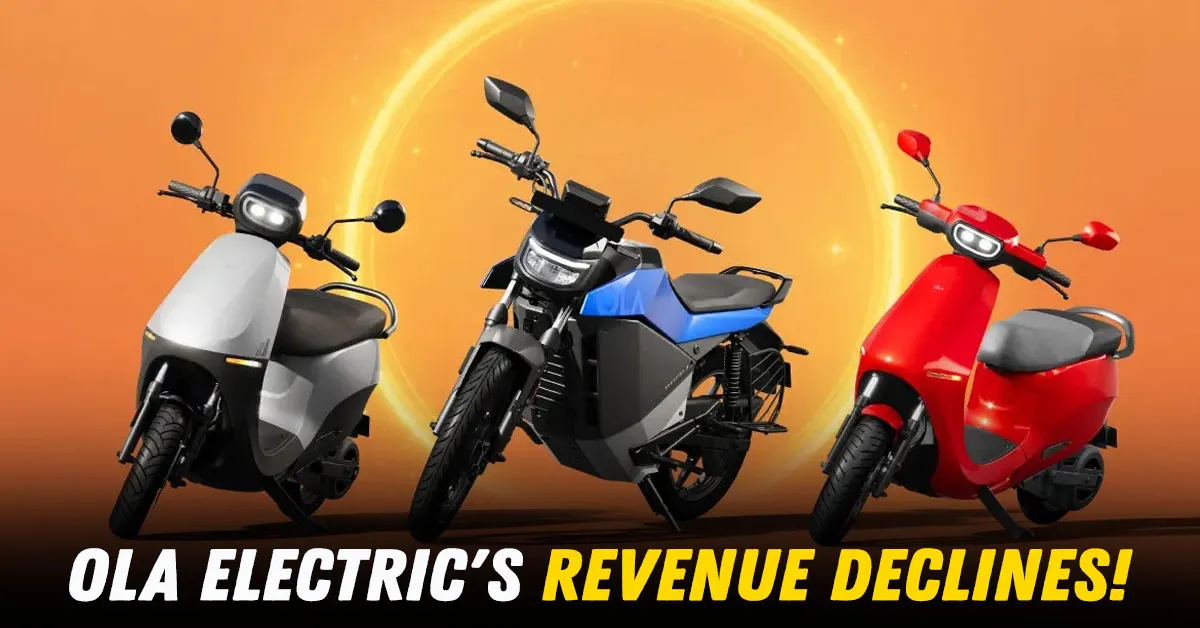
Ola Electric’s latest quarterly results tell an uncomfortable story. The electric two-wheeler market is expanding, but the company that once set the pace is earning substantially less revenue and losing more money relative to its sales. Its management believes a revamped dealer network, higher production and locally made battery cells will help turn things around. For now, the financial numbers show how much ground it has to recover.
In the July–September 2026 quarter, Ola Electric Mobility reported consolidated revenue of Rs 421 crore, down 39% from Rs 690 crore a year earlier. Revenue also slipped from Rs 455 crore in the preceding quarter. Mint described this as the eighth consecutive quarter of year-on-year revenue decline.
The reported net loss narrowed to Rs 362 crore from Rs 418 crore in the same quarter last year. At first glance, that looks encouraging. The catch is that revenue fell much faster than the absolute loss. A smaller net loss alone does not demonstrate a stronger underlying vehicle business.
Ola’s own investor figures put adjusted operating EBITDA at a loss of Rs 246 crore, compared with a loss of Rs 258 crore a year earlier. The adjusted operating EBITDA margin worsened from minus 37.4% to minus 58.5%. In plain English, the operating loss, measured on this basis, became much larger relative to every rupee of revenue. That is the weakness behind the headline about worsening unit economics.
It is important not to confuse this with the cost of building each scooter. Ola reported a consolidated gross margin of approximately 29.9%, down slightly from 30.9% a year earlier. That means the gross margin remained positive before the wider costs of running the business were accounted for. The problem is that sales volume is currently too small to support the company’s operating overhead comfortably.
The contrast with rivals is striking. Ather Energy reported revenue of Rs 1,526 crore for the same quarter and a small net profit of Rs 1.26 crore, against a substantial loss a year earlier. Bajaj has also reported positive operating contributions from its electric two-wheeler operation. TVS, Bajaj, Ather and Hero are all now formidable competitors, with established products, retail channels and service support.
Registration numbers underline the change in market position. Mint, citing Vahan data for 2026, reported 1,22,890 Ola Electric registrations against 2,13,372 for Hero, 3,06,012 for Ather, 4,20,857 for Bajaj and 4,92,424 for TVS. These are registrations rather than the company’s wholesale dispatches, but they show the scale of Ola’s challenge in a market that is not short of demand.
Ola says it is moving away from its company-operated direct-to-consumer stores and towards independently run dealerships. Its November 12 shareholder letter says dealer stores numbered 319 on November 8. The plan is to have about 450 by December and 700 by March 2027. The company has stopped taking orders through its own stores and expects most of those locations to close by December.
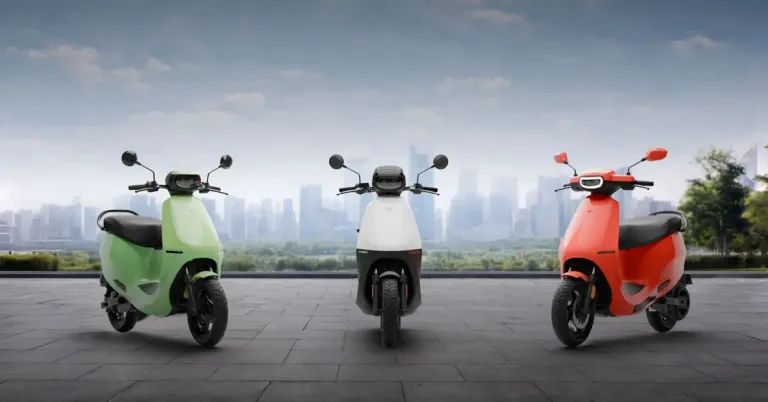
The new channel is already changing the dispatch pattern. Dealer wholesale orders rose from 3,955 in September to 13,505 in October, and Ola is targeting around 20,000 in December. Production, meanwhile, reached 14,092 vehicles in October and is targeted to rise to 25,000 in December. These are management targets, not achieved future sales.
The company argues that demand is ahead of its supply chain’s ability to ramp up. It also says dealer stock is currently around 15 days. That is a possible explanation for the gap between the electric two-wheeler market’s growth and Ola’s weak reported quarter. But the improvement must ultimately show up in consistent registrations, deliveries, service experience and stronger finances.
Ola has commissioned 6 GWh of capacity at its cell facility and plans to put more of those cells into its own vehicles. Local production could eventually reduce reliance on outside suppliers and improve costs, if yields and utilisation develop as planned. But a large factory does not automatically become profitable merely because it has installed capacity.
The company has also strengthened its balance sheet through fundraising. It says total borrowings declined from Rs 3,132 crore in December 2024 to Rs 1,819 crore in September 2026. Lower debt helps, but cash requirements remain significant while the company builds its sales network and increases production.