
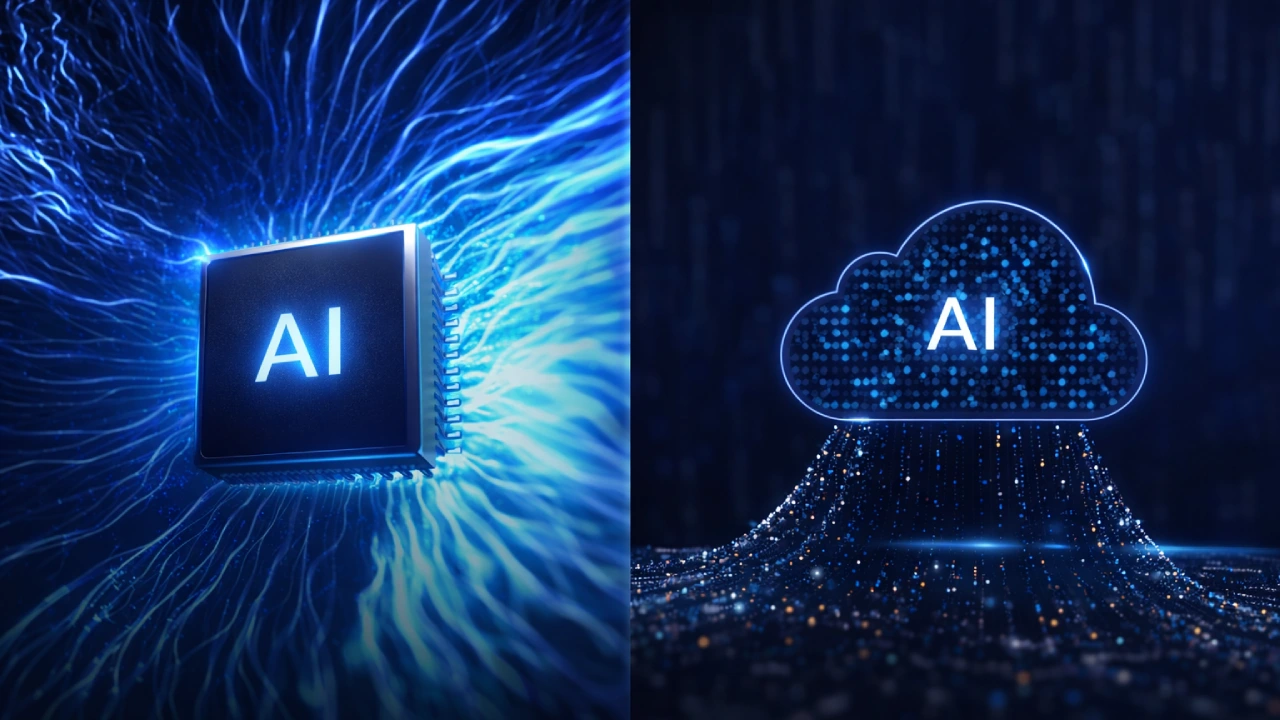

Artificial intelligence is no longer confined to big data centers or futuristic labs. It now fits in people’s pockets. From real-time language translation to smart photo editing and voice assistants, smartphones have turned into powerful AI tools. A significant debate is shaping the future of this technology: which AI features should run on the device and which should run in the cloud?
The difference between on-device AI vs. cloud AI goes beyond technical details; it involves trade-offs in privacy, speed, cost, energy efficiency, and computing power. Companies like Apple, Google, and Samsung are investing more in local AI processing. Meanwhile, cloud service providers like Amazon Web Services are enhancing their AI capabilities. Understanding the strengths of each approach shows how mobile intelligence is developing.
What Is On-Device AI?
On-device AI refers to artificial intelligence models that run on a smartphone or tablet without needing an internet connection. These models use specific hardware components such as neural processing units (NPUs) or AI accelerators found in modern chips. Devices with systems like Apple A17 Pro or Qualcomm Snapdragon 8 Gen 3 can perform complex AI tasks locally.
The main advantage of on-device AI is privacy. When data is processed locally, sensitive information such as voice recordings, facial data, or typing patterns remains on the device. This limits exposure to data breaches and meets stricter data protection laws. For instance, biometric systems like Face ID operate entirely on-device, storing facial maps securely in encrypted hardware rather than sending them to external servers.
Speed is another important benefit. There’s no need to send data to a remote server and wait for a response, which significantly cuts down latency. Features like predictive text, live photo enhancements, and offline translation respond almost instantly. This quick response is vital for real-time tasks like augmented reality filters or live captions during phone calls.
On-device AI also boosts reliability. Users in places with unstable internet can still access basic AI functions. In areas with unreliable mobile networks or expensive data plans, this independence from the cloud is especially important.
The Limits of Local Processing
Despite its advantages, on-device AI has some limits. Smartphones, no matter how advanced, have less processing power, memory, and battery life compared to large data centers. Training large AI models or running demanding generative systems requires computing resources far beyond those of a handheld device.
Large language models like ChatGPT need billions of parameters and significant computing infrastructure. Even optimized “lite” versions of these models cannot achieve the same depth, context, and diversity of training as their cloud-based counterparts.
Battery usage is another challenge. Intensive AI tasks can quickly drain power, especially when generating complex images or performing multi-step reasoning. Thermal limits also restrict how long a smartphone can handle heavy computational tasks without overheating.
While on-device AI excels in fast, narrow, and privacy-sensitive tasks, it struggles with large-scale processing and complex data gathering.
What Is Cloud AI?
Cloud AI refers to artificial intelligence models that run on remote servers managed by tech companies. When a user interacts with a cloud feature, data is sent to these servers, processed, and returned as a response. These data centers are equipped with powerful GPUs and AI accelerators that can handle large workloads at once.

Cloud platforms like Microsoft Azure and Google Cloud offer scalable infrastructure for training and deploying advanced AI models to millions of users. This scale enables continuous improvement, centralized updates, and access to the latest research.
The key strength of cloud AI is its computational scale. Large generative systems, advanced image synthesis, real-time global search integration, and cross-platform personalization all depend on the cloud. When a user makes a complex request that involves analyzing vast data sets, accessing real-time information, or generating creative text, cloud processing becomes essential.
Cloud AI also supports continuous learning. Unlike on-device systems that may need software updates to improve, cloud-based models can be updated centrally and immediately. This allows for rapid innovation and refinement without needing users to upgrade their hardware.
On-device AI vs cloud AI: The Trade-Off: Privacy vs. Scale
The discussion about on-device versus cloud AI often focuses on privacy versus capability. On-device AI reduces data exposure, while cloud AI enhances performance and complexity.
For highly sensitive data like biometric authentication, personal health metrics, or private messages, local processing builds user trust. Companies are increasingly promoting privacy-first approaches, especially in regions with strict regulations. Keeping such data on the device lowers legal risks and boosts consumer confidence.
However, for tasks that require external data sources – such as real-time web searches, collaborative tools, or global mapping services – the cloud is crucial. Cloud AI can combine diverse data sets in ways that isolated local models cannot.
The ideal solution is not an either-or situation but a combination.
The Rise of Hybrid AI Systems
Modern smartphones are increasingly adopting a hybrid AI setup. Simple and sensitive tasks are handled locally, while complex or resource-heavy tasks are sent to the cloud. This method combines the benefits of both systems.

For example, voice assistants may perform wake-word detection on-device to maintain privacy and speed, while forwarding complex queries to cloud servers for deeper analysis. Image enhancement might take place locally, while advanced generative editing relies on remote computing.
Hybrid systems also help optimize battery use. Devices can decide in real time whether a task requires cloud power or can be efficiently managed on-device. This smart routing ensures users get both speed and sophistication.
Which Features Belong on the Phone?
Some AI features clearly work better when processed locally:
- Biometric Authentication: Facial recognition and fingerprint scanning should stay on-device for enhanced security and privacy.
- Predictive Text and Autocorrect: These features benefit from quick responses and offline functionality.
- Live Translation (Basic): Core language processing can run locally without requiring an internet connection.
- Photo Sorting and Tagging: Sensitive personal image libraries are best processed privately.
- Health Monitoring: Fitness and biometric metrics should stay secure within the device ecosystem.
On the other hand, some features depend on the cloud:
- Large-Scale Generative AI: Creative writing, coding help, and advanced reasoning need substantial computing resources.
- Real-Time Global Search: Accessing current events or extensive web knowledge requires server access.
- Collaborative AI Tools: Editing shared documents and cloud-based analytics rely on centralized systems.
- Advanced Image and Video Generation: High-resolution output exceeds the capabilities of mobile hardware.
- Continuous Model Training: Improving AI with large datasets requires cloud infrastructure.
Energy, Cost, and Environmental Implications
Energy efficiency adds another layer to this discussion. Cloud data centers consume a lot of electricity, but spreading AI tasks across millions of devices also raises overall energy use. The focus is not just on what consumes more energy but on where to optimize effectively.
Cloud providers can invest in renewable energy and large-scale cooling systems. However, on-device processing can reduce constant data transmission, potentially lowering network energy consumption. Future AI strategies will likely aim to strike a balance in these environmental factors.

From a cost perspective, on-device AI can lower server expenses for companies but increase the demand for advanced chip manufacturing. Cloud AI shifts costs toward centralized infrastructure but enables cheaper hardware for consumers.
Conclusion: A Balanced Future
The future of mobile AI will not favor only on-device or cloud systems. Instead, it will depend on how intelligence is distributed. Privacy-sensitive, fast, and frequently used features will increasingly shift to local hardware. Meanwhile, large-scale generative capabilities and data-heavy operations will remain in the cloud.
As smartphone processors become more powerful and cloud models improve, the boundaries between the two will continue to blur. The most successful AI systems will incorporate both seamlessly. In doing so, they will redefine intelligence in the palm of a hand.

Comments are closed.