OpenAI first shared GPT-6 Sol on September 22, 2026. It then released GPT-6.1 Sol on September 29, one week later. OpenAI frames GPT-6.1 Sol as a tweak to the Sol line, not as a full swap for GPT-6 Astra.
OpenAI says GPT-6.1 Sol can deliver near-Astra performance for complex coding, computer use, and professional work, but at a lower cost. OpenAI also suggests people test it against Astra on their own workloads, since the quality-versus-cost mix can change from task to task.
OpenAI GPT-6.1 Sol Standard API Rates are the Main Shift
GPT-6.1 Sol keeps the same normal input and output rates as GPT-6 Sol. Its cached input costs less. For prompts up to 272K input tokens, the standard charges are listed as
- $2 per million input tokens
- $0.10 per million cached input tokens
- $2.50 per million cache-write tokens
- $10 per million output tokens
The context limit is bigger than 272K, though. If a request goes past 272K input tokens, pricing jumps. The input and cached input use 2× the earlier rates. The output uses 1.5× the earlier output rate, and the change applies to the whole request.
Fast mode is priced the same way, at 2× Standard pricing.
So the simple “one-fifth” comparison only fits Astra’s normal short-context input and output rates. Astra is listed at $10 per million input tokens and $50 per million output tokens.
With that, GPT-6.1 Sol matches at exactly one-fifth for both lines. Cached input comes out to one-tenth of Astra’s $1-per-million figure. Still, real task costs can vary a lot, since effort and token counts depend on the work.
A 1.05-million-token context limit
OpenAI GPT-6.1 Sol offers a 1.05-million-token context window. It can return up to 128,000 output tokens. OpenAI also says its knowledge cutoff is April 30, 2026.
This bigger window matters more for long coding runs and agent-style work. In those cases, the model may need to juggle large chunks of code, docs, and earlier task notes. At the same time, a large window does not mean every call will cost the same. Higher charges for prompts over 272K tokens are a key point for developers planning to use very large contexts.
Tool use depends on which API you pick. GPT-6.1 Sol can run tools via the Responses API. OpenAI also lets you use the model with Chat Completions. But Chat Completions will not trigger tool calling for GPT-6.1 Sol. This difference is important if you are building an agent. The model’s support for coding, computer actions, and work tasks relies on tool use. So you should match the model with the right API when you build.
Where it shows up in practice
GPT-6.1 Sol is offered through the API. It is also rolling out inside ChatGPT Work and Codex. The rollout starts with Pro users, then moves across supported paid plans. For Enterprise and Edu, an admin may need to enable the model.
GitHub is also rolling it out in stages. It is coming to GitHub Copilot for Pro+, Max, Business, and Enterprise users. GitHub notes that the model will work in supported editors and Copilot views, but access may vary during the rollout. This lets the model reach developer workflows in more than one way, not only through direct API integration.
OSWorld Highlights a Trade-Off in Computer Use
Computer-use results add another angle. In the offline test for OSWorld 2.0, with maximum reasoning, OpenAI lists GPT-6.1 Sol at about seven points above GPT-6 Sol. In the same run, it is about 2.1 points under Astra.
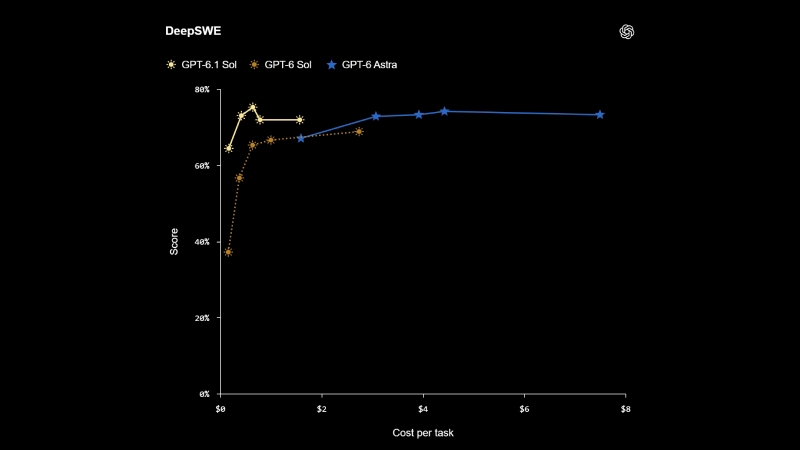
OpenAI also reported benchmark results that include a cost estimate for each task. It says GPT-6.1 Sol runs at roughly one-seventh the cost of Astra for that specific evaluation. This cost figure is a benchmark estimate. It is not a blanket statement about every workload. Overall, the numbers match GPT-6.1 Sol’s goal. It aims for a much lower cost while staying close to Astra on a set of tough tasks.
Final Thoughts
GPT-6.1 Sol is aimed at people building and shipping software, plus other professionals who want strong reasoning but do not want to pay Astra’s usual token rates. For short prompts and short replies, input and output prices are set at one-fifth of Astra’s.
Don’t treat that as a guaranteed one-fifth cut for every job. The real cost depends on more than the rate card. How much reasoning you ask for matters. Token usage matters too. The amount of context you pass in matters. Even how you structure the work changes the total.
This model offers a 1.05 million-token context budget. It also supports coding benchmarks, computer-use outputs, and API tools. As a result, it fits well with software agent workflows.
Still, Astra is the better choice when top performance matters more than cost.