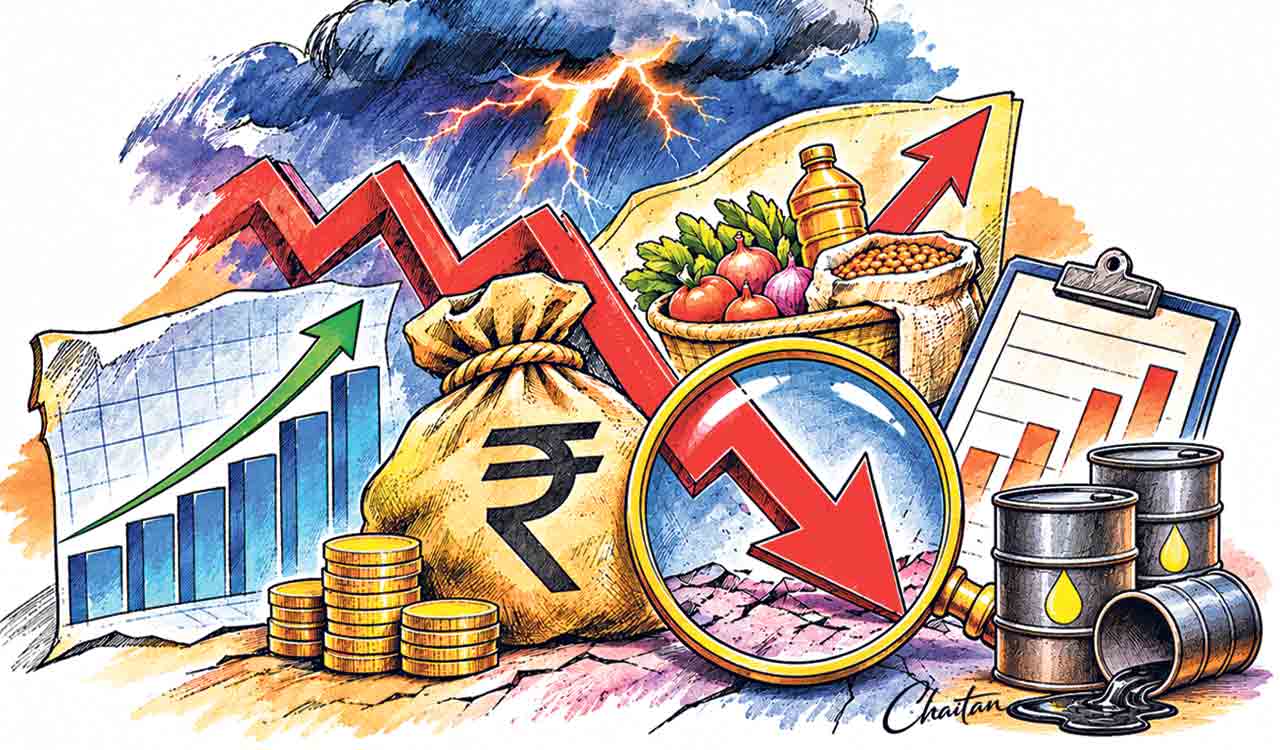
Good policymaking requires not only better predictions but also the ability to respond when they fail, while ensuring economic analysis accounts for decisions and expectations
Published Date – 10 November 2026, 09:57 PM
Illustration: Chaitanya Mulla
By Dr Sushanta Kumar Mahapatra and Dr Madan Meher
Economic forecasts influence government budgets, business investment, and household decisions. They shape expectations about growth, inflation, employment, and tax revenue. Yet forecasts can fail when they are needed most. An energy price shock, changing consumer behaviour, or a production disruption can make projections unreliable. The 2026 Nobel Prize in Economic Sciences offers a lesson: good policymaking requires not only better predictions, but also the capacity to respond when they go wrong.
Robert E Hall and Michael Woodford received the Sveriges Riksbank Prize in Economic Sciences in Memory of Alfred Nobel for their contributions to the “microeconomic foundations of macroeconomic stabilisation”. Their work placed household and firm decisions at the centre of macroeconomic analysis. Rather than treating consumption, investment, and inflation simply as aggregate movements, this approach asks how people choose, how firms set prices, and how expectations shape decisions. It reminds policymakers that the economy’s future path cannot be known with certainty.
Challenging Conventional Thinking
Hall’s contribution challenged conventional thinking about household consumption. Under the permanent-income approach, people base their spending on expected lifetime resources rather than responding mechanically to every change in current income. Hall showed that, under certain assumptions, consumption should change mainly when households receive new information about future resources.
Changes in consumption should, therefore, be difficult to predict from available information. If spending can be systematically forecast from existing information, the model’s assumptions may not fully describe household behaviour. Families with limited savings, unstable earnings, or restricted access to credit may be unable to smooth consumption when income changes. Their spending can respond sharply to a delayed wage payment, job loss, or rise in essential costs.
This matters because forecasting can create an illusion of precision. Projections suggest paths for consumption, tax revenue, or investment. But every forecast depends on assumptions about behaviour, information, prices, policy, and economic conditions. Changes in these assumptions or an unexpected shock can make the original projection less useful. The answer is not to abandon forecasting, which remains essential for planning. Instead, it is to understand its limits, disclose its assumptions, and avoid treating a central estimate as a guarantee.
New Keynesian Framework
Woodford’s New Keynesian framework adds another insight. It connects household demand, inflation, interest rates, and firms’ pricing decisions to explain how the economy responds to policy and shocks. Prices do not always adjust immediately when demand or costs change; firms consider future costs, sales and competitors’ decisions.
Monetary policy, therefore, works through current interest rates and through what households and businesses expect policymakers to do. Communication and credibility are important policy instruments. These models offer an analytical laboratory: what might happen if interest rates fall, demand weakens, or imported energy becomes more expensive? They help compare outcomes, but cannot predict the future with certainty.
For India, this distinction matters in fiscal planning. Revenue depends on activity, consumption, profits, imports, and tax compliance, while spending commitments are made before final outcomes are known. If budgets rely too heavily on one optimistic growth projection, a slowdown can create revenue shortfalls and force choices between protecting essential spending and containing the fiscal deficit. Excessive pessimism also has costs: it can delay public services, maintenance, and investment in productive infrastructure. A credible budget must balance fiscal discipline with the capacity to absorb shocks.
The lesson is particularly relevant for Telangana, where decisions on urban infrastructure, transport, water supply, public services, and skills development involve long planning horizons. Investments cannot wait for uncertainty to disappear. But their design, sequencing, and financing should account for different conditions. A transport project may face higher construction costs, delays, or lower demand, while a water or public health service may experience demand above estimates as cities expand.
Projects that remain useful under slower revenue growth, changing demand, or higher costs are more resilient than those dependent on every assumption proving correct. This requires realistic cost estimates and attention to operating and maintenance expenses, not just initial capital outlay.
Economic governance should not be judged solely by the accuracy of forecasts, but by how effectively institutions adapt to changing assumptions, explain their decisions and respond when reality takes a different turn
Scenario planning can make this approach practical. Rather than relying exclusively on a baseline projection, governments can examine alternatives: What if revenues grow more slowly? What if borrowing or construction costs rise? What if demand for a public service exceeds expectations? Which spending can be postponed, and which commitments must be protected?
Governments can identify priority expenditure, make contingency provisions, and decide what information would trigger changes in allocations. These exercises expose vulnerabilities before pressures become emergencies. Some risks are difficult to assign reliable probabilities, particularly when shocks are unprecedented. Plans should also be stress-tested against severe but plausible conditions.
Social Protection
The principle also applies to social protection. Hall’s research highlights household decisions, while income security and access to credit shape families’ ability to respond to shocks. Families with savings can absorb a temporary income loss more easily than those living from one wage payment to the next. Aggregate indicators can conceal this inequality.
Planning, therefore, requires timely information about employment, wages, consumption and household finances alongside data on growth and inflation. During a downturn, targeted support can prevent a temporary income shock from becoming a longer-lasting setback in nutrition, education, or productive capacity.
There is an institutional lesson. A forecast should be a guide that can be revised, not a promise defended regardless of new evidence. Governments and central banks should explain their assumptions, monitor incoming information, and communicate why decisions change. Budget documents can set out alternative scenarios and identify programmes that should be protected under pressure.
Updating revenue estimates and project costs strengthens accountability when revisions are clearly explained. Changing a decision in response to credible evidence is not necessarily a policy failure; refusing to revise it can be more costly.
The 2026 Nobel Prize does not suggest that forecasting is futile or that models can eliminate uncertainty. It shows why economic analysis must examine decisions and expectations. The task is to combine forecasts with scenario planning, build flexibility into public finance, and protect essential investments when conditions deteriorate.
Economic governance should not be judged solely by whether a projection proves correct, but also by whether institutions recognise changing assumptions, explain their choices, and make sound decisions when reality takes a different turn.
(Dr Sushanta Kumar Mahapatra teaches Economics at the ICFAI School of Social Sciences, IFHE, Hyderabad. Dr Madan Meher teaches Economics at Amity Business School, Amity University Chhattisgarh, Raipur)