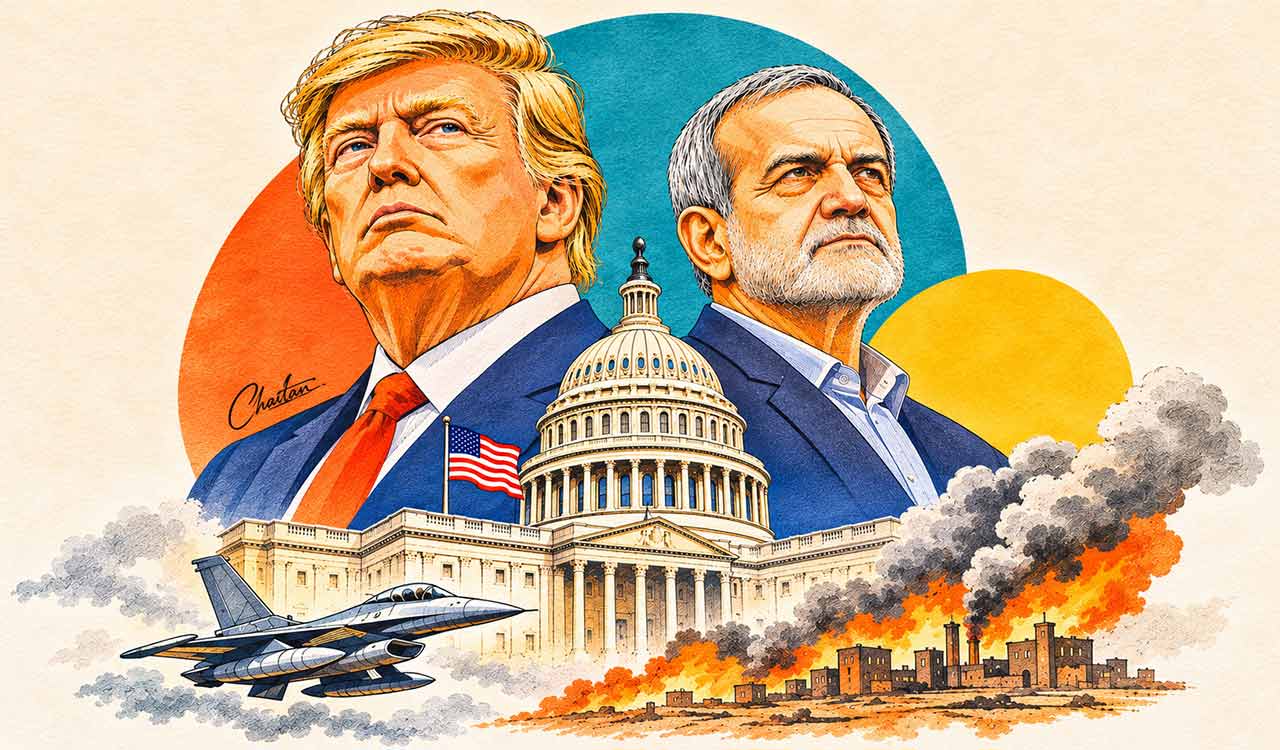
Congress can challenge Trump’s war powers through funding and oversight, but constitutional hurdles and presidential resistance could thwart efforts to end the Iran war
Published Date – 23 November 2026, 11:13 PM
Illustration: Chaitanya Mulla
By Brig Advitya Madan
The political battle over the Iran war in Washington is increasingly shifting from the battlefield to Capitol Hill. Yet, removing Defence Secretary Pete Hegseth and ending the war are two very different propositions. The former may become politically easier as Democrats prepare to take control of Congress in January 2027; the latter will require overcoming constitutional constraints, presidential resistance and divisions within both parties. For now, President Donald Trump retains considerable room to continue the conflict, even as its political costs mount.
Hegseth has become a controversial figure, not least over his decisions concerning senior women officers and his questioning of women’s roles in the armed forces. Republican Congressman Thomas Massie sought his impeachmentaccusing him of initiating an unlawful war, disregarding congressional demands for withdrawal, and showing insufficient regard for civilian casualties.
The resolution also cited American military actions in Yemen and Venezuela, besides strikes on suspected drug-smuggling vessels. However, on November 10, the Republican-led House voted 211-204 to refer the impeachment resolution to the Judiciary Committee, effectively killing the initiative. Eleven Democrats were absent, and only Massie broke with the Republican leadership. Hegseth survived, but the narrow margin offered little indication of broad political confidence in his stewardship.
Reviving Impeachment
The political arithmetic could change in January, when Democrats assume control of both chambers following their strong performance in the November 3 midterm elections. They may revive impeachment proceedings against Hegseth, but removal would remain difficult. Even if the House impeaches him, conviction in the Senate requires a two-thirds majority.
That would necessitate substantial Republican support, an unlikely prospect unless the political costs of defending the Defence Secretary rise considerably. Some Republicans may therefore prefer that the White House replace Hegseth rather than let the controversy deepen. Yet, a change of Defence Secretary would not, by itself, bring the Iran war to an end.
The 2007 Iraq precedent shows how President Bush vetoed congressional efforts to impose a timetable for withdrawing American troops
The more consequential instrument available to Congress is its constitutional authority over the use of military force and public expenditure. The War Powers Resolution of 1973, enacted amid the domestic discontent generated by the Vietnam War, requires the President to terminate the use of American forces within 60 days of notifying Congress of hostilities, unless Congress authorises their continuation. An additional 30 days may be allowed where necessary for the safe withdrawal of troops. Its practical effectiveness, however, depends on congressional willingness to challenge the President and the legal circumstances surrounding the military operation.
Restricting Military Operations
Democrats are likely to explore this avenue after January. However, a resolution seeking to restrict military operations could face a presidential veto, requiring a two-thirds majority in both chambers to override it. The September congressional attempt to constrain the war did not succeed. Consequently, the more practical instrument may be Congress’ power of the purse. Without appropriations, the executive cannot sustain military operations indefinitely, although Congress would have to frame any funding restrictions carefully to avoid undermining the safety of deployed American personnel.
This leverage could become particularly relevant during negotiations over government funding. The existing continuing resolution, which keeps federal agencies operating at current funding levels, expires on December 11. Congress must pass full-year appropriations or another temporary measure to prevent a government shutdown. The National Defense Authorization Act, which sets Pentagon policy and authorises defence programmes and military pay, is also part of the legislative negotiations.
Democrats could use these discussions to seek conditions on further funding for the Iran campaign. However, a continuing resolution merely extends existing spending arrangements; it does not automatically restrict military operations. Any attempt to make continued funding conditional on ending the war would require explicit legislative provisions and sufficient political support.
The economic consequences strengthen the case for congressional scrutiny. The war is imposing substantial additional costs on an already stretched American fiscal position. Yet, budgetary uncertainty and funding delays do not hurt politicians alone. Military personnel deployed in the conflict and ordinary citizens dependent on public services are among those who bear the consequences. Democrats themselves acknowledge that their ability to control military expenditure will remain limited until they assume congressional power in January, and even then, exercising that authority will not be straightforward.
Instructive Precedent
There is an instructive precedent. In 2007, when Democrats controlled both chambers of Congress, they sought to compel President George W Bush to withdraw American troops from Iraq by attaching withdrawal provisions to a supplementary military funding Bill. Bush vetoed the legislation. Unable to override the veto, Congress subsequently passed a revised funding measure without the withdrawal timetable. The episode demonstrated that control of Congress does not necessarily translate into control of military policy when the President is determined to resist.
Some Democrats may nevertheless hope that growing Republican fatigue with the Iran was will produce bipartisan support for a negotiated exit. The recent near-unanimity among Republicans in shielding Hegseth from impeachment offers little encouragement. Moreover, while Iran continues to threaten commercial shipping and disrupt energy flows, the conflict carries consequences far beyond Washington.
For India, the central concern is not whether Hegseth survives impeachment, but how long the United States remains engaged in a war that threatens energy security, maritime commerce and regional stability. Congressional pressure may constrain Trump’s freedom of action, but neither a change in political leadership nor a funding confrontation guarantees a swift end to hostilities.
India’s strategic interests, therefore, require close attention to both Washington’s domestic political calculations and the evolving security situation in the Gulf. The eventual end of this war will depend not merely on who controls Congress but on whether political pressure can be translated into a credible diplomatic and military exit.

(The author commanded 15 Punjab in Lebanon under the United Nations Flag, commanded 27 Sector as DIG in Churachandpur, and was Brigadier, Operational Logistics in HQ Western Command. He is currently an analyst on geopolitics, international and defence affairs)