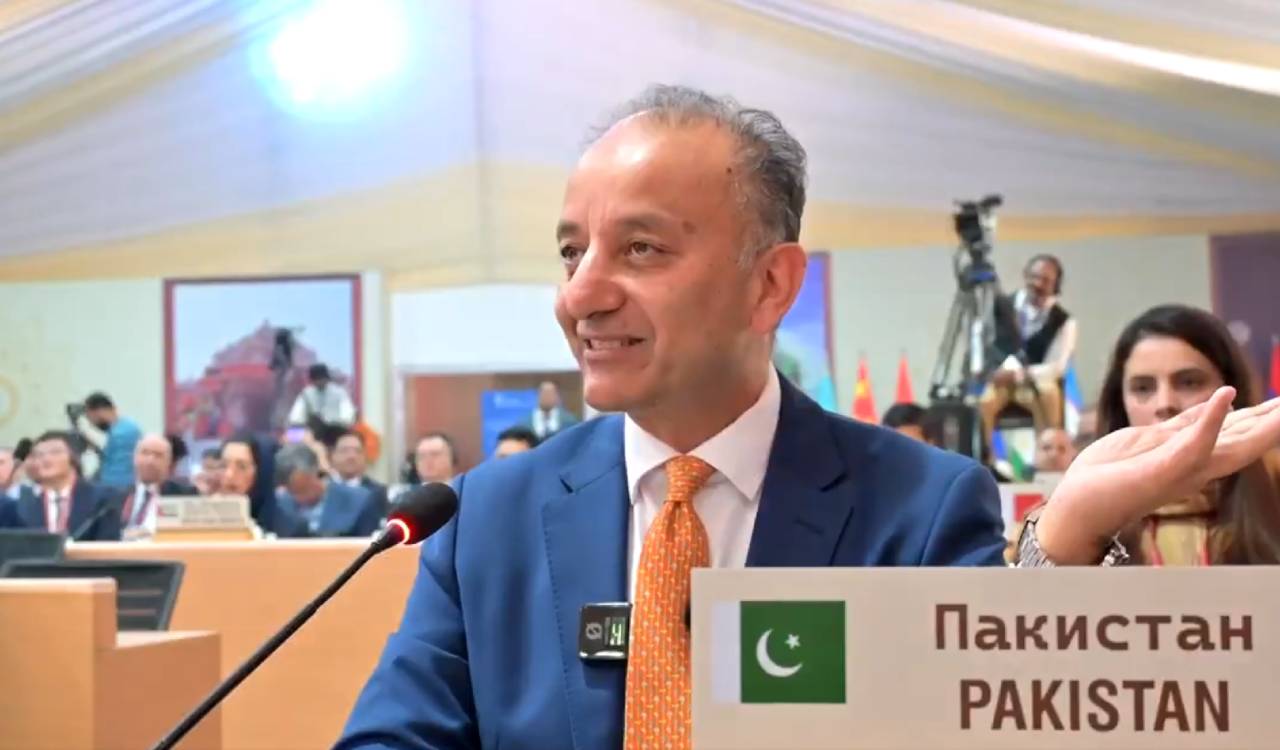
Pakistan Minister Musadik Malik, speaking at the SCO Civilisational Dialogue Forum in New Delhi’s Purana Quila, highlighted the monument as a symbol of layered history, citing its links to Mughal emperor Humayun and Afghan ruler Sher Shah Suri. Emphasising dialogue among diverse identities and civilisations, Malik said the historic fort reflects coexistence and the exchange of ideas.
Published Date – 22 November 2026, 12:55 AM
New Delhi: Pakistan Minister Musadik Malik in his address at the SCO Civilisational Dialogue Forum here invoked Mughal Emperor Humayun and Sher Shah Suri, both associated with the construction of the Purana Quila, and said the old fortress is in itself a story of multiple layers of history.
India is hosting the three-day civilisational summit at the historic precinct of the Purana Quila, which was inaugurated on Friday evening by Prime Minister Narendra Modi in the presence of various SCO delegates, including Malik from Pakistan.
“This (Purana) Quila, where we are sitting, is in itself a story. A fort, whose foundation was laid by Humayun, who had a descent from the Timurid (dynasty) linkage.. came from Central Asia. And, Sher Shah Suri further built on it, who was an Afghan. One wall, two rivals, meaning two rulers and one fort, meaning two layers and one trench,” the Pakistan minister said.
Malik’s office posted a video of his remarks on his X handle and also wrote in Urdu that this Quila is a “story”.
Humayun was the second Mughal emperor, whose final resting place — the famed Humayun’s Tomb — a UNESCO World Heritage Site in the Nizamuddin area is located not far from the Purana Quila.
The tomb is the first garden-tomb on the Indian subcontinent and marked a major departure from earlier funerary traditions. It is a pioneering example of Indo-Islamic architecture and a proud representation of India’s heritage, according to the website of the culture ministry.
Amid unease in India-Pakistan ties since the 2025 Pahalgam attack, the minister is visiting India for the first time.
In his remarks delivered at the thematic session ‘Civilisational and Cultural Expressions’, chaired by Union Culture Minister Gajendra Singh Shekhawat, he also said, “dialogue is between distinct identities, and between diversity, and we have come here for that dialogue only”.
“Meaning, many voices, many identities, and their dialogues, and free flow of ideas, among them… free flow of identities. The wisdom lies in it, the wisdom lies in embracing it, embellishing it. So, wisdom is there in it, and needs courage too. And, we have gathered here to celebrate these two things,” Malik said, without elaborating.
India is hosting the SCO forum at the Purana Quila — a centrally protected monument in the heart of Delhi — to showcase the richness of its civilisational wealth and the multiple layers of history spanning thousands of years.
As part of the Forum, a special site exhibition, titled ‘Astitva — The Essence of our Existence’, offers SCO delegates an immersive account of Delhi’s history through archaeological evidence dating from 1,200 BC to 1200 CE, including excavated remains, artefacts, architectural fragments and other significant discoveries.
Reflecting on the historic setting of the Purana Qila, the prime minister, in his address on Friday, described it as an “extraordinary heritage”. He said the historic fort is as captivating as the fascinating tales associated with it.
According to scholars, he said, the history of this fort dates back thousands of years to the Mahabharata era.
Malik said delegates have been invited to celebrate the diversity of civilisations.
“This is what you described as ‘tehzeeb ki guftagu’, as in dialogue of civilisations,” he said.
In Greek etymology of the word dialogue, ‘dia’ means through, and ‘logos’ means ideas, the minister said.
“So, what is dialogue, (it is) free flow of meaning through us across civilisations. So, this is dialogue. And to carry out a dialogue, we need distinct identities. Dialogue happens between diversity.. the instance that I gave of the (Purana) Quila,” he underlined.
“And, the way Shekhawat sahab, you cited the examples of the layers, which have existed here for thousands of years,” Malik said, referring to the archaeological evidences at the Quila site.
Built on the site of the most ancient of the numerous cities of Delhi, Indraprastha, the Purana Quila is roughly rectangular in shape, with a circuit of nearly two kilometres, reads a description on the website of Delhi Tourism.
The massive gateway and the walls of the Purana Quila were built by Mughal Emperor Humayun and the foundation was laid for the new capital, Dinpanah. The work was carried forward by Sher Shah Suri, who displaced Humayun, it reads.
The three-day event is being hosted by the Ministry of Culture and the Ministry of External Affairs from November 20-22.
On Friday, Malik had said that he had come to Delhi for discussions in the “multilateral context”, even as he had emphasised that culture has a very key role to play in fostering dialogue between the two sides.
On the sidelines of the SCO Civilisational Dialogue Forum, when reporters had asked Pakistan’s Climate Change Minister Malik if the ongoing forum would lead to improvement in bilateral ties between India and Pakistan, he said, “Everything here is happening in a multilateral context. We have also come here for multilateral discussions.”