
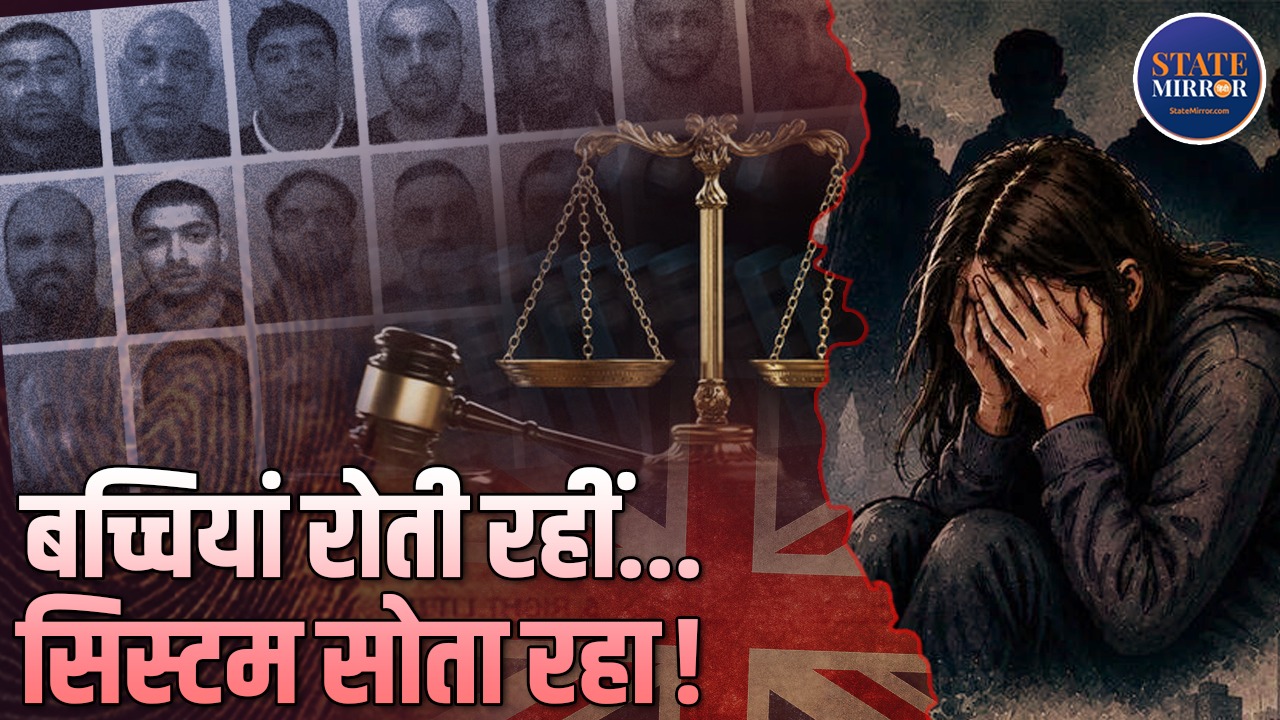
Grooming Gangs: Who was saving the brutes? The story of the dark truth of Britain, which ‘exposed’ the system

Grooming Gangs: A truth about Britain, which has exposed the darkness behind Britain’s shining image to the world. For decades, many girls lived in fear, intimidation and silence, while the very institutions that were responsible for their safety began to be questioned. The grooming gang scandal put not just the criminals in the dock, but the functioning of the entire system.
Investigations triggered by cases like Rotherham revealed how minor girls remained victims of exploitation for a long time. Now the big estimates and new reports have once again raised the same question – how did all this go on for so many years and whose silence gave strength to the criminals?
This is why the issue of grooming gangs is still counted among the most controversial social and political issues in Britain. This matter was not limited to criminals only. Investigations revealed that at many places the police, local administration, child protection agencies and other institutions failed to respond in time. Instead of providing protection and assistance to many victims, their complaints were ignored.
Grooming gang scandal: The dark truth of the system’s silence
At present, the cases of grooming gangs (sexual exploitation gangs) that have been going on for decades in Britain have shaken the entire country. According to estimates, the number of girls and women who have become victims of these gangs is said to be more than 2.5 lakh. This issue came into focus again after the recent The Rape Gang Inquiry Report, in which questions were raised on institutional failures in cases of child sexual abuse.
The layers of this entire matter were revealed after cases like Rotherham and investigations like Operation Stovewood. Alexis Jay’s report mentioned the exploitation of about 1,400 children in Rotherham. Many victims were very young. However, the figure of 2.5 lakh is based on estimates and the actual number is still under debate.
What is grooming?
Grooming is a process in which criminals gradually take children or vulnerable teenagers under their influence. It often starts with gaining trust. By giving gifts, emotional support, money, false relationships or assurances of security. After this the victims are exploited. In Britain, the term “grooming gangs” was used to describe organized groups who were accused of targeting underage girls and sexually exploiting them over a long period of time. There were investigations, trials and punishments in many cases.
How did the issue become a matter of national debate?
This controversy gave rise to many big questions simultaneously. On one hand there was the issue of safety of children, on the other hand there was accountability of government institutions. Along with this, debates regarding ethnic identity, migration and multicultural society were also added. Over time the question became whether some institutions were holding back from taking tough decisions to avoid social and political controversy?
Why were the voices of the victims not heard?
A report published in 2025 led by Baroness Louise Casey examined group-based child sexual abuse. The report said that various institutions failed to protect children for several decades. Many victimized girls were treated as “critical cases” rather than treated as children in need of help. Their complaints were not taken seriously. The report called it not just the fault of any one department but the result of institutional failures.
Why did the issue of racial identity come into controversy?
One of the most sensitive aspects in the grooming gang controversy was the question related to the identity and data of the suspects. The Casey report said that data related to ethnic identity was not available in a large number of cases, making it difficult to build a clear picture of the entire country. Records from some local areas showed a higher presence of some groups, but the report also said it could be dangerous to draw broad conclusions based on incomplete data.
Did fear of racism stop action?
This question is most discussed in Britain. Some officials and critics said that in some cases there was hesitation in raising questions related to ethnic identity. They feared that they might be accused of discrimination or that tension between communities might increase. But experts say the full picture was more complex than that. Institutional weakness, wrong priorities, lack of coordination between agencies and prejudice against victims were also major reasons.
Were only ethnic reasons responsible?
Many investigations showed that the social background of the victims was related to poor economic status, unstable families or social support systems. In some cases, officials made a mistake in assessing their risk. The criminals benefited from this for a long time.
Key recommendations of the KC report
- Better monitoring of child abuse cases
- Strong coordination between police and social services
- recording correct data
- Re-review of old cases
- Strengthening child protection systems
- The report indicated that official figures do not show the full picture of the problem.
Grooming Gang and “Love Jihad”
Both the words were used together many times during the debate, but both are related to different contexts. Grooming gangs relate to organized child sexual exploitation cases investigated in Britain. Whereas “Love Jihad” is a controversial socio-political term used in India, about which different claims are made. It is important to differentiate between individual crimes and an organized conspiracy.
Why question media and intellectuals?
After this case, some critics said that the media and experts did not discuss uncomfortable questions enough. On the other hand, many people argued that solid evidence and balanced investigation are necessary before reaching any conclusion. This debate continues even today in Britain.
What lesson for the world?
Britain’s experience shows that major crimes often escalate not because information is not available, but because different institutions are unable to connect the signals received in time. When institutions try to save their image, avoid controversy or avoid responsibility, the weak suffer the most.
Child safety is the biggest responsibility of any society. Criminals should be punished, but investigation should always be based on evidence and an entire community cannot be judged on the basis of a few criminals. The biggest lesson of the grooming gang controversy is this – the real test of democracy comes when it has to face inconvenient truths.
What should India learn?
The biggest lesson for India from Britain’s grooming gang case is that the safety of children is ensured not only by making laws but by implementing them honestly. In such crimes, ignoring the initial complaints, suppressing the voice of the victims or weakening the investigation due to political-social pressure can become a big tragedy in the future. India needs to create a strong child protection system, speedy investigation, sensitive policing and an environment of trust for victims. The most important thing is that the criminal should not be identified on the basis of religion, caste or community, but on the basis of crime. The safety of children should be above every debate.
British grooming gang scandal: complete timeline
1980s–1990s: early signs, but no action
Complaints of sexual exploitation of teenage girls began to surface in many industrial cities of England (Rotherham, Rochdale, Oldham, Bradford and Telford). Some social workers and police officers indicated that girls from weaker social and economic backgrounds were being systematically targeted. But in many cases the victims were viewed as “difficult teenagers” rather than at-risk children. Early warnings remained scattered and no major institutional action was taken.
1997–2003: Increase in complaints and system lapses
The number of complaints increased in Rotherham and surrounding areas. Many victims said that they were lured into the trap of criminals through money, alcohol, drugs, gifts and false relationships. Complaints reached the local administration and security agencies, but comprehensive and coordinated action could not be taken. Later investigations revealed that a large number of children became victims of exploitation during this period.
2004-2009: Danger signs become clear
During this period, police and child protection agencies started getting indications of organized exploitation networks. Some local investigations revealed that many criminals were working in groups. Despite this, critics said that the institutions underestimated the seriousness of the problem and did not intervene effectively in time.
2010: Rochdale case opens national issue
Allegations of exploitation of underage girls in Rochdale, Greater Manchester, attracted national attention for the first time. This case raised the question as to how the crime continued for so long and why no action was taken on the complaints of the victims.
2012: Rochdale trial and big reveal
Nine men were convicted of organized child sexual abuse charges in the Rochdale case. It was revealed in the court proceedings that many victims were exploited by luring and pressurizing them for a long time. After this decision the debate intensified throughout Britain.
2013: System of questions on failures
Separate independent reviews raised questions about the role of police and social services. An investigation began into whether officials refrained from taking timely action due to social tension, political pressure or sensitive issues.
2014: Rotherham report created a stir
An independent report by Professor Alexis Jay came out, which exposed serious shortcomings of Rotherham Council and associated bodies. The report estimated that approximately 1,400 children were affected by exploitation between 1997 and 2013. This report became one of the biggest criticisms of the child protection system in Britain.
2015: Government intervention
Special monitoring arrangements were implemented in Rotherham Council. Responsibility was fixed on many senior officers and some left their posts. The government started taking steps to improve the child protection system.
2015-2017: Cases reported from other cities also
After Rotherham and Rochdale, cases of organized child abuse also came to light in Oxford, Newcastle, Telford and other areas. This made it clear that the problem was not limited to any one city.
2017: IICSA investigation initiated
The “Independent Inquiry into Child Sexual Abuse” (IICSA) launched a national review into child abuse cases in the UK. The role of police, local administration, institutions and other organizations was examined in the investigation.
2018: Telford controversy
The Telford cases again raised questions about whether local authorities ignored warnings for too long. After media reports, the debate on administrative accountability intensified.
2020–2022: Debate on identity and accountability
During this period the discussion was not limited to crime only. Questions arose whether some institutions avoided taking action openly on some issues due to caste and community sensitivities. At the same time, many experts said that it is necessary to keep the investigation based on evidence and no entire community can be held responsible for crimes.
2022: IICSA final report
- The national inquiry concluded that major reforms were needed in the child protection system.
- The report recommended better assistance to victims, stronger monitoring and institutional accountability.
- January 2025: The issue returns to national politics again
- The issue of grooming gangs once again came to the center of British politics and public debate.
- Victim groups and many leaders demanded re-investigation of old cases and a comprehensive national review.
June 2025: Casey Report
- Baroness Louise Casey’s “Group-Based Child Sexual Exploitation and Abuse” report again focused on institutional failures.
- The report said that mistakes continued to be made at many levels for a long time. In many cases, data recording was weak and the needs of victims were not given adequate consideration.
- There was discussion about the ethnic identity of the suspects in the data from some areas, but the report called for better data and cautious conclusions.
2025-2026: New investigations and old questions
The debate continues even today. The issue is no longer limited to criminals only, but has spread to policing, government accountability, data transparency, child protection policy and challenges of multicultural society. The biggest lesson of the British grooming gang controversy is that it is often the most vulnerable who pay the price for ignoring early warnings.

Comments are closed.