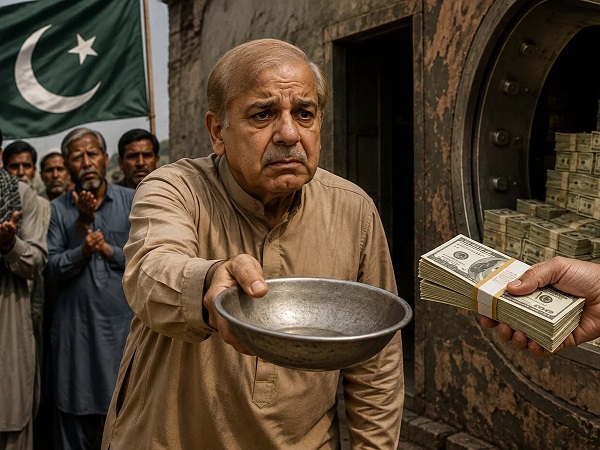
Islamabad. As the medicine was given, the disease increased. This saying fits completely with the economic situation of Pakistan. Pakistan, which has been struggling with economic crisis and debt burden for a long time, is continuously getting foreign aid and bailout packages. Despite this, his financial health is not improving as expected. The World Bank's 'International Debt Report 2026' has presented a worrying picture of Pakistan's increasing external debt. According to the report, Pakistan's foreign debt has almost doubled in the last 10 years. Meanwhile, China has emerged as its largest bilateral lender.
According to the report, the total foreign debt of Pakistan in the year 2015 was $68.7 billion. This figure will increase to $129.9 billion in 2024 and reach $135.1 billion in 2025, an increase of about 4 percent. That means Pakistan's foreign debt has increased by about 97 percent in a decade. Amidst the economic crisis, this increasing debt burden has become a big challenge for Pakistan. The question is, why are the big countries and international financial institutions of the world continuously giving loans to Pakistan which is facing economic crisis?
Mountain of debt and increasing burden of interest
According to the World Bank report, out of Pakistan's total foreign debt of $135.1 billion, $107.1 billion falls in the category of public and publicly guaranteed debt. Of this, about $57 billion is the share of multilateral institutions and more than $42 billion is the share of bilateral lenders.
Pakistan's economic condition can be gauged from the fact that in 2025, it will have to spend about 33 percent of its total export earnings in repaying foreign loans and its interest. At the same time, the country's total foreign debt has reached approximately 34 percent of the gross national income (GNI). Due to this, the pressure on Pakistan's economy is continuously increasing.
What is the strategy behind China's kindness?
China is Pakistan's largest bilateral lender. Pakistan owes a debt of about $22.4 billion to China. After this, the World Bank has a loan of $19.2 billion and the Asian Development Bank has a loan of $16.83 billion.
A major means of economic assistance to China is the China-Pakistan Economic Corridor (CPEC). It is part of Beijing's ambitious Belt and Road Initiative. Under this, an investment of about $62 billion was planned for the development of infrastructure, energy and transportation projects in Pakistan.
According to Sushant Sarin, senior fellow of Observer Research Foundation (ORF) and expert on Pakistan affairs, China's repeated financial assistance to Pakistan and extending the period of repayment of old loans is not just an economic decision. Strategic interests of both the countries are also behind this. Through CPEC, China wants to maintain its economic and strategic influence in Pakistan.
IMF help and America's role
Pakistan became a member of the International Monetary Fund (IMF) in the year 1950. Since then, he has resorted to financial assistance and bailout programs about 24 times. Recently in October, the IMF agreed to release another installment of $1.21 billion to Pakistan under its existing program.
According to former IMF Chief Economist Geeta Gopinath, the objective of the organization is to provide financial assistance to member countries facing economic crisis. However, economic conditions as well as political and strategic interests of member countries can influence IMF decisions.
The Times of India report quoted Sushant Sarin as saying that America's stake in the IMF is about 16 to 17 percent. More than 15 percent voting power is needed to stop important decisions. In such a situation, America's role becomes important in terms of economic assistance to Pakistan. On the other hand, India's voting share is a little over two percent, which is not enough to stop such decisions.
New loan being taken to repay old loan
The vicious cycle of debt is continuously deepening in Pakistan's economy. The situation is that a large part of the new loan is being spent in repayment of principal and interest of the old loan. In fiscal year 2026, Pakistan took a new foreign loan of $ 16.16 billion. Of this, $14.44 billion was spent in repayment of old loans. This included $11.20 billion principal and $3.24 billion interest.
Government data is showing signs of economic growth and improvement in foreign exchange reserves. The economic growth rate is estimated to be 3.7 percent in fiscal year 2026 and 3.8 percent in fiscal year 2027. At the same time, by September 2025, Pakistan's foreign exchange reserves were said to be 21.5 billion dollars. However, despite these figures, loan repayment and raising foreign exchange remain a big challenge for Pakistan.
People struggling with poverty, unemployment and inflation
Pakistan's economic crisis is not limited to government debt alone. Its direct impact is also on the lives of common people. According to available data, the poverty rate in the country has increased from about 22 percent in 2018-19 to about 29 percent in 2024-25. About seven crore people are living in poverty.
The employment crisis is also becoming serious. Every year about 35 lakh new youth are entering the job market, while in the year 2024 the unemployment rate is recorded at around seven percent. Of the 1.8 crore jobs created since 2018, a large number fall in the informal sector, low-wage employment and self-employment.
Inflation has also increased the problems of the common people. The core inflation rate is expected to reach 8.2 percent in fiscal year 2027. In such a situation, despite government claims of economic development, providing relief to the common people remains a big challenge.
Will Pakistan ever be able to get out of the debt trap?
The biggest problem facing Pakistan is not just the size of the foreign debt but also raising sufficient foreign exchange to repay it on time. Experts believe that if foreign lenders stop giving new loans to Pakistan, it will not be necessary to immediately declare the country financially bankrupt, but it may have to face a serious financial crisis for many years.
To stabilize Pakistan's economy, it will be necessary to increase exports, improve revenue collection, attract foreign investment and reduce debt dependence. At present the situation is such that to repay the installments of the old loan one has to take the help of a new loan. This is the most serious aspect of Pakistan's economic challenge.