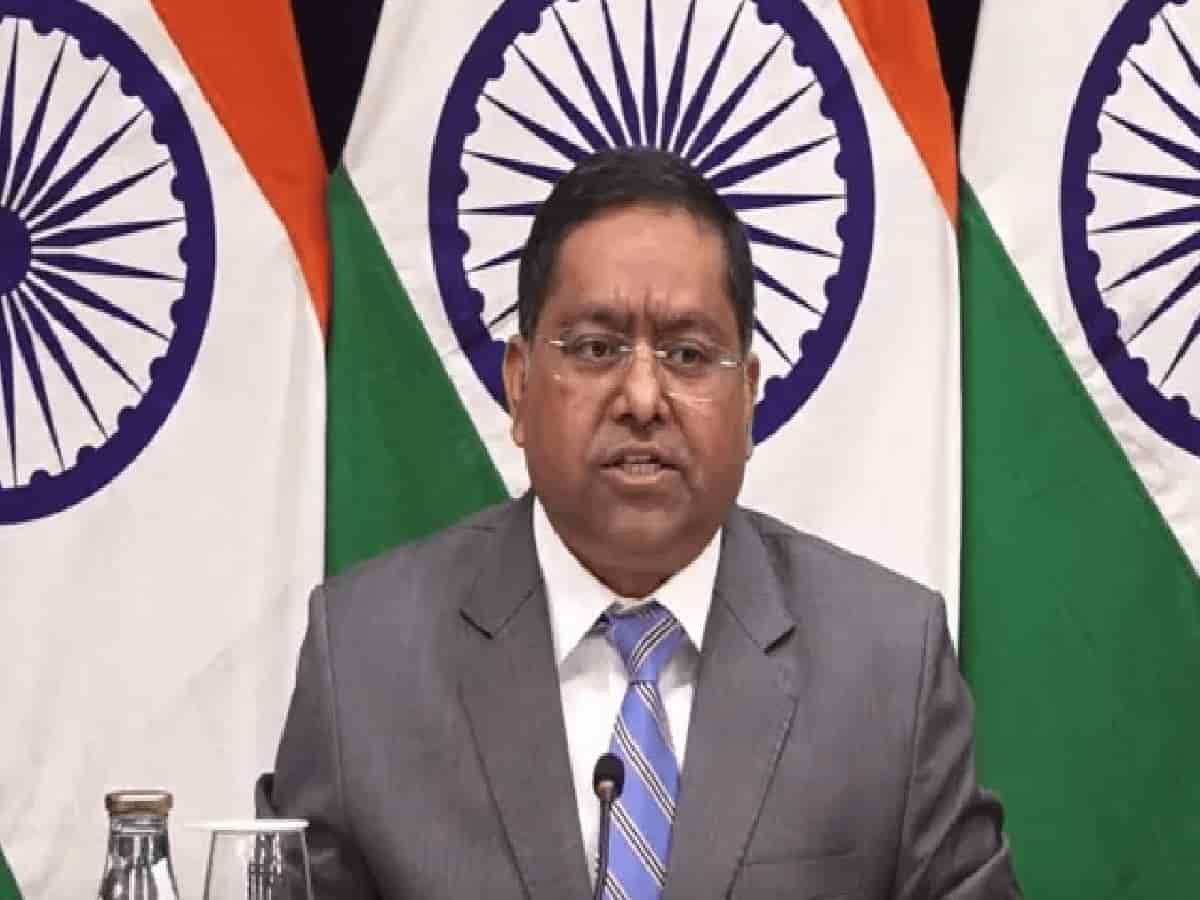
In a firm diplomatic counterstroke against politically motivated legal maneuvering on foreign soil, the Government of India has categorically dismissed as “fabricated and malicious” the allegations leveled against National Security Advisor (NSA) Ajit Doval and former Research and Analysis Wing (RAW) chief Samant Goel in a civil lawsuit filed in a United States federal court by designated pro-Khalistan terrorist Gurpatwant Singh Pannun. The sharp rebuke from New Delhi follows the transmission of a court summons by the United States Department of State via diplomatic channels to the Indian Embassy in Washington. Addressing a weekly media briefing, the Ministry of External Affairs (MEA) asserted that frivolous legal actions orchestrated by anti-India extremists carry zero merit and violate established legal conventions governing sovereign nations. Taking the diplomatic offensive a step further, New Delhi held American monitoring bodies directly up to the mirror, delivering a stinging response to the US Commission on International Religious Freedom (USCIRF) for concocting biased narratives about attacks on Sikh gurdwaras in India while maintaining a deafening silence regarding the surging wave of hate crimes, racial abuse, and vandalism targeting the Indian diaspora and places of worship across North America.
Legal Stance and Sovereign Immunity: Ministry of Law and Justice Is Sole Authority
The diplomatic friction centers around procedural notifications stemming from a civil lawsuit initiated in the US District Court for the Southern District of New York. The US State Department formally handed over the summons documents to the Indian Embassy in Washington on October 9, 2026, pursuant to a diplomatic note signed on September 30. However, the State Department itself clarified in its filings that transmitting such paperwork was purely administrative under statutory obligations outlined in the Foreign Sovereign Immunities Act (FSIA), emphasizing that its action in no way validates the merits of Pannun’s claims, the jurisdiction over foreign officials, or whether procedural requirements were lawfully fulfilled.
Rejecting the entire premise of the lawsuit, MEA spokesperson Randhir Jaiswal outlined India’s clear institutional protocol and jurisdictional boundaries:
Dismissal of Frivolous Litigation: Jaiswal stated plainly: “We reject the fabricated and malicious attacks on our high officials. Also, we reject the frivolous lawsuits.”
Designated Central Authority: New Delhi highlighted that under the Hague Service Convention and Indian domestic statute, foreign judicial documents cannot simply be served arbitrarily or through informal channels. Requests for the service of any judicial documents within Indian territory must be formally submitted through the designated central authority—the Ministry of Law and Justice.
Precedent of Dismissed Foreign Suits: Diplomatic observers noted that this is far from the first instance where separatist groups have sought publicity through American civil courts. In 2013, the same outfit filed an identical civil suit against then-Prime Minister Manmohan Singh, which was subsequently thrown out, mirroring a similar dismissed suit against former Chinese President Jiang Zemin in 2002.
The Extremist Playbook: Sikhs for Justice and Gurpatwant Singh Pannun’s Lawfare
The individual behind the contentious lawsuit, Gurpatwant Singh Pannun, is not an ordinary litigant but an internationally recognized radical operating as the general counsel for Sikhs for Justice (SFJ). Declared an unlawful association under India’s Unlawful Activities (Prevention) Act (UAPA) in 2019, SFJ has spearheaded an aggressive secessionist campaign aimed at balkanizing India. Pannun himself was formally designated an individual terrorist by the Ministry of Home Affairs in 2020 under anti-terror statutes.
Pannun’s documented record highlights a sustained history of violent provocation:
Explicit Threats Against Civil Aviation and Parliament: Over recent years, Pannun has released provocative video messages threatening to blow up Air India passenger aircraft, urging boycotts of Indian commercial flights, and issuing warnings of violent attacks against the Parliament of India.
Incitement of Violence Against Indian Diplomats: Under the guise of political advocacy, Pannun and his extremist network have orchestrated public intimidation campaigns against Indian ambassadors, high commissioners, and consuls general in the United States, Canada, and the United Kingdom, distributing posters featuring their names and photographs under threatening crosshairs.
Exploitation of Western Civil Courts: Facing severe investigative pressure from India’s National Investigation Agency (NIA), Pannun’s legal team filed the civil suit in September 2024 seeking financial damages for an alleged 2023 assassination conspiracy. While US prosecutors pursued parallel criminal proceedings against individual actors like Nikhil Gupta—who pleaded guilty to murder-for-hire charges in February 2026—New Delhi has consistently debunked claims attempting to implicate constitutional state authorities and intelligence leadership in extrajudicial plots.
Calling Out USCIRF: Rebuffing Fabricated Claims Regarding Indian Gurdwaras
Simultaneously, the Ministry of External Affairs took sharp aim at the US Commission on International Religious Freedom (USCIRF), dismantling its recent assertions alleging that Sikh places of worship were facing state-sponsored hostility or systemic attacks within India. Last week, two USCIRF commissioners issued public statements expressing alarm over supposed violence against gurdwaras, lobbying the Biden-Harris administration to exercise diplomatic leverage against New Delhi.
India’s response was swift, unsparing, and precise in dismantling the commission’s credibility:
A Politically Compromised Entity: Randhir Jaiswal dismissed USCIRF as a “biased and misinformed organization with a blatantly political agenda,” making it clear that New Delhi refuses to entertain its unwarranted lecturing on domestic religious harmony.
Echoing Separatist Narratives: Indian intelligence agencies have noted that the commission’s talking points increasingly mirror the propaganda disseminated by SFJ operatives, who actively brief American legislative panels to manufacture friction between Washington and New Delhi.
History of Partisan Overreach: The MEA noted that USCIRF has repeatedly overstepped its mandate, citing its controversial August report that went so far as to demand sanctions and a ban against the Rashtriya Swayamsevak Sangh (RSS)—recommendations that the US State Department itself has historically declined to adopt due to their extreme bias.
Holding America to the Mirror: Silence on Hate Crimes Targeting Indian Communities
The crux of New Delhi’s diplomatic riposte focused on the glaring hypocrisy exhibited by American watchdog bodies when evaluating human rights issues. While USCIRF and associated partisan committees routinely scrutinize other sovereign democracies, they maintain complete institutional silence regarding systemic racial violence occurring on their own soil.
The MEA forcefully held American authorities up to the mirror over demonstrable domestic hate crimes:
Attacks on Hindu Temples in the US: Over the past three years, prominent Hindu temples across California, New York, and Georgia have been desecrated with anti-India graffiti and separatist vandalism, yet local American law enforcement agencies have made few arrests, and USCIRF has failed to publish any dedicated inquiries into these hate crimes.
Vandalism of Diplomatic Missions: When extremist mobs attacked the Indian Consulate in San Francisco on multiple occasions, attempting arson and physically threatening consular personnel, institutional condemnation from American religious freedom watchdogs was virtually nonexistent.
Targeting of the Indian Diaspora: Indian-origin professionals, students, and community elders in the United States have faced an alarming rise in unprovoked physical assaults, street muggings, and xenophobic verbal abuse, which partisan commissions continually overlook.