
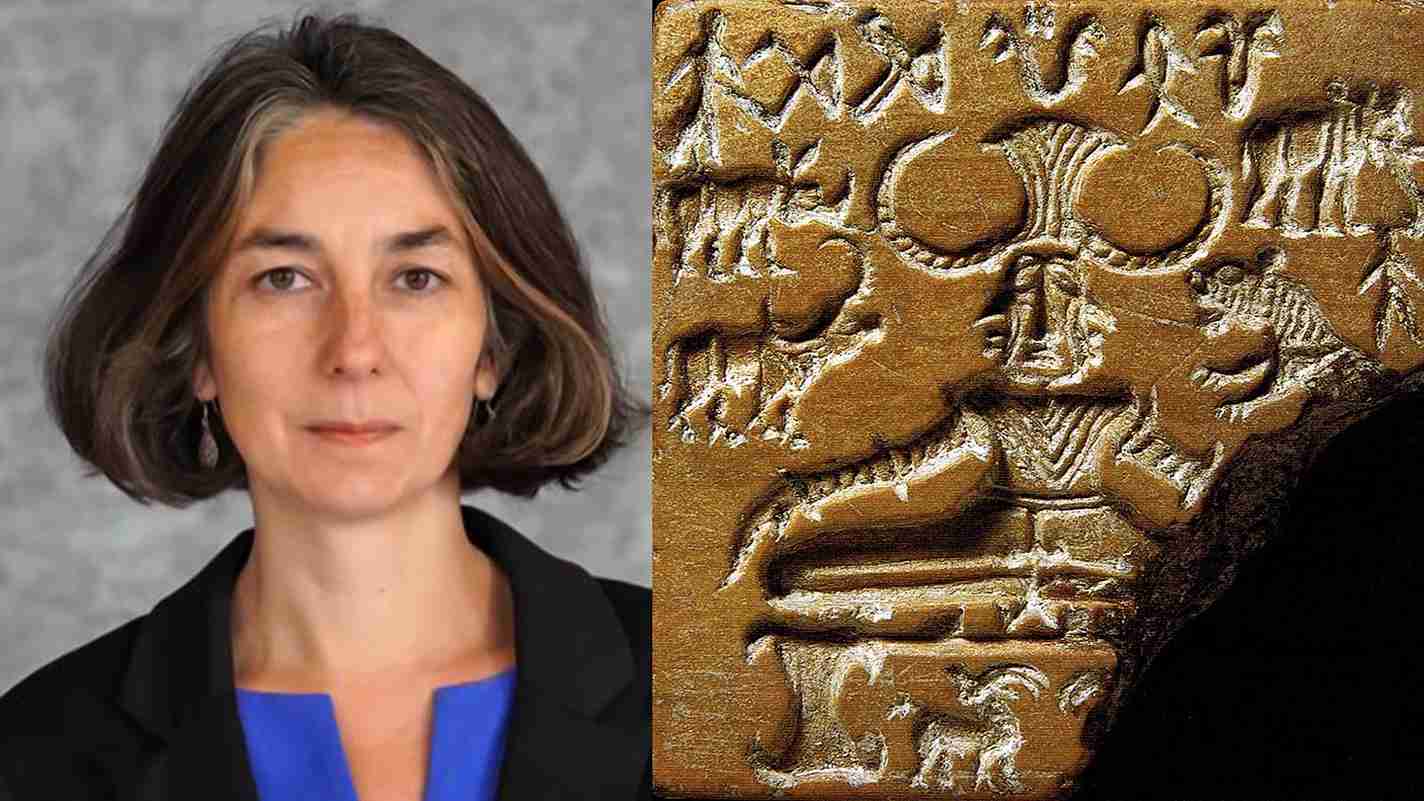

A 4,300-year-old artefact from the Indus Valley Civilisation has become the centre of a heated debate involving historians, archaeologists and cultural commentators. The controversy erupted after American historian Audrey Truschke challenged the Indian government’s interpretation of the famous ‘Pashupati Seal’, a small steatite seal discovered at Mohenjo-daro in present-day Pakistan.
The debate goes beyond archaeology. It also raises questions on India’s civilisational continuity, the origins of Hindu traditions and who gets to interpret the country’s ancient past.
Who is Audrey Truschke?
Audrey Truschke is a professor of South Asian history at Rutgers University in the United States. She is known for her research on medieval India, the Mughal Empire and Sanskrit literature. Truschke has often been a controversial figure in India because of her views on Indian history and religion, with critics accusing her of downplaying indigenous perspectives.
The latest controversy began after she responded to a social media post by India’s Ministry of Culture about the Pashupati Seal.
What is ‘Pashupati Seal’?
The ‘Pashupati Seal’, also known as Seal 420, was discovered during excavations at Mohenjo-daro, one of the largest cities of the Indus Valley Civilisation.
The seal depicts a horned human figure seated cross-legged in what is described as a yogic posture. The figure is surrounded by animals, including an elephant, rhinoceros, tiger and water buffalo. The artefact dates back to roughly 2350-2000 BCE.
Also read: 500 years of Battle of Panipat: Why the Mughals still shape India | Interview
In 1931, British archaeologist Sir John Marshall proposed that the figure represented a “Proto-Shiva” or an early form of Pashupati, a name associated with the Hindu God Shiva, meaning “Lord of Animals”. His interpretation became widely accepted in popular discussions, although scholars have continued to debate it for decades.
What did the government say?
The debate started after the Ministry of Culture on May 27 shared the seal on X and described it as a symbol of India’s “unbroken civilisational continuity”.
The ministry argued that the figure’s yogic posture, animal symbolism and spiritual imagery show links with later Hindu traditions, particularly Shaivism. It identified the figure as Shiva-Pashupati and said such cultural elements continue to survive in India’s religious and spiritual practices today.
What is Audrey Truschke’s argument?
Truschke dismissed the government’s interpretation.
She argued that the figure cannot be conclusively identified as Shiva because the Indus script remains undeciphered and there is no direct textual evidence linking the seal to Hindu traditions.
According to her, the image is more likely influenced by Proto-Elamite iconography and represents a broader Eurasian “Lord of Animals” motif found in several ancient cultures.
Also read: How Indian queens across history scripted stories of valour and victory
She argued that similarities between ancient civilisations should be studied through archaeology and comparative evidence rather than by projecting later religious identities onto much older artefacts.
What is Proto-Elamite iconography?
The Proto-Elamite civilisation flourished in parts of present-day Iran between roughly 3200 BCE and 2700 BCE.
Its art frequently featured powerful figures associated with animals, a theme often called the “Lord of Animals” motif. Similar imagery appears in parts of Mesopotamia and other ancient Near Eastern cultures.
Truschke argues that the Harappan seal may have drawn from these wider cultural influences rather than representing a specifically Hindu deity.
Why do many Indian historians disagree?
Several Indian historians and writers argue that Truschke’s comparison overlooks key details.
Author Amish Tripathi pointed out that the seal depicts animals such as the elephant, rhinoceros and water buffalo, all native to the Indian subcontinent but not to ancient Elam. He also questioned how the distinctly yogic posture seen on the seal could be explained through a Proto-Elamite framework.
“The Pashupati seal has an elephant, a water buffalo and a rhinoceros. Ancient Elam was centred in southwestern Iran. Elephants, water buffalos and rhinoceroses are not native to ancient Elam. BTW, they are native to India. Also, the figure is seated in a Yogic posture. Is Yoga also Elamite now? Seriously?” he asked, while taking a dig at Truschke.
Also read: Keeladi excavation fuels India’s ancient civilisation origin debate
Historian Lavanya Vemsani similarly argued that Proto-Elamite seals and the ‘Pashupati Seal’ show little resemblance and that the Harappan figure fits more naturally within indigenous Indian traditions.
In a post on X, she said, “They can say whatever they want: but – good genes-they cannot take away our genetics- our history is embedded in us. We were here since 73KYA -they cannot take away our gods and goddesses- they are in our minds and over land and underground Others contend that even if the figure cannot be definitively identified as Shiva, it may still represent an early form of religious symbolism that later evolved into Shaivite traditions.”
Truschke also faced a backlash on social media over her viewpoints on the seal.
Why the debate matters?
The dispute is ultimately about more than a single artefact. Supporters of the government’s view see the seal as evidence of cultural continuity between the Indus Valley Civilisation and later Hindu traditions.
Also read: What bringing back India’s ancient ports and harbours from the depths of time could mean
Critics argue that such conclusions remain speculative because the Harappan script has never been deciphered and many aspects of the civilisation remain unknown.
Nearly a century (around 1928-29) after Marshall first proposed the Proto-Shiva theory, the ‘Pashupati Seal’ remains one of the most intriguing and contested artefacts of the ancient world.

Comments are closed.