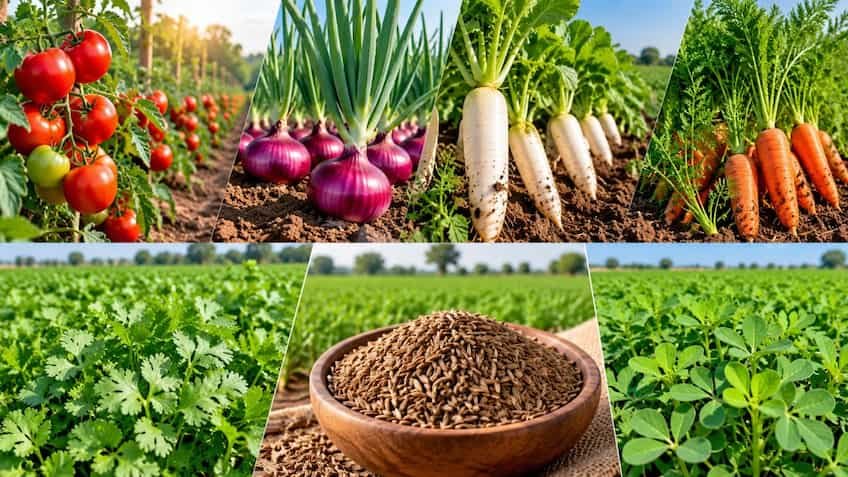
With the completion of harvesting of Kharif crops and the beginning of Rabi season, the month of October is considered to be the most important agricultural season of the year for Indian farmers. Mild cool weather, adequate soil moisture and ideal temperature of 20 to 28 degrees Celsius during October in the plains of North India create a favorable environment for the germination and vegetative growth of vegetables and cash crops. For farmers struggling with limited profits and rising costs in the traditional rice-wheat crop cycle, this is the best opportunity to adopt crop diversification. If farmers do proper field preparation at this time and sow early green vegetables and premium spice crops, they can get the highest wholesale prices for the produce in late November and early December when the arrival of fresh produce in the mandis is limited. According to agricultural scientists and horticulturists, the right 7 crops chosen in October can increase the net income of farmers by many fold in less time and limited cost. 1. Early cultivation of green peas: Bumper returns in 60 days The first and second fortnight of October is the best time for sowing of early peas. Improved varieties like 'Kashi Mukti', 'Kashi Ageti', 'Arkel' and 'Pusa Pragati' are ready for first harvest within just 55 to 65 days of sowing. At the time of weddings and the beginning of the festive season, the demand for green beans skyrockets in the market, due to which farmers can easily get wholesale prices of ₹60 to ₹90 per kg from the farm itself. The biggest feature of pea cultivation is that it is a legume crop, the Rhizobium bacteria present in its roots fix atmospheric nitrogen in the soil. This increases the fertility of the field and after harvesting the peas, a bumper yield of late wheat or spring sugarcane can be obtained in the same field in December. 2. Garlic cultivation: Low risk and secure earning throughout the year. Garlic is considered as ATM of cash among spice crops. By planting improved varieties of garlic like 'Yamuna Safed' (G-1, G-50, G-282), 'Bhima Omkar' and 'Agrifound Parvati' in the month of October, the tubers become bigger in size and heavier. In the last few years, the huge rise in the prices of garlic in the country and international market has made it the most favorite crop of the farmers. Animals do not harm the garlic crop and the incidence of pests and diseases is very less in it as compared to other crops. Sowing done by making beds at a distance of 15 cm in sandy loam soil with proper drainage gives a yield of 40 to 50 quintals per acre, which the farmers can store and sell at desired prices in the off-season instead of selling it immediately. 3. Coriander: Double profit from both leaves and seeds. The demand for green coriander for daily use in salads, chutneys and vegetables remains in every house for 12 months. Green coriander sown in October becomes harvestable in just 30 to 35 days. Improved varieties like 'Kumbharaj', 'RCR-41', 'Pant Haritama' and 'Hisar Sugandh' are capable of giving repeated harvests. If a farmer prepares beds in the field and harvests the leaves 3 to 4 times, he gets a direct income of ₹ 40,000 to ₹ 60,000 per acre at a seed and fertilizer cost of only ₹ 5,000 to ₹ 8,000. Apart from this, when the plants are left after the final harvesting, excellent grains are also prepared in March-April, which can be sold in the spice market to earn additional profit. 4. Cauliflower and Cabbage: Medium term cash crops October is the most favorable time for planting medium and late varieties of cauliflower like 'Pusa Snowball', 'Pusa Synthetic' and 'Kashi Kumari'. In cabbage, varieties like 'Golden Acre' and 'Pride of India' produce very firm and shiny heads in cold weather. By planting 20 to 25 day old seedlings prepared in the nursery on ridges during October, the roots of the plants become stronger and irrigation water does not directly fall on the stem, thereby avoiding the risk of fungal diseases. Between December and January, when there is huge consumption of cabbage in the hotels and catering markets of big cities, this crop has the potential to give a net profit of ₹ 80,000 to ₹ 1.2 lakh per acre. 5. Carrot and Radish: Farm empty in 40 to 50 days, instant cash money Carrot and radish are the safest option for marginal farmers with less land and low input costs. 'Pusa Himani', 'Pusa Chetki' and 'Japanese White' varieties of radish become ready to be uprooted in just 40 to 45 days after sowing. Whereas indigenous red varieties of carrots like 'Pusa Rudhir' and 'Hisar Garik' acquire deep red color and excellent sweetness when sown in October. By making ridge sowing, the roots develop straight, long and without knots, due to which the best grade price is available at the time of sorting of produce in the market. The biggest feature of these crops is that immediately after their harvesting, the farmer can cultivate another Rabi crop or potato in the same field. 6. Spinach, Fenugreek and Green Leafy Vegetables: Daily Liquid Income There is no match to the cultivation of Spinach and Kasuri Methi to meet the daily expenses and everyday needs of the family in the rural economy. Sowing of 'Pusa Bharti' and 'All Green' spinach and 'Pusa Kasuri' fenugreek is done in October by sprinkling or row method. Their first harvesting starts 25 days after sowing and 4 to 5 cuttings can be taken comfortably at an interval of every 10 to 12 days. There is a constant demand for fresh green leaves in local haat-bazaars and urban markets in winter, due to which the farmer gets cash money week after week and he does not have to resort to any loan for fertilizers, seeds or irrigation. 7. Fenugreek and Fennel: Spice crops with high yield in less water If you have limited means of irrigation, sowing of fennel and grain fenugreek in October is an extremely profitable deal. 'Gujarat Fennel-11', 'RF-125' and 'Hisar Suvarna' varieties of fenugreek give excellent production even with less water and normal care. By sowing these in the second fortnight of October, when the day temperature is stable around 25 degrees, the plants develop more branches and the amount of natural oil in the grains increases. Due to medicinal properties and high demand in the pickle-spice industry, the prices of these crops always remain stable and attractive in the market, due to which farmers do not have to bear any major risk of market fluctuations. Scientific advice for farmers of Lucknow, Purvanchal and Western UP. The loamy soil from Uttar Pradesh capital Lucknow (Malihabad, Mohanlalganj, Kakori), Barabanki, Sitapur, Kanpur and Varanasi to Meerut-Hapur belt of Western UP is highly suitable for all these crops. Scientists of Indian Council of Agricultural Research (ICAR) and State Agricultural Universities recommend that farmers should do seed treatment with Trichoderma or Carbendazim before sowing the seeds so that root rot and wilt diseases can be protected. Along with this, adding 4 to 5 trolleys of well decomposed cowdung manure or vermicompost per acre at the time of last plowing of the field improves the water holding capacity of the soil and unnecessary expenditure on chemical fertilizers is saved. By using drip irrigation or sprinkler systems, an additional increase of up to 25 percent in yield can be achieved with 40 percent water savings.