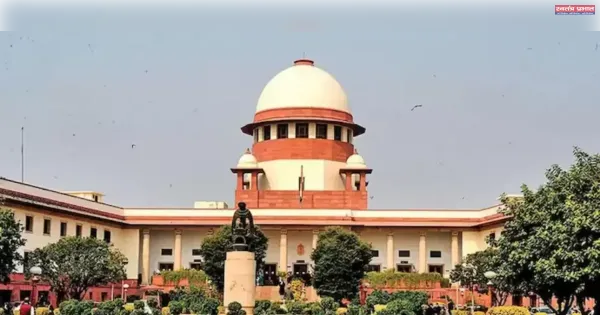
New Delhi, Read Bureau. The Supreme Court has said that the financier's right to take possession of a vehicle mortgaged for loan cannot be exercised by force, fraud or by violating the terms of the loan agreement. Recovery of loan or seizure of the vehicle can be done only through legal process.
Making this comment, a bench of Justice PS Narasimha and Justice Alok Aradhe quashed the order of the Allahabad High Court. The Supreme Court directed to pay compensation of Rs 10 lakh to the vehicle owner. The allegation in the case was that his truck was taken away without prior notice by breaking the steering lock at around 1 am in the night.
The case pertained to a truck owner who had taken a commercial vehicle loan from Cholamandalam Investment and Finance Company Limited in the year 2019. The vehicle was mortgaged for loan. He was also given additional loan in June 2021. After default in payment of installments, the company took possession of the vehicle in the year 2022, however, the vehicle was returned after partial payment.
In April 2023, the truck was parked at a CCTV monitored location. It is alleged that four unknown people reached there at around 1 o'clock in the night and broke the steering lock and drove away with the vehicle. The vehicle owner lodged an e-FIR on the same day, but no action was taken. Later he came to know through a legal notice that the company had taken possession of the vehicle and sold it. Even after the sale, the company was still stating the outstanding amount.
Citing the Fair Practices Code and loan recovery guidelines issued by the Reserve Bank of India, the Supreme Court said that harassing borrowers, contacting them late at night or using force for loan recovery is not acceptable.
The bench has given its old decisions ICICI Bank Ltd vs Prakash Kaur (2007) Also mentioned. In that case, the court had said that there is rule of law in the country and banks or financial institutions cannot use muscle power to seize vehicles.
The court said that the provisions related to taking possession of the vehicle should be valid and in accordance with the Indian Contract Act, 1872 and RBI guidelines. Such a process should have provisions like notice period before taking possession of the vehicle, procedure for taking possession and giving the borrower a last opportunity for payment before selling the vehicle.
The bench said that taking away the vehicle by breaking the steering lock at 1 o'clock in the night cannot in any way be considered as peaceful possession. The court also found that the vehicle possession memo did not even have the signature of the vehicle owner.
The Supreme Court also took into account that the Appellant was a person of limited means and was dependent on this vehicle for his livelihood. However, the court refused to cancel the sale of the vehicle. Instead, the company was directed to close both the loan accounts and return the amount of Rs 4.50 lakh received from the sale of the vehicle along with six percent annual interest.
Apart from this, the court ordered a compensation of Rs 10 lakh to the vehicle owner for mental agony and loss of livelihood for a long time. The appellant will also be given Rs 50,000 as cost of the case.