Sunil Kumar Vajpayee Shivam
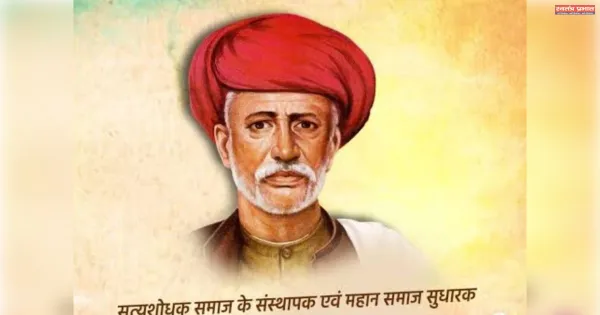
The name of the great social reformer Mahatma Jyotirao Govindrao Phule, who awakened the spirit of social consciousness, education, equality and human rights in the Indian society, is inscribed in golden letters in history. She dedicated her entire life to fighting against caste discrimination, untouchability, illiteracy, superstition and oppression of women prevalent in the society. He was not only a social reformer but also a great thinker, writer, educationist and pioneer of social revolution.
Mahatma Jyotiba Phule was born on 11 April 1827 in a gardener's family in Katgun village of Satara district of Maharashtra. His father's name was Govindrao and mother's name was Chimnabai. His family later settled in Pune. Due to economic circumstances, his early education was interrupted, but his interest and curiosity towards education remained. Later he received re-education and gave a strong foundation to his views against social inequality.
Jyotiba Phule believed that education is the most effective medium of social change. He did the historic work of connecting women and deprived classes with education. In the year 1848 he established the first school for girls in Pune. His wife Savitribai Phule supported him shoulder to shoulder in this work and herself became the pioneer of women's education. At that time, teaching women was considered against social conventions. Despite this, Jyotiba and Savitribai kept the lamp of education burning regardless of opposition, insults and difficulties.
He also raised his voice against the upliftment of widows, the evil practice of child marriage and exploitation of women. On 24 September 1873, Jyotiba Phule founded the Satyashodhak Samaj. Its main objective was to end the caste discrimination, religious hypocrisy and social exploitation prevalent in the society. He envisioned a society where every person would have equal rights, respect and opportunities. He opposed the priestly system and birth based hierarchy.
Jyotiba Phule attacked social evils through her writings. His famous book 'Gulamgiri' was published in the year 1873. Apart from this, in 'Shetakriyacha Asud' he exposed the exploitation of farmers and their problems. The spirit of humanity, freedom, equality and fraternity were prominent in his thoughts. Mahatma Jyotiba Phule died on 28 November 1890 in Pune. His life is a unique example of struggle, courage and social commitment. In the year 1888 he was given the title of 'Mahatma'.
Undoubtedly, Jyotiba Phule worked to give a new direction to the Indian society. He proved that real progress of any civilized society is possible only when education is accessible to all and no one in the society is discriminated on the basis of caste, gender or class. His thoughts even today inspire us for social justice, women empowerment and building an egalitarian India.