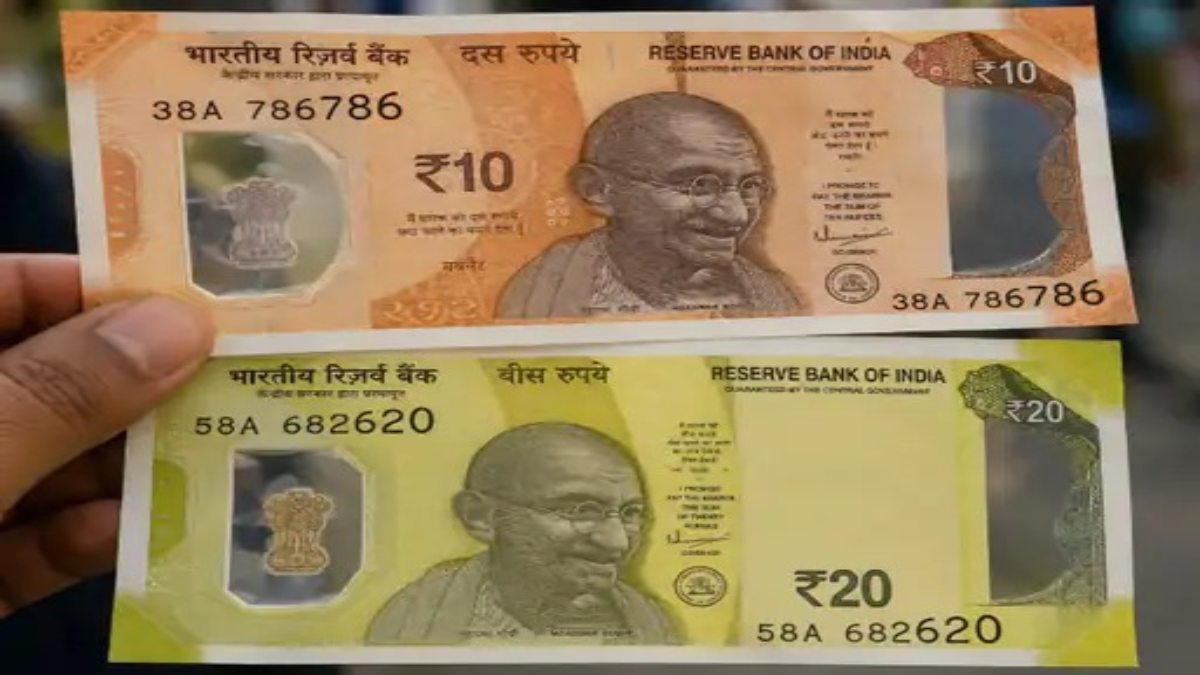
Business Desk – Plastic Currency Note: The Reserve Bank of India (RBI) will launch polymer (plastic) currency notes in the country between April and May 2027. This information was given by RBI Governor Sanjay Malhotra after a three-day meeting of the Monetary Policy Committee (MPC).
He said the rollout will begin with lower-denomination currency notes, as the 10, 20, and 50 rupee notes are the most widely used and tend to get dirty or torn quickly. The new polymer notes will be more durable and last longer.
Lower denomination notes will be issued first.
The RBI Governor said that initially, polymer notes of lower denominations will be issued. These are the most widely circulated notes in the market. He explained that these notes have been successfully used in many countries around the world for decades.
According to the Governor, polymer currency notes have been in use for more than 30 years in countries like Britain, Australia, and Canada. In India, paper notes, especially the 10, 20, and 50 rupee notes, quickly become dirty or tear. The introduction of polymer notes will largely eliminate this problem.
Will not be damaged by water, government expenditure will also reduce
Sanjay Malhotra said that the biggest advantage of polymer notes is their longevity. These notes will not be easily damaged by water, moisture, dust, or dirt. The need to print new notes frequently will also be reduced, thereby reducing costs for the government and the RBI.
Questions and Answers: 5 Big Questions Related to Plastic Currency Notes
Question 1: What are polymer notes and why are they being introduced?
Answer: Polymer banknotes are printed on a special plastic material called a polymer substrate instead of paper. They look and feel similar to regular banknotes, but are much stronger and more durable.
- live long
These notes are resistant to water, dust, and dirt and have a significantly longer lifespan than regular paper notes.
- Ban on fake notes
Advanced security features can be added to the polymer sheet, making it extremely difficult to counterfeit notes.
- Lower printing costs
Paper notes wear out quickly, requiring frequent printing of new notes. In FY25, the RBI spent ₹6,372.8 crore on printing paper notes. Polymer notes will last longer, so this cost may be reduced in the future.
Question 2: Will old paper notes be discontinued?
Answer: No. The RBI and the government have clarified that the introduction of polymer notes does not mean that the old paper notes will be discontinued.
Both polymer and paper notes will be in circulation simultaneously. The transition will be phased in. Until the new notes are fully implemented, the old notes will remain in circulation.
Question 3: When did the proposal to introduce polymer notes come?
Answer: Work on polymer notes in India first began in 2012. At that time, the plan was to increase the shelf life of notes, but the project did not move forward due to technical reasons.
Subsequently, media reports and RBI reports again discussed polymer notes in May-June 2026. In June, RBI Governor Sanjay Malhotra confirmed that the proposal was under consideration and its pros and cons were being evaluated.
Question 4: In which countries of the world are plastic notes used?
Answer: Polymer banknotes are used in more than 60 countries around the world. Polymer banknotes have been in circulation successfully for a long time in Australia, Canada, the United Kingdom (UK), and New Zealand.
Question 5: When have big notes been banned in India so far?
First time: January 1946
During the British rule, Rs 500, 1000 and 10,000 notes were discontinued.
Purpose: To curb black money and illegal wartime gains. Later, in 1954, 1,000, 5,000, and 10,000 rupee notes were reintroduced.
Second time: January 1978
The Morarji Desai government demonetized 1,000, 5,000, and 10,000 rupee notes.
Aim: To curb black money and corruption.
Third time: November 8, 2016
Prime Minister Narendra Modi declared the 500 and 1,000 rupee notes in circulation invalid at 8 pm. These were replaced by a new 500 rupee note and, for the first time, a 2,000 rupee note.
2,000 rupee notes withdrawn from circulation in 2023
On May 19, 2023, the RBI decided to withdraw 2,000 rupee notes from circulation under its Clean Note Policy. However, this was not called demonetization, as people were given sufficient time to deposit or exchange the notes at banks.