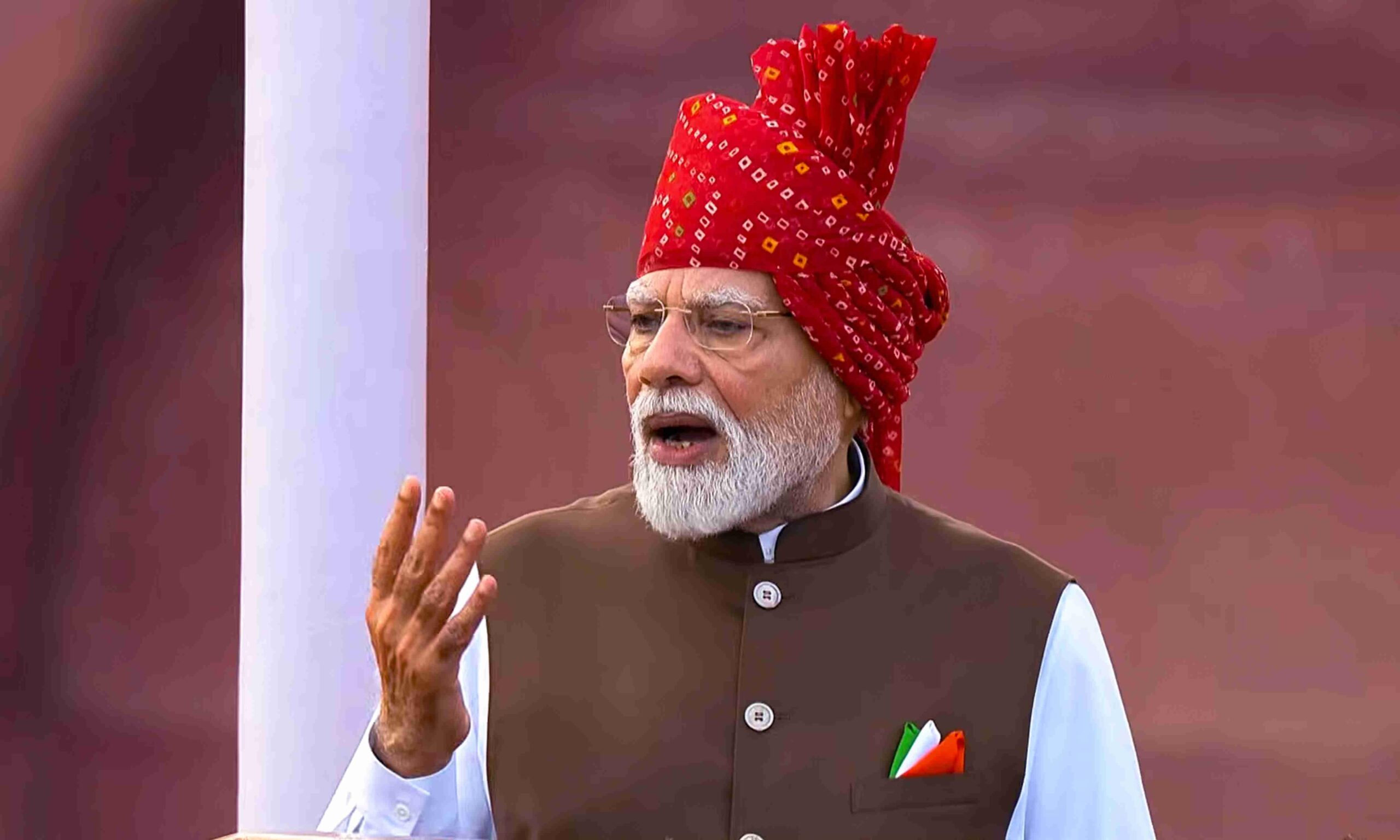
Perhaps it was the jinx of number 13. After 12 consecutive years of using the ramparts of the Red Fort each Independence Day for grand announcements of his government’s next policy offering and partisan tirades against opponents, Prime Minister Narendra Modi’s speech this August 15 had little new to offer.
The Prime Minister’s 13th I-Day address could be summed up with 3Ts – tired, tedious and tenuous.
Modi’s fading appeal
Modi appeared tired of carrying his prime ministerial burden, which, despite his party’s continuing electoral successes, was now drawing fewer fawning admirers but inviting increasingly merciless scrutiny, particularly from the country’s youth.
Also read: How RSS, its ally Hindu Mahasabha, opposed Quit India Movement, tricolour national flag
His speech was a tedious regurgitation of promises made over the years and of prophecies about Viksit Bharat by 2047 even as the present remained unaddressed.
The labelling of dissenters as ‘Dimagi Naxal’ and the call for identifying and isolating them was a tenuous attempt at glossing over the steady demolition of the Modi cult by India’s agitated youth.
Twin challenges
The speech was also symptomatic of 2Ds – denial and desperation.
Just two days ago, his government came away scarred by a washed-out monsoon session that had Modi and Home Minister Amit Shah cowering in the safe refuge of their offices to avoid facing a combative Opposition on the floor of Parliament on issues of student protests, police brutalities against young agitators and donation theft at Ayodhya’s Ram Mandir.
Also read: Modi’s I-Day speech: ‘PM failed to address students, youth issues’
For weeks, Modi’s regime has been pilloried by students for its failure to ensure that examination papers don’t leak, that recruitment exams pave the way for jobs instead of stalled recruitments and for failing to meaningfully engage with countless Indians who suffered this double whammy. Yet, Modi’s I-Day speech remained blissfully, and most likely deliberately, in denial of these twin challenges.
Growing youth crisis
What the Prime Minister offered the aggrieved was not empathy or an assurance of course-correction. Instead, he gave inane homilies about great strides India had supposedly taken under the past 12 years of his rule. This is the same period that has seen, by some estimates, over 150 examination papers being leaked across the country.
It has also been a decade of steadily soaring unemployment. The Centre’s own Periodic Labour Force Survey (PLFS) pegged unemployment among Indians aged 15 to 29 years at 16.2 per cent this June, the highest since monthly unemployment levels became available in April 2025 (the corresponding data then stood at 13.8 per cent).
Also read: A changing India: How the country has transformed in the past two-and-a-half decades
The Labour Force Participation Rate (LFPR) outlines an even more worrying reality – as unemployment among the 15 to 29 age bracket rose, the overall youth LFPR dropped in April-June 2026 to 40.3 per cent from 42.7 per cent in the same period last year, indicating that many youth had simply stopped looking for jobs.
‘Impressing’ the youths?
If Modi and his scriptwriters believe that the Seven Sources of Power (seven streams of power) plank, which sounded more like a ChatGPT-generated gist of the PM’s past 12 I-Day addresses, will win over an irreverent Gen-Z and Gen-Alpha, then they clearly haven’t learnt any lessons from the countless memes of Modi’s Instagram experiment.
The Prime Minister’s new task for the youth, urging them to spend an hour helping out their family to self-enumerate for the ongoing Census, his announcement of training one crore youth in AI over the next year and of a talent hunt to scout for potential athletes and sportspersons who can represent India in the 2036 Olympics came across as a desperate attempt to somehow gain the youth’s ear.
At 75 minutes, this was Modi’s fourth shortest I-Day address since he became Prime Minister in 2014 and the shortest since he assumed office a third time in 2024. Running out of words?