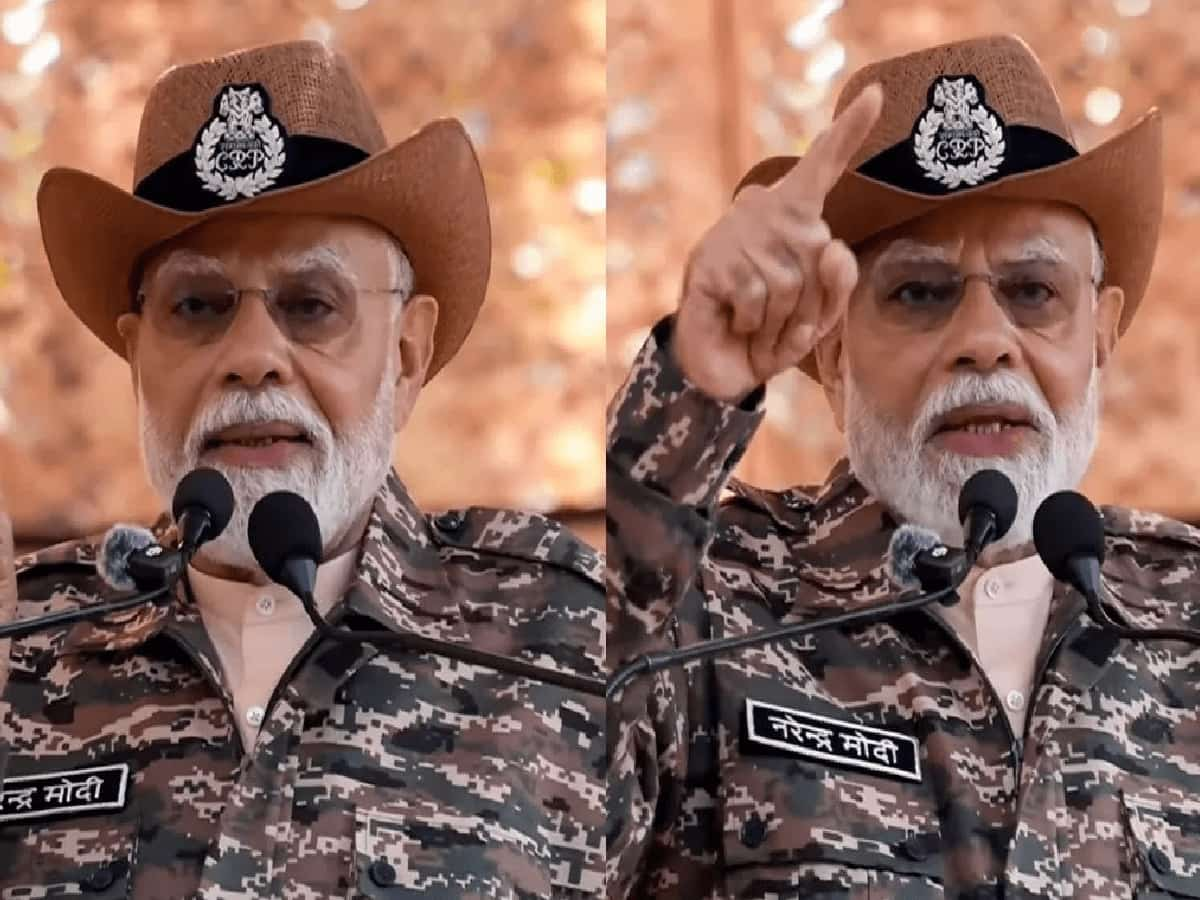
Continuing his long-standing tradition of spending the festival of lights alongside the nation’s frontline guardians, Prime Minister Narendra Modi celebrated Diwali on Sunday, November 8, 2026, with security forces stationed in Chhattisgarh’s Bastar region. Arriving in the tribal heartland that was once considered the nerve center of Left-Wing Extremism (LWE), the Prime Minister described the 2026 festive celebrations as historically unique, defining it as India’s very first Diwali after securing decisive victory in its decades-long battle against Naxalism and Maoist insurgency. Addressing a massive gathering of jawans drawn from the Central Reserve Police Force (CRPF), Border Security Force (BSF), Indo-Tibetan Border Police (ITBP), and state commando units including the District Reserve Guard (DRG), the Prime Minister commended their bravery, resilience, and supreme sacrifices in restoring peace. He noted that every administrative district in India has successfully shed the shadow of organized Maoist terror, liberating millions of citizens from fear and steering remote tribal belts into an era of stability, governance, and infrastructural connectivity.
A Historic Milestone: Celebrating the Decisive Victory Over Naxalism
Taking the podium amidst spirited chants from uniformed personnel, Prime Minister Modi framed this year’s celebrations as a watershed moment for the country’s national security architecture. For decades, vast stretches of the Red Corridor—spanning central and eastern India—were held hostage by parallel administrative setups, landmine networks, and violent ambushes that stalled schools, healthcare facilities, roads, and rail transit.
Describing the profound transformation on the ground, the Prime Minister highlighted the historic shift:
Liberation from Terror: “This is the first Diwali after achieving victory in the decades-long fight against Naxalism and Maoist terror,” the Prime Minister declared.
National Reach: “This is the first Diwali when every district of the country is free from Naxalism,” he emphasized, noting that the fear that once restricted public life in rural forest tracts had been dismantled.
Empowering the People: The Prime Minister observed that millions of citizens, particularly tribal families and youth across central India, have finally gained freedom from extortion, forced recruitment, and fear, allowing traditional cultural life and democratic institutions to thrive unhindered.
The Doctrine of Internal Security: Shielding the Nation from External Threats
During his address, the Prime Minister outlined the strategic connection between domestic peace and external sovereignty, emphasizing that a nation’s foreign defense is only as resilient as its internal stability. Emphasizing that border vigilance and domestic security operate in close harmony, he explained how internal fault lines are historically exploited by hostile foreign elements whenever domestic policing is compromised.
“When internal security is strong, external enemies cannot do anything,” the Prime Minister asserted. “It is only when internal security becomes weak that external enemies gain the upper hand.” Paying homage to the fallen martyrs who laid down their lives during decades of counter-insurgency operations in dense jungle terrains like Abujhmad and Dandakaranya, he reiterated that their sacrifice laid the foundation for the security, sovereign pride, and economic growth India experiences today.
Paradigm Shift in Strategy: Moving Past Decades of Administrative Inertia
Reflecting on the protracted timeline of the anti-Naxal campaign, Prime Minister Modi offered a candid appraisal of past policy shortcomings, noting that previous administrations had resigned themselves to the insurgency as an intractable status quo. He recalled the painful operational period when casualty ratios heavily disfavored state forces, leaving uniformed personnel vulnerable in heavily mined jungles without tactical cover or technological support.
“There was a time when more of our brave soldiers were martyred than the number of Naxalites killed,” the Prime Minister remarked, noting that past leaderships had accepted the conflict as an unavoidable reality. Rejecting that defeatist attitude, he maintained that national security cannot be guided by administrative apathy: “No country moves forward with an approach that says, ‘This is how things will continue’. To take the country forward, enemies have to be defeated with determination.” He explained that after 2014, a decisive shift in political will occurred, ensuring clear mandates, full operational backing, and the dismantling of the urban and financial networks that sustained insurgent groups.
Operational Autonomy and Welfare: Empowering Frontline Commanders
Highlighting the structural reforms implemented across the counter-insurgency grid, the Prime Minister stated that his administration replaced bureaucratic micromanagement with full tactical freedom, allowing field commanders on the ground to devise operational strategies based on real-time intelligence. This policy shift went hand-in-hand with an intelligence-led strategy focused on cutting off terror financing, stopping weapons procurement pipelines, and securing remote terrain.
The Prime Minister emphasized that these operations were conducted with strategic precision, discretion, and deep sensitivity toward local tribal populations:
Protecting the Future: “Our goal was that no mother should lose her child and no young person’s future should be destroyed,” he noted, reiterating that developmental outreach accompanied tactical operations.
A Remarkable Safety Benchmark: Highlighting the discipline and modernization of the security forces, the Prime Minister noted a landmark achievement: for the first time in 47 years, not a single CRPF jawan lost their life in operations over the past year. He credited this operational milestone to improved tactical equipment, indigenous mine-protected vehicles, real-time drone surveillance, and professional training.
‘You Are My Family’: A Heartfelt Tradition of Solidarity
Explaining why he chose Bastar for Diwali over celebrating in New Delhi, the Prime Minister reaffirmed that he considers the men and women in uniform his immediate family. For more than a decade, his Diwali itinerary has taken him to forward border posts—from the glaciers of Siachen and the desert border outposts of Jaisalmer to the Line of Control in Jammu and Kashmir, and now the forests of Chhattisgarh.
“Today, across the country and in every corner of the world, crores of Indians are celebrating the auspicious festival of lights. People are travelling from far and wide to return to their homes to be with their families. I too have come among you to celebrate Diwali,” he told the gathering. He expressed pride in seeing Bastar shed its reputation as a conflict-prone zone and emerge as a vibrant developmental hub, complete with new educational campuses, rural medical centers, robust metalled highways, and growing local markets.
Bastar’s New Dawn: Development Replaces Conflict
Prime Minister Modi’s visit to Bastar provides a fitting backdrop to the conclusion of one of India’s most complex internal security challenges. What was once marked by roadblocks, fear, and conflict is now entering a new chapter defined by constitutional governance, digital connectivity, and economic growth.
As the Prime Minister distributed festive sweets among the jawans and shared lighthearted moments with personnel from various states, the gathering reflected the resilience of the security forces. With peace restored and local infrastructure taking root, Diwali 2026 in Bastar stands as a lasting symbol of national resolve, unity, and a peaceful future for the tribal communities of central India.