
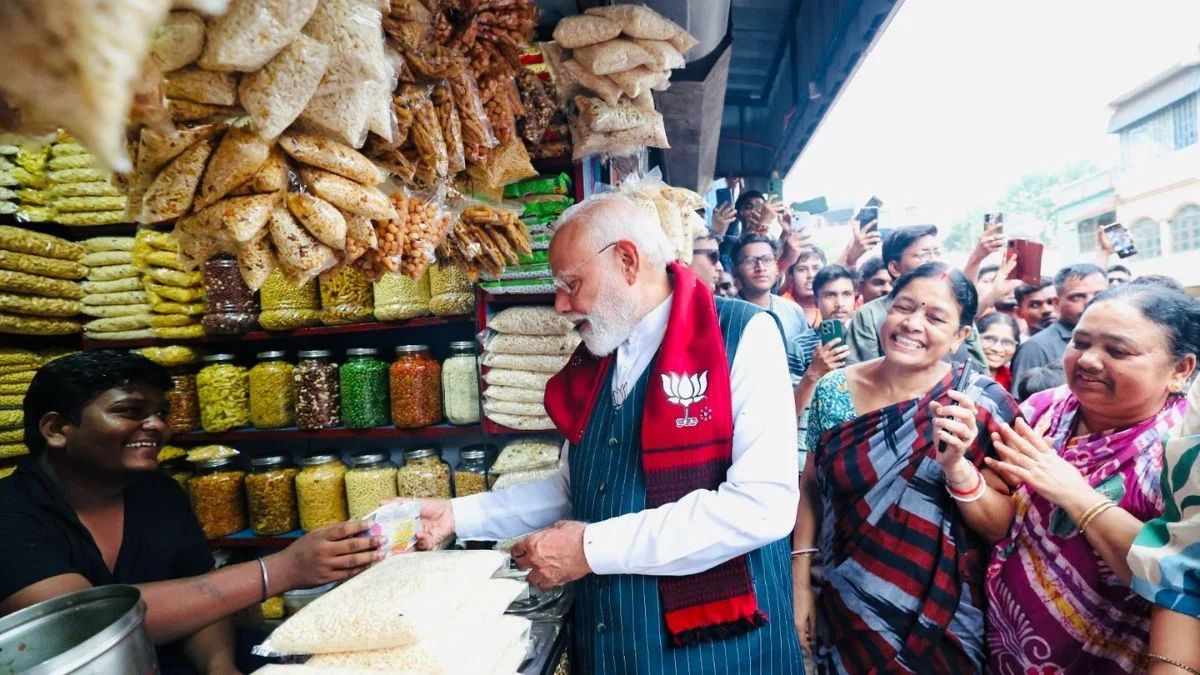
PM Modi Just Stopped His Convoy in Jhargram and Bought Jhalmuri From a Street Shop — Watch What Happened

Prime Minister Narendra Modi did something on Sunday that nobody in his convoy, his security detail, or the waiting crowd at Jhargram quite saw coming. He stopped. Got out. And walked into a local shop to buy jhalmuri.
The moment — unscripted, spontaneous, and completely human — has left India speechless in the best possible way. And it happened four days before West Bengal goes to the polls in the first phase of its 2026 Assembly elections.
The Election Context That Makes This Moment Significant
Modi was in Jhargram as part of a four-rally blitz across West Bengal on Sunday, April 19, as the BJP intensifies its campaign ahead of the 2026 assembly elections. He was scheduled to begin his tour with a rally in Bishnupur in Bankura district before heading to Purulia, Jhargram and then Medinipur.
The West Bengal assembly elections will be held in two phases — on April 23 and April 29 — with votes counted on May 4. The rallies assume significance as the BJP seeks to consolidate its support base in the western and south-western districts of the state, regions where the saffron party had put up a strong performance in previous Lok Sabha and assembly elections.
The jhalmuri stop did not happen at a rally stage or a government event. It happened between them — on the road through Jhargram, in the middle of a campaign day, four days before the people of this constituency decide who gets their vote.
What Happened in Jhargram
Modi was travelling through Jhargram — the forested district in West Bengal’s southwest — when the convoy came to an unexpected halt. The Prime Minister stepped out and approached a local shop to pick up jhalmuri, the quintessential Bengali street snack of puffed rice tossed with mustard oil, raw onion, green chilli, chopped tomato, roasted peanuts and a squeeze of lemon that is as embedded in Bengal’s food identity as mishti doi or kosha mangsho.
In between four rallies across West Bengal on a packed Sunday, had some delicious Jhalmuri in Jhargram. pic.twitter.com/NEKLm5R0mE
— Narendra Modi (@narendramodi) April 19, 2026
The shop owner had absolutely no preparation for this particular customer. The security choreography that surrounds a Prime Minister’s every public movement was, in this moment, secondary to Modi’s apparent desire for a handful of jhalmuri from a roadside stall in Jhargram.
Why This Moment Hits Differently in an Election Week
Jhalmuri is not a Delhi snack. It is not a state banquet snack. It is Bengal’s snack — sold from bicycles and street corners, wrapped in newspaper cones, eaten standing up in the afternoon heat by schoolchildren, office workers and everyone in between. It costs almost nothing. It is available everywhere. And it is deeply, specifically Bengali.
For Modi to stop for jhalmuri in Jhargram — four days before Bengal votes — is to speak a cultural language that no rally speech, no policy announcement, and no political advertisement can replicate. It says: I know where I am. I know what you eat here. I am not too important to eat it with you.
Whether it was entirely spontaneous or gently choreographed, the image it has produced — the Prime Minister of India holding a cone of jhalmuri outside a local shop in Jhargram as West Bengal’s election week reaches its peak — is already travelling faster than any press release could.
Jhargram and Its Political Weight
Jhargram is not incidental geography in this election. The district, carved out of West Midnapore in 2017, sits in a region that has seen significant BJP-TMC contestation and was historically one of the most affected areas of the Maoist insurgency in Bengal. It is a district where the BJP has been working to consolidate its tribal voter base, where the development narrative competes with the Trinamool Congress’s welfare state argument, and where a Prime Minister stopping mid-convoy for a jhalmuri carries meaning that extends well beyond the snack itself.
The western and south-western districts — Bankura, Purulia, Jhargram, West Midnapore — are precisely the belt where the BJP has been building its Bengal story. Modi addressed four rallies across this belt on Sunday for a reason. The jhalmuri stop, whether planned or not, added a dimension to that story that four rally speeches could not.
What Comes Next
Bengal votes on April 23 and April 29, with results on May 4. The 294-member assembly is the prize — and the BJP’s challenge to Mamata Banerjee’s Trinamool Congress in what is one of the most fiercely contested state elections in India.
The jhalmuri moment in Jhargram will be talked about for the remaining four days of campaigning and well beyond it. In a state where street food is identity, and identity is everything in an election, stopping for jhalmuri was not a small thing.
The shop owner will never forget Sunday afternoon. And in the counting rooms on May 4, someone somewhere will remember it too.

Comments are closed.