
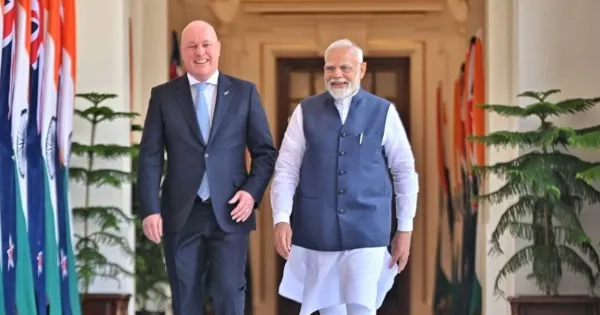

Wellington. New Zealand’s Prime Minister Christopher Luxon made a big announcement on Friday that Indian Prime Minister Narendra Modi is coming to New Zealand on his first official visit next week. Without disclosing the exact date of this important visit, Prime Minister Luxon said in a post shared on social media.
“I am pleased to announce that Prime Minister of India Narendra Modi will pay his first official visit to New Zealand next week.”
India’s importance is very special for New Zealand
PM Lakson praised India’s growing strength on the global stage. He described India as one of the largest and fastest growing economies in the world. Along with this, he stressed that India’s support is extremely important for the economic prosperity and development of New Zealand.
Free trade agreement (FTA) will increase opportunities
Speaking on bilateral relations, Lakson said, “We are taking the relationship between the two countries to the next level through the New Zealand-India Free Trade Agreement (FTA) signed in April.” He expressed hope that this historic agreement will create more employment opportunities in New Zealand. There will be a huge increase in exports. The country’s strong economic development will gain momentum.
A market of 1.4 billion people and benefits to Kiwi communities
According to Prime Minister Luxon, this free trade agreement will open the doors to the huge Indian market, with a population of 1.4 billion people, for New Zealand goods and services. This will bring more wealth into New Zealand’s local ‘Kiwi’ communities, create new employment opportunities and increase workers’ wages.
What is India-New Zealand FTA?
It is noteworthy that India and New Zealand had signed a Free Trade Agreement (FTA) earlier this year to accelerate bilateral trade in goods and services and encourage investment. Under this agreement, 100 percent of India’s exports have been provided duty-free access to New Zealand. For India, the agreement not only strengthens access to a high-income and rules-based Pacific market, but also provides a major support to its broader Indo-Pacific economic strategy.

Comments are closed.