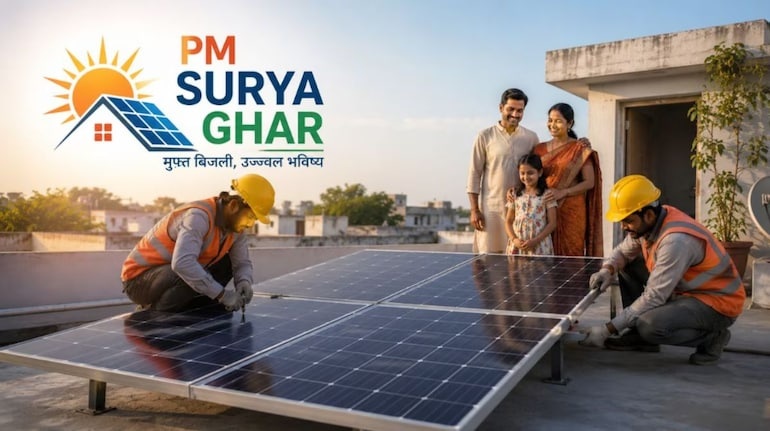
Special Energy and National Reporter, New Delhi: The central government’s visionary and ambitious “PM Surya Ghar Muft Bijli Yojana” has created a new history of success in the country’s energy revolution and green development. This scheme, which provides permanent relief to middle- and lower-middle-class families across the country from exorbitant electricity bills and gives them the opportunity to generate and sell their own electricity, has reduced the electricity bills of more than 1.9 million families to zero. Furthermore, many beneficiary families are earning an additional income of ₹2,500 to ₹3,500 per month by selling the surplus solar energy generated to local electricity distribution companies (DISCOMs).
Launched by Prime Minister Narendra Modi, the scheme’s primary goal is to install rooftop solar systems on the roofs of 10 million households across the country. According to the implementation of the scheme and the latest data released by DISCOMs, this initiative has completely transformed India’s solar energy landscape. Families who used to receive electricity bills of ₹2,000 to ₹4,000 per month are now not only benefiting from free electricity but also setting an example of a self-reliant India by transforming from ‘energy consumers’ to ‘energy producers’. The substantial direct subsidy provided by the government and subsidized, unsecured loans from banks have made this scheme extremely popular among the general public.
PM Surya Ghar Free Electricity Scheme: How to earn an additional ₹3,500 along with 300 units of free electricity? Learn about the subsidy and the complete online application process.
The framework of the PM Surya Ghar Yojana is highly scientific and common man-friendly. Under the scheme, eligible beneficiary families are provided with up to 300 units of completely free electricity every month. A 3 kilowatt (kW) rooftop solar plant installed in a home generates an average of 12 to 15 units of electricity daily, or approximately 360 to 450 units per month. A typical household’s monthly consumption is around 250 to 300 units. Any surplus electricity left after daily consumption is supplied directly to the government or private electricity grid through a net metering system. At the end of the month, power companies pay this surplus electricity directly into the beneficiary’s bank account at the prescribed rates, resulting in direct savings and income of up to ₹3,500 per month on average.
The Central Government’s attractive subsidy on rooftop solar:
To bring the cost of installing solar panels within reach of the general public, the government has significantly liberalized the subsidy rates, which are transferred directly to the beneficiary’s bank account (via DBT) within 30 days:
1 kilowatt (1 kW) system: Direct subsidy of ₹30,000.
2 kilowatt (2 kW) system: Government subsidy of ₹60,000.
3 kilowatt or more (3 kW+) system: A bumper subsidy of up to ₹78,000.
Easy and affordable loan facility without any guarantee:
For families who cannot arrange the initial capital for installing solar panels, the government has signed special agreements with major nationalized and private banks (such as SBI, PNB, BOB, etc.). Loans for rooftop solar systems up to 3 kW are being provided at a very low annual interest rate of just 7%, without any collateral. The savings from the solar panels’ electricity bills easily cover the bank loan’s monthly installments (EMIs), eliminating any additional financial burden on the family.
How to apply online for the PM Surya Ghar Yojana:
Visit the official portal: First, log in to the scheme’s official national portal, pmsuryaghar.gov.in.
Register: Select your state, the name of your electricity distribution company (DISCOM), and enter your consumer account number, mobile number, and email address.
Apply for rooftop solar: Log in with your consumer number and mobile number and fill out the rooftop solar application form.
Discom Approval and Installation: After receiving technical feasibility approval from the Discom, install solar panels on your rooftop through your registered vendors.
Net Metering and Subsidy Claim: After the solar plant is installed, a net meter is installed by the Discom. After the commissioning report is issued, upload your bank account details (cancelled check or passbook) to the portal. The subsidy amount of ₹78,000 will be credited to your account within 30 days.
From an environmental and green energy perspective, the installation of solar panels in over 1.9 million homes has significantly reduced carbon emissions and reduced dependence on conventional coal-fired power. These solar panels, which come with a 25-year warranty, not only guarantee free electricity for a generation but also increase home value. If you haven’t yet availed this scheme, apply today on the official portal and transform your home into a digital and green home with zero electricity bills.