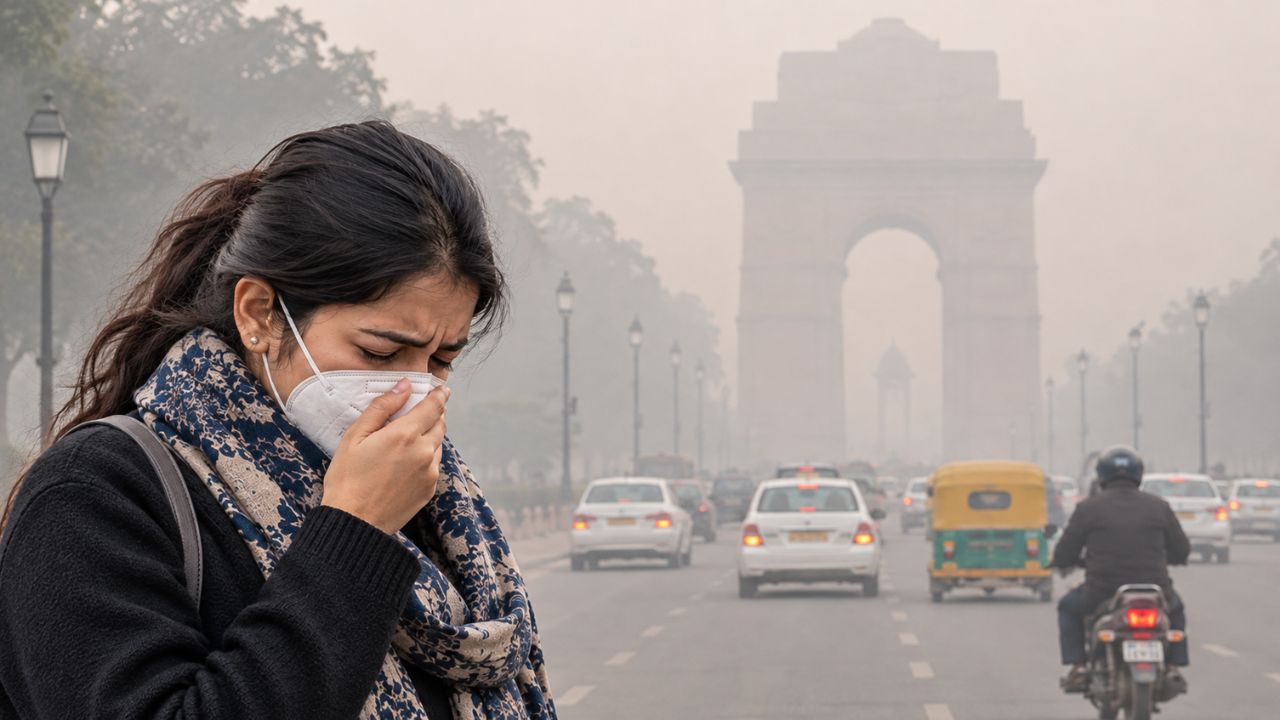
After fireworks on Diwali night in Delhi-NCR, a thick blanket of smog and pollution was seen early today. The air quality reached dangerous levels in many areas on Monday morning. According to Central Pollution Control Board (CPCB) data, Delhi's average air quality index (AQI) was recorded at 366 at 6 am on Monday. During this period, AQI crossed 400 at 15 monitoring stations in the capital.
Pollution levels have also increased in Noida and Ghaziabad adjacent to Delhi. It has become difficult for people to breathe amidst the thick blanket of smog in the surrounding areas including the capital Delhi. The third phase (Stage III) of 'Graded Response Action Plan' (GRAP) is implemented in Delhi-NCR for pollution control.
Also read: Heavy rain in South India, how will be the weather in UP-Bihar, Delhi today?
Where is AQI in Delhi?
According to the CPCB, the AQI was recorded at 406 at around 4:20 am at the air quality station at ITO, which falls in the 'severe' category. Meanwhile, the air quality remained 'very poor' in many other major areas of the capital. At 1:30 am, AQI 381 was recorded at Rajiv Chowk, while at 4:00 am, AQI 360 was recorded in the area around South Extension.
- Sonia Vihar: 449 – 463 (most severe)
- Burari Crossing: 445
- Vivek Vihar: 441
- Jahangirpuri: 439
- North Campus: 437
- Chandni Chowk: 418
- ITO: 404
- Aya Nagar: 378
- Burari: 373
- Dwarka Sector-8: 361
- IIT Delhi: 361
- Ashok Vihar: 312
- IGI Airport (T3): 297
Air deteriorates rapidly after Diwali fireworks
According to a Hindustan Times report based on CPCB's 15-minute pollution data, the average PM2.5 level at 39 monitoring stations at 7:45 pm on Diwali was 190 micrograms per cubic metre. At 8 pm it increased to around 259 micrograms per cubic metre. That means a sharp jump in the level of PM2.5 was recorded in 15 minutes.
According to media reports, this average level at 8 pm last night was more than four times the national 24-hour standard of PM2.5 of 60 micrograms per cubic meter. From which it is clear that the smoke from firecrackers worsened the already polluted air situation.
GRAP-3 implemented in Delhi-NCR
In view of the increasing air pollution, the Commission for Air Quality Management (CAQM) had implemented the third phase of Graded Response Action Plan (GRAP) in Delhi-NCR from November 6. After the implementation of GRAP-3, rules regarding ban on many activities related to construction and demolition, strictness on polluting vehicles and dust control measures came into force. The Commission had also expressed concern over the increase in incidents of stubble burning in Punjab.