
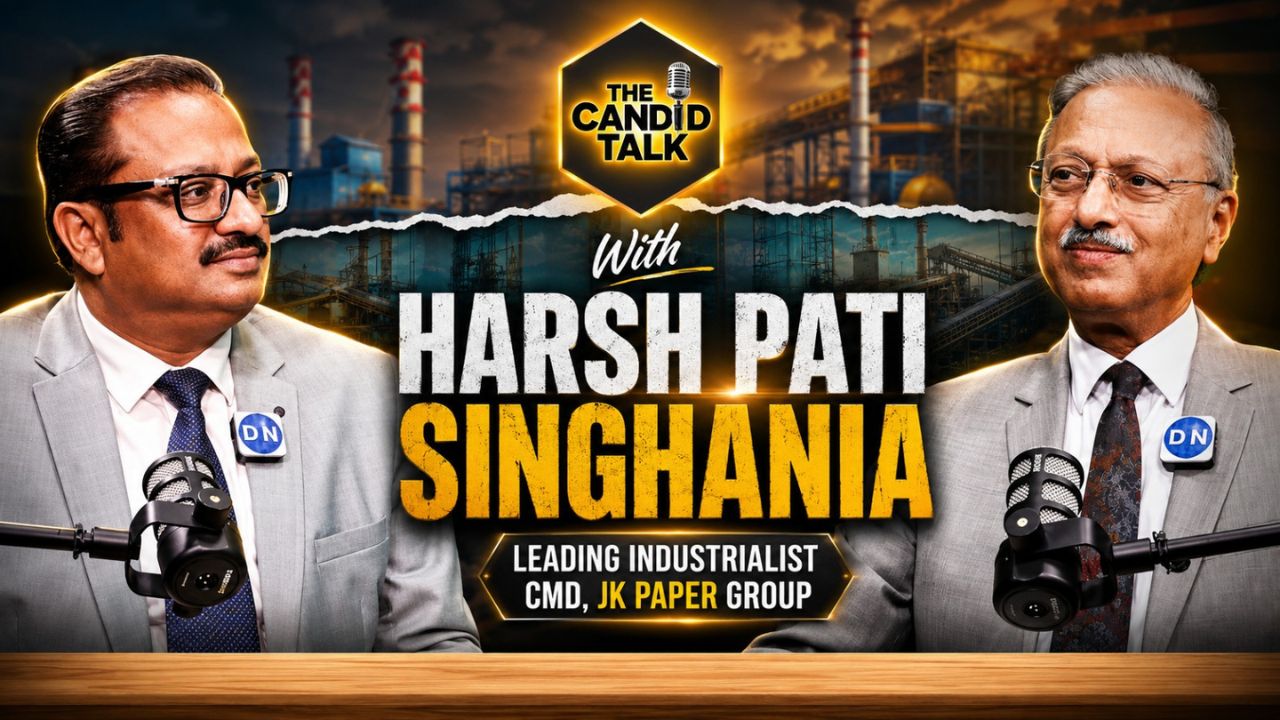

New Delhi: Harsh Pati Singhania, a fourth-generation industrialist belongs to one of India’s largest industrial groups– JK Organisation, has said that “policy stability is very important for the economic progress of any country and the growth of its industries. According to him, the business community needs policies that are predictable.
Singhania is the first Vice-Chair and Executive Board Member of the International Chamber of Commerce (ICC), Paris. He has also served as President of the Federation of Indian Chambers of Commerce & Industry (FICCI) and the All-India Management Association (AIMA).
In an exclusive interview with Tezzbuzz Newshe said, “When the government introduces a policy or a scheme, the industry expects stability and certainty. Modifications can certainly be made according to changing times and circumstances, but if policies are changed abruptly, the entire planning and investment strategy gets disrupted. Certainty and stability in policies are extremely important.”
The Candid Talk: ‘Delhi Policing is a test every moment’, says IPS Devesh Kumar Mahala
Speaking to senior journalist Manoj Tibrewal Aakash during the interview series ‘The Candid Talk’, Singhania said that while the government does listen to industry during the policy-making process, both sides need to play a more proactive role.
Policy stability crucial for economic growth, says Industrialist Harsh Pati Singhania (Img: Tezzbuzz News)
“To some extent, the government needs to develop a deeper understanding of the challenges and requirements of industries. At the same time, industry must also present its views more effectively and in a timely manner. If suggestions or feedback are sought on a policy and industry itself does not come forward with its views, then there is little justification for complaints later,” he said.
People will go wherever opportunities exist
When asked why many successful Indian industrialists eventually choose to settle abroad, Singhania said there are several reasons behind such decisions. “People will go wherever opportunities exist. However, that does not mean opportunities exist only abroad and not in India. There is no shortage of opportunities in India.
Today, India is among the fastest-growing economies in the world and offers immense possibilities for entrepreneurship and investment,” he said.
Sharing his views on the start-up culture, Singhania said that start-ups are an important part of India’s economic ecosystem and their role will continue to grow in the future.
MSMEs Remain Backbone of the Economy
“Family business models and start-ups are not competitors; they complement each other. Family businesses today are also being run by professionals. If we look at entrepreneurs such as Elon Musk and Steve Jobs, every major business began with the vision and initiative of an entrepreneur. In some cases, the next generation becomes involved in the business, while in others it does not,” he said.
He added that a large part of the MSME sector, considered the backbone of the global economy, is made up of family-owned businesses, and this model will continue to remain relevant in the years ahead.
The Candid Talk: Dr. Lokesh Muni shares hard truths about social media and true life value
Digitalisation Has Changed the Paper Industry
Responding to a question about the impact of digitalisation on the paper industry, Singhania acknowledged that the expansion of digital technology has affected the printing and writing paper segments. However, he maintained that the paper industry still offers significant growth opportunities.
Referring to environmental concerns and questions often raised about the paper industry; He said that the sector needs to present its case and facts more effectively before the public and policymakers.
“The paper industry has strong facts on its side, but often it is unable to present them as effectively as it should. We need to communicate our commitment to environmental protection and sustainable development in a much better manner,” he said.

Comments are closed.