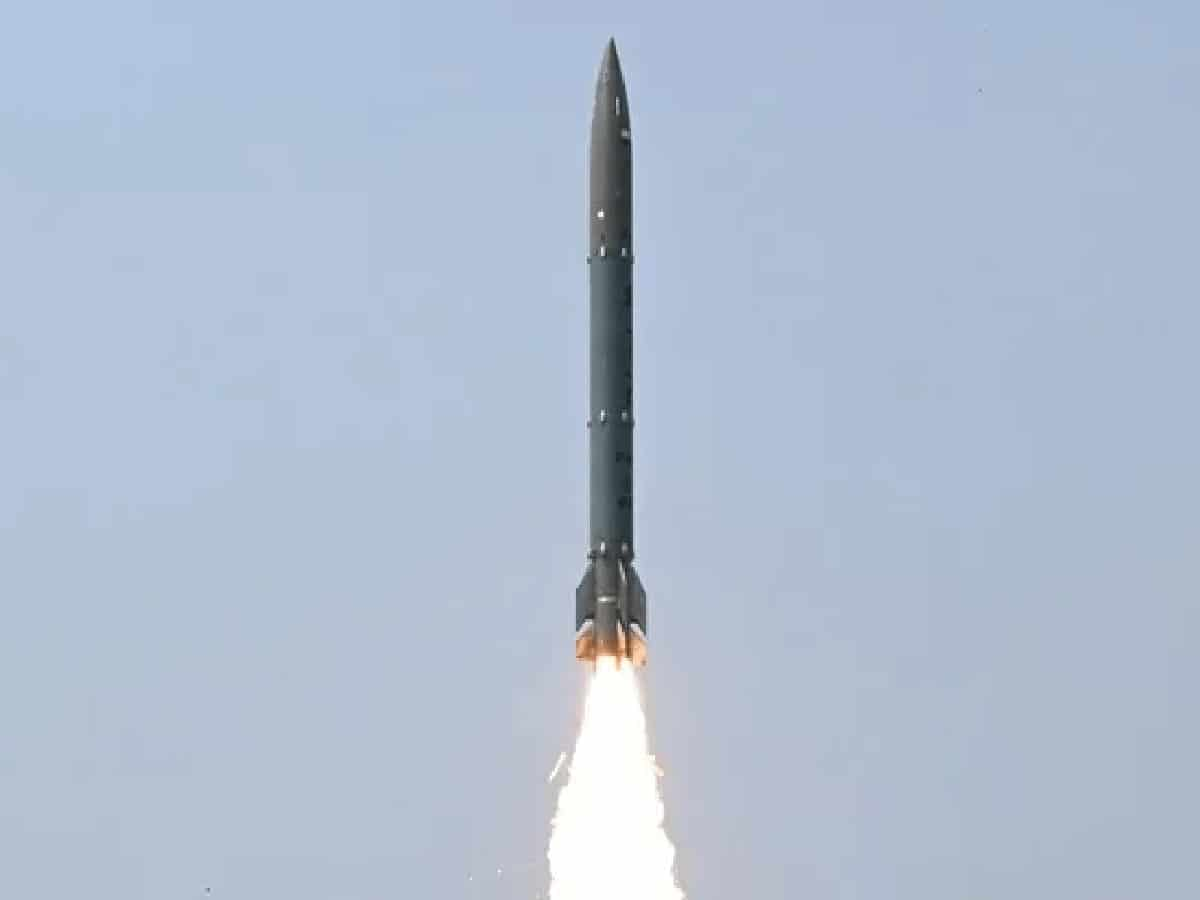
In a decisive step that reinforces India’s indigenous battlefield deterrence along contested frontiers, the Defence Research and Development Organisation (DRDO) on Thursday successfully conducted a critical flight test of the indigenously developed short-range surface-to-surface tactical missile ‘Pralay’. Launched from the launch complex at Dr APJ Abdul Kalam Island off the coast of Odisha, the test was carried out as part of comprehensive user evaluation trials in the presence of representatives from the armed forces and defense industry partners. According to official confirmations from the Ministry of Defence, the quasi-ballistic missile met every designated mission parameter with clinical precision, validating its aerodynamic maneuvering, propulsion performance, and pinpoint guidance capabilities. The flawless execution of these advanced user evaluations now clears the path for the weapon system’s imminent induction into the Indian Army and the Indian Air Force, cementing a vital conventional punch within the nation’s tactical strike architecture.
Successful Test-Firing from Kalam Island Validates Core Parameters
The flight test, executed at approximately 11:10 AM, represents a vital operational milestone for India’s tactical rocketry program. Mounted on a mobile road-launch vehicle, the missile lifted off smoothly from the seaside test complex before ascending into a controlled, flatter trajectory. The entire flight path was tracked and monitored in real time using a battery of advanced electro-optical telemetry systems, precision radar networks, and downrange naval monitoring instruments deployed by the Integrated Test Range (ITR) at Chandipur. Telemetry analysis confirmed that the missile adhered strictly to its pre-programmed algorithmic course, proving its capability to sustain extreme thermal and mechanical stresses while executing mid-flight course corrections. Defence Minister Rajnath Singh took to social media to celebrate the operational feat, congratulating the DRDO scientists, defense manufacturing partners, and the armed forces on the achievement. Commending the teams, Defence Secretary and DRDO Chairman Rajesh Kumar Singh noted that the successful user trial demonstrates the technological maturity of India’s indigenous missile defense industrial base.
Quasi-Ballistic Trajectory: The Engineering That Bypasses Air Defenses
What sets the Pralay missile apart from traditional short-range artillery rockets and standard ballistic systems is its sophisticated quasi-ballistic flight envelope. Conventional ballistic missiles travel on an immutable parabolic arc, climbing high into the atmosphere before descending along a mathematically predictable trajectory that modern surface-to-air missile (SAM) radars can easily calculate and intercept. In sharp contrast, Pralay operates on a significantly lower, flatter trajectory while maintaining high supersonic velocity. Powered by a state-of-the-art two-stage solid propellant rocket motor, the missile is equipped with aerodynamic control fins and specialized thrusters that enable dynamic mid-course maneuvers. By actively altering its direction and descent angle during the terminal phase, Pralay can outmaneuver opposing anti-ballistic missile (ABM) shields and point-defense interception systems, striking high-value hardened targets before enemy radar units can coordinate an effective countermeasure.
Versatile Range, Heavy Payloads, and Cutting-Edge Guidance Systems
Engineered primarily by the Research Centre Imarat (RCI) in Hyderabad in collaboration with key DRDO laboratories across the country, Pralay is designed to strike targets situated between 150 kilometers and 500 kilometers away. The missile features a flexible payload integration system capable of carrying conventional warhead modules weighing between 500 kilograms and 1,000 kilograms. When carrying a maximum 1,000-kg warhead, it delivers severe impact over an operational distance of roughly 350 kilometers, whereas configuring the system with a lighter 500-kg warhead extends its strike radius to the full 500-kilometer ceiling. The system supports a wide array of specialized conventional munitions, including high-explosive pre-fragmented blast warheads, hard-target penetrating warheads designed to obliterate reinforced subterranean command bunkers, and runway-denial submunitions built to crater enemy airfield runways. To achieve devastating accuracy, Pralay relies on a modern integrated navigation suite combining a domestic Ring Laser Gyroscope-based Inertial Navigation System (INS), satellite navigation, and an advanced digital terminal seeker, ensuring a circular error probable (CEP) of just a few meters.
Countering Adversary Missile Arsenals Along Northern and Western Borders
The strategic development of Pralay addresses an essential operational requirement along India’s northern and western borders. For years, defense analysts have observed the rapid deployment of short-range tactical missile systems by regional adversaries, notably China’s Rocket Force, which deploys the Dongfeng-12 (DF-12) and PHL-16 long-range rocket artillery complexes along the Line of Actual Control (LAC). On the western front, Pakistan has fielded tactical nuclear-capable short-range missiles like Nasr. While India possesses long-range nuclear deterrent platforms like the Agni series and supersonic cruise missiles like BrahMos, military planners recognized the need for a dedicated, non-nuclear quasi-ballistic missile that can be deployed rapidly in conventional skirmishes without crossing strategic escalation thresholds. Pralay bridges this exact tactical gap, providing theater commanders with a rapid-reaction conventional strike weapon capable of neutralizing enemy fuel depots, radar installations, troop staging grounds, and communication nodes across mountainous and desert terrains.
Mass Production Underway: BDL Partners with Armed Forces for Rapid Induction
With user evaluation trials now completed, industrial production is moving at an accelerated pace. State-run defense manufacturer Bharat Dynamics Limited (BDL), which has served as the key development-cum-production partner for the project, is producing the production-standard missile units. The Defence Acquisition Council (DAC) has already sanctioned the procurement of multiple Pralay regiments, clearing the acquisition of 120 missiles for the Indian Air Force alongside dedicated regiments for the Indian Army’s artillery formations deployed across strategic sectors. The missile’s canister-based launcher system enables road-mobile deployment aboard specialized heavy cross-country trucks, allowing military units to store, transport, and launch missiles on short notice with minimal setup time. As Indian military formations integrate Pralay into their joint operational strike plans, this successful test confirms that the country’s conventional deterrence is entering a self-reliant, technologically advanced era.