
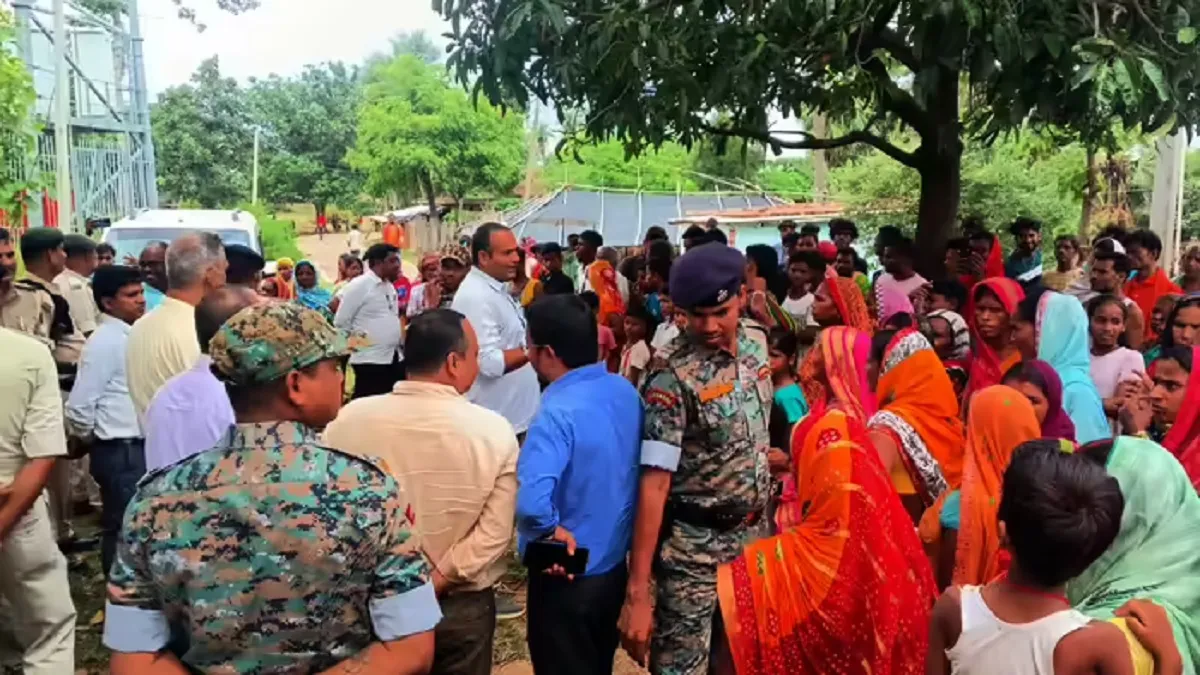

These days, Raghunathpur Panchayat of Banka district has emerged as an important question not only for Bihar but for the entire country. Amid reports of intensification of activities for the proposed nuclear power project in this area, the tribal community and villagers here have taken up a front with drums and drums to protect their forests. This local protest over water-forest-land entitlements and the existence of tribal identity is another deeply democratic question on the capitalist model of development being rapidly implemented in the so-called New India.
Despite the scorching heat with temperatures exceeding 40 degrees, villagers are monitoring the forests. They say that their land, forest and future cannot be decided without their consent. The scene of Raghunathpur Panchayat is not just the scene of a movement, it is a symbol of the restlessness of the society, which feels that its voice is being lost in the glitter of development.
I myself am a resident of Bhitiya of this area. This article is not a civil protest written in support or against any political party, but in favor of our soil, our society and our future. With the hope that the voice of the local citizens raised against the proposed nuclear energy will become the voice of the concerned citizens of the entire country; And the government will cancel this project.
The geography of Raghunathpur Panchayat is not just the name of the boundaries drawn on the map. The forests here are an integral part of the economy, society, culture, i.e. life of the local people. Mahua, Sal, Sakhua and other forest resources are not just natural wealth but the pivot of livelihood and social life. For the tribal community, the forest is a market, a medicine, a place of gods and also history.
This is why when the possibility of a nuclear power project comes up, the question of land acquisition alone does not arise in the minds of the local people, but the concern also arises whether the social and cultural structure of this entire area will change in the coming years? Will the arrival of outside population and big industrial structures increase the pressure on local identity? These questions cannot be answered by economic data alone.
An important question of the villagers is also regarding forest land. I have seen and felt with my own eyes how for years, permission was not given from the forest area for basic facilities like roads. In such a situation, the question is that where land was not allotted for building roads, how are the processes towards such a big energy project appearing so fast? The government should answer this question with facts and transparency. In a democracy, such questions are not anti-development, but a demand for constitutional responsibility and accountability.
The movement of Raghunathpur Panchayat is also important because it is not a movement to increase the amount of compensation. It is a movement to protect rights over water, forests and land and protect local identity.
Here cultural symbols like Dhol-Mandar have become the voice of democratic resistance. Sadly, this movement did not get the space it deserved in the mainstream media. In metropolitan cities, every movement of the stock market becomes news, but when the tribal community takes to the streets to save their forests and identity, their voice is often left on the sidelines of the national discourse.
Any nuclear project requires vast land, large amounts of water and tight security infrastructure. Such projects have long-term impacts on the social structure, livelihoods and environment of the local population.
There is ongoing debate among experts over the safe disposal of nuclear waste (radioactive waste), the risk of an accident, the pressure on water sources, and the impact on local biodiversity. This concern deepens in forest and tribal dominated areas like Raghunathpur Panchayat, because here the question is not just about a power plant, but about the future of the society that has been living in balance with nature for centuries.
If the project goes ahead, the government’s responsibility will not only be to generate power, but also to win the trust of local people, conduct transparent environmental impact assessments and protect constitutional rights. The biggest contradiction of this entire development is visible on the question of water.
Reports suggest that the possibility of providing adequate water for the proposed nuclear power plant is being considered. Because the operation of such plants requires a continuous and large water source. But the experience of the farmers of Raghunathpur Panchayat and surrounding areas has been completely different. Even after almost eight decades of independence, farms are dependent on rain. There is a lack of permanent irrigation system and farmers are forced to do farming by looking towards the sky in every season.
This irony raises questions about development in the minds of the villagers that how is the state whose schemes could not provide adequate irrigation water to the farmers’ fields in decades, now appearing so active in arranging water for a huge industrial project? This is not just a question of resources, but of development priorities.
This entire incident also reminds us of Godda in Jharkhand. For years, local communities and social organizations have raised questions about land acquisition, environmental impact, local employment and development promises regarding the thermal power project established there. Godda’s experience teaches that the success of any big project cannot be measured only by MW, it should also be judged on the basis of how much respect, security and participation the local society feels.
After 1991, India took the path of liberalization, privatization and globalization. Through this change, it was claimed to open new doors of economic opportunities, but along with it new questions also arose regarding the control of resources and the direction of development. There were mass movements in many parts of the country against big industries, mining projects, dams and power plants. But his voice was not given due importance. This history teaches us that development is sustainable only when it is based on dialogue, consensus and justice.
Mahatma Gandhi had said that any policy should be evaluated from the point of view of the last person who is the weakest. Today the question is whether the tribals and farmers of Raghunathpur Panchayat are equal participants in that development journey, or have they become just a statistic?
Through this comment, I protest against that vision of development which shows a haste in building the future without listening to the concerns of the local society. If development progresses without people’s trust, it creates less progress and more social tension.
The voice of resistance being heard in Raghunathpur Panchayat today is not just protecting its forest, it is asking the question to Indian democracy that does development mean only investment, production and electricity, or does it also include the basic concepts of man, nature, culture and the Constitution?
(Rajesh Kumar is a tv journalist)

Comments are closed.