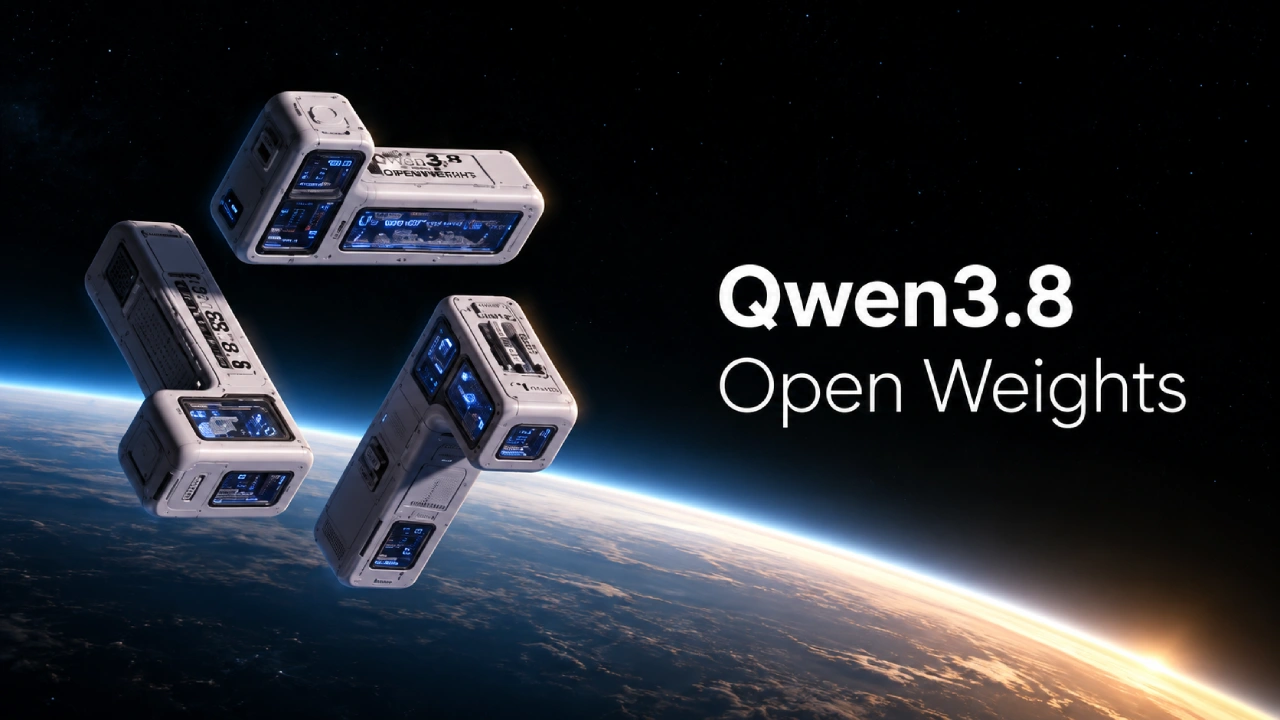
Qwen 3.8 open weights are now available as Alibaba’s AI division takes another major step in the rapidly evolving artificial intelligence market. In a recent post on social media, the Qwen team revealed that the open weights of the Qwen 3.8 model family are now available, including the Qwen3.8-27B model and the larger version of the Qwen3.8-2.4T-A95B (Max-level) model. This strategic move reinforces Alibaba’s commitment to providing accessible, high-performance artificial intelligence tools to developers and enterprises worldwide.
This comes after the introduction of Qwen 3.8 Max, which was recently launched by Alibaba as the largest and most powerful AI model ever built by the company. This development is consistent with Alibaba’s wider approach of creating broader access to sophisticated AI models through the open-weight framework.
Qwen 3.8 Max Becomes Alibaba’s Largest AI Model
Alibaba officially introduced Qwen3.8-Max in early August 2026, positioning it as the flagship model within the Qwen family.
According to the company, the number of parameters used in the model is said to be 2.4 trillion. Specifically, a Mixture of Experts (MoE) architecture is applied, which means that only 95 billion parameters are actually active during the processing of any single request.
The launch places Qwen3.8-Max among the largest AI models announced publicly. Industry comparisons have placed it behind only a handful of competing systems in terms of total parameter count.
Alibaba has also claimed that the performance of Qwen3.8-Max can be compared to other AI models from leading companies like OpenAI and Anthropic, specifically across agentic coding and complex enterprise workflows.
A Strong Focus on Multimodal AI
One of the most notable aspects of Qwen3.8-Max is its multimodal capability. Unlike traditional language models that primarily process text, multimodal models can understand and work with multiple types of data, including text, image, and video inputs.
According to Alibaba, the model has been created to accommodate a variety of enterprise and developer use cases. These applications can be found in programming, office productivity, document analysis, and autonomous agent tasks.
In fact, the company has concentrated on real-life applications of the model, instead of solely aiming for high benchmarking scores. This focus stems from the need for practical AI that will serve everyday business needs.
The Open-Weight Strategy Sets Qwen 3.8 Apart
The latest news about open weights may turn out to be one of the most important events concerning the Qwen ecosystem.
In its social media update, the company confirmed that developers can now access the open weights for Qwen3.8-27B, a native multimodal dense model containing 27 billion parameters.
Alibaba stated that the model outperforms Qwen3.7-Plus in overall performance while delivering strong results in coding and office-related tasks.
The company also highlighted several key features:
- Native multimodal architecture
- Expandability to one million tokens through YaRN
- Apache 2.0 licensing
Expanding Access for Developers
In addition, the company has made it clear that the models are accessible via Hugging Face and ModelScope so that developers can download, use, and fine-tune them.
“Built for builders,” Alibaba stated regarding the model launch, stressing the importance of supporting developers in building AI applications and autonomous agents.
Additionally, Alibaba mentioned the native capability of the model to process a 262,000-token context window, which can be scaled up to 1 million tokens with the help of a context extension technology called YaRN.
The release of the open-weight version of Qwen3.8-2.4T-A95B further expands the options available to developers.
While the larger model targets advanced AI systems and agent development, the 27B version appears to be designed for local deployment and lightweight applications, running efficiently on standard developer hardware.
Why Open Weights Matter for Developers
Open-weight AI models allow developers to access and modify a model’s parameters instead of relying exclusively on cloud-based APIs.
This approach provides several advantages. Organizations can run models locally, customize them for specific applications, improve data privacy, and reduce dependence on third-party platforms.
Open-weight releases have become increasingly important within the AI industry, particularly as Chinese technology companies continue to promote more accessible AI ecosystems.
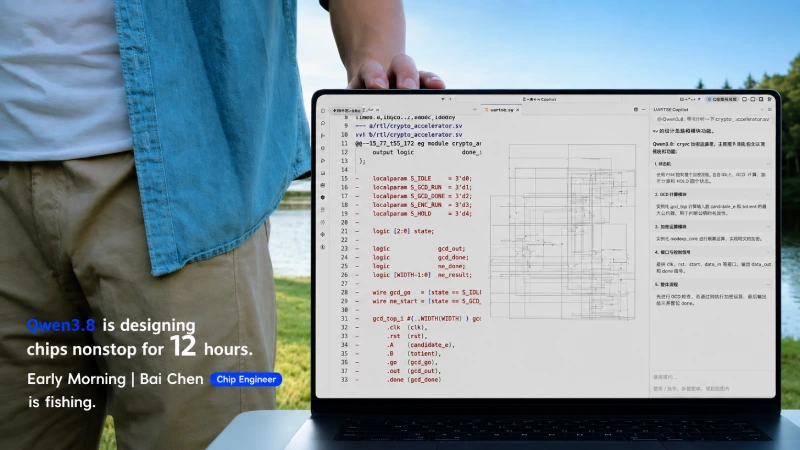
Alibaba’s latest move follows a broader trend in which AI developers are attempting to balance performance, affordability, and transparency.
Industry analysts have noted that many businesses do not necessarily require the most powerful AI models available. Instead, they often prioritize solutions that are cost-effective, adaptable, and easier to integrate into existing workflows.
Competition in the Global AI Race Continues to Intensify
Qwen3.8-Max’s arrival takes place amidst a more competitive time for the AI industry. Chinese companies, including Alibaba, Moonshot AI, DeepSeek, ByteDance, and MiniMax, have accelerated model development over the past year. Several of these companies have adopted open-weight strategies to attract developers worldwide.
Alibaba’s latest announcement demonstrates that the company intends to remain a major participant in this competition.
By combining large-scale multimodal capabilities with open-weight accessibility, the Qwen3.8 family represents an effort to expand AI adoption beyond research laboratories and into practical business environments. As the global artificial intelligence sector evolves in 2026, accessible open-weight models will play a central role in driving enterprise innovation.
Whether opting for the smaller 27B version to deploy locally or the Max version for more sophisticated AI applications, this new launch from Alibaba shows that the importance of accessible and customizable AI technologies is becoming increasingly important in the next leg of the global AI competition.